Worksheets
Final Exam-Fall
Total questions: 102
Worksheet time: 1hrs 20mins


gaining a neutron


The three particles that make up an atom are
protons, neutrons, and isotopes
protons, neutrons, and electrons
positives, negatives, electrons
protons, ions, and electrons
A covalent bond is formed as a result of
transferring electrons
sharing an electron pair
transferring protons
sharing a proton pair

Which Major Class of Bio-molecule is this?
Carbohydrate
Lipid
Protein
Nucleic Acid

Which Major Class of Bio-molecule is this?
Carbohydrate
Lipid
Protein
Nucleic Acid

Which Major Class of Bio-molecule is this?
Carbohydrate
Lipid
Protein
Nucleic Acid

Which Major Class of Bio-molecule is this?
Carbohydrate
Lipid
Protein
Nucleic Acid

What are the smallest basic units of matter?
molecules
atoms
elements
7th graders
Many monomers bonded together form a:
Multimer
Polygon
Polymer
Manymer


A bee receives nectar from a flower and carries the pollen to other flowers:
predation
parasitism
mutualism
commensalism
Mistletoe grows and spreads on trees, taking their nutrients:
predation
parasitism
mutualism
commensalism
What would be a good example of a primary consumer?
carnivore
detrivore
decomposer
herbivore

Which organisms would be at the top or last trophic level?
plant
herbivore
omnivore
carnivore

The monkey would be a
decomposer
producer
primary consumer
secondary consumer
Introduced species disrupt ecosystems because they are a/an
Keystone Species
Endemic Species
Invasive Species
Native Species
Which event would not cause secondary succession?
forest fire
flooding of a valley
volcanic lava flow
tornado
A lion that eats a zebra that eats grass is a
primary consumer
secondary consumer
tertiary consumer
quaternary consumer

90% of the energy that gets lost as you move up a food pyramid or chain gets lost as
pollution to the environment
heat to the environment
energy for decomposers
gets recycled
What percentage of energy is passed on to the next trophic level?
5%
10%
50%
90%
In Cellular Respiration, cells use energy available in food to create what energy-rich compound?
ATP
ADP
glucose
water
Energy is released from ATP when:
ATP is exposed to sunlight
a phosphate group is broken
adenine bonds to ribose
a phosphate group is added

Which of the following organisms perform cellular respiration?
A
D
B and C
All of these
Does photosynthesis most commonly occur in heterotrophs or autotrophs?
Heterotrophs
Autotrophs
What is the primary goal of Photosynthesis?
To produce energy in the form of light
to produce oxygen
to produce chloroplasts
to produce glucose for the plant
Which of the following would most affect the rate of photosynthesis?
Amount of carbon dioxide in the atmosphere
amount of water in the soil
amount of sunlight
All of the above
The process that releases energy from food in the presence of oxygen is:
fermentation
photosynthesis
cellular respiration
synthesis
The process that produces glucose using sunlight, water and carbon dioxide is:
cellular respiration
Krebs Cycle
Osmosis
Photosynthesis
In what organelle does cellular respiration take place?
mitochondria
chromosomes
lysosomes
nucleus
What is the equation for photosynthesis?
O2+ H2O → C6H12O6 + CO2
CO2+ Light → C6H12O6 + O2
CO2+ H2O+ light → C6H12O6 + O2
CO2+ H2O → C6H12O6 + O2
Energy is required for which of the following cellular functions?
metabolism
movement
growth
all of these require energy
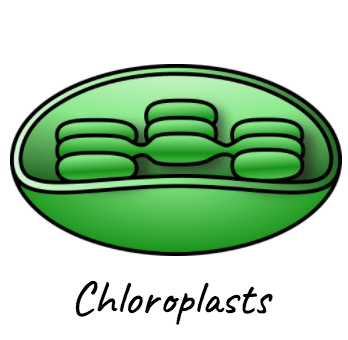
Which of these most accurately shows the relationship between photosynthesis and cellular respiration?


What is the purpose of cellular respiration
to create energy
to produce glucose
to produce oxygen
all of these

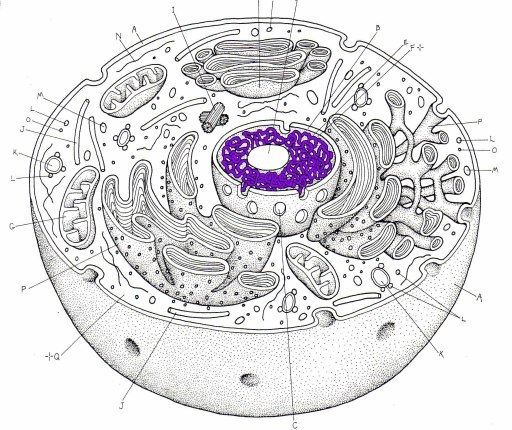

clear gel-like fluid in cells that holds the
organelles
Cytoplasm
Microtubules
Centrosome
Vacuole
where DNA is stored in a eukaryotic cell
vacuole
mitochondria
lysosome
nucleus
where proteins are made
flagella
ribosome
lysosome
centriole
organelle in eukaryotic cells near the nucleus
that has ribosomes attached to it
rough ER
smooth ER
golgi apparatus
lysosome

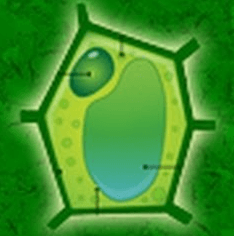
The arrow is showing the fluid inside the cell that surrounds the cell organelles and gives the cell its shape. What is the arrow pointing to in the cell?
cytoplasm
mitochondria
ribosomes
nucleus

Identify the structure that is indicated by the arrow in the image.
cell wall
central vacuole
chloroplast
cell membrane

What type of cell is being shown in the image?
plant
animal
This organelle breaks down (digest) worn out cell parts
cytoplasm
lysosomes
mitochondria
vacuoles
This organelle stores water, and is very big in plant cells
nuclolus
ribosomes
golgi bodies
vacuoles


Equilibrium is when....
there is a large amount of substance on the inside of the cell and a small amount in the outside solution
there is a small amount of substance on the inside of the cell and a large amount in the outside solution
there is an equal amount of substance on either side of the cell membrane
there are no particles on either side of the the cell membrane

Movement of solute, NOT WATER, through the cell membrane from high to low concentration.
diffusion
active transport
facilitated diffusion
osmosis