
 Worksheets
hahaha
Total questions: 122
Worksheet time: 1hrs 28mins
In the Late Middle Ages, there was a struggle in power in Europe between: (choose all that apply):
Popes
Lords
Monks
Kings
EXCOMMUNICATION happens when:
The pope stops giving your kingdom money unless you fight holy wars for him.
The pope "kicks you out" of the church, taking away your chance to go to heaven.
The pope sends priests and monks to assist a kingdom in feeding and aiding the poor.
The pope makes the call across all of the church for a Crusade, or holy war.
What happens in an ALLIANCE?:
Countries work together for protection.
People decide to go on a Pilgrimage to the Holy Land.
Kings decide to take their armies to the Holy Land for the Crusades.
Countries split up based on their religious beliefs.
When the Christian church split in two, the western portion of Europe under the pope became known as:
The Eastern Orthodox Church
The Holy Byzantine Church
The Roman Catholic Church
The Holy Roman Empire
When the Christian church split in two, the eastern portion of Europe became known as:
The Eastern Orthodox Church
The Holy Roman Empire
The Holy Byzantine Church
The Roman Catholic Church
What were some main reasons of the Crusades? (choose all that apply):
People thought that it was a sure way to get to heaven if they fought and died.
Lords and knights wanted to gain money and land.
People wanted to convert Muslims to Christianity.
The pope was simply looking to make more money for the church by starting the Crusades.
Muslims conquered the Holy Land.
What were several reasons why the Crusades failed? (choose all that apply):
European Christians were not used to fighting in the desert.
They were thousands of miles from home and could not expect help quickly.
Bad leadership and planning from Lords and Kings.
Christians were weaker fighters than the Muslims were.
They were massively outnumbered by the Muslims.
Which Crusades were successful? (choose all that apply):
1st Crusade
2nd Crusade
3rd Crusade
4th Crusade
Children's Crusade
The fierce and brilliant king of England who fought in the 3rd Crusade was called:
King Richard
King Harold
Saladin
Bohemond
The Muslim sultan who fought against the Christians in the 3rd Crusade was called:
Mubahrak
Saladin
Mohammed
Ibn Battuta
The Holy Land was: (choose all that apply):
The area around the city of Jerusalem.
a place with rich farmland that was desired by Christians and Muslims.
desired by Christians, Muslims and Jews alike.
reconquered and kept by Christians throughout the rest of the medieval ages.
ruled by King Richard the Lionheart.
What were several after-effects of the Crusades? (choose all that apply):
A deep mistrust between many Muslims and Christians that exists even today.
a better understanding between Islam and Christianity.
new trade between the Muslim world and Europe; new trade goods began to flow.
a successful reconquest of the Holy Land by the Christians.
The holy city of Constantinople eventually being captured by Islam.
What did French knights do when they reached Constantinople during the 4th Crusade?
Destroyed the city
Joined the Byzantines
Looted the city
Destroyed the Greek Orthodox Church
Even though the European knights all came from different countries, what language did they all have in common to help communicate?
French
Latin
English
Spanish


Who was often rich and lived in beautiful palaces?
Kings
Popes
Both Kings and Popes
Who would inherit their position of power from their father?
Kings
Popes
Both Kings and Popes


_________ are the most common physical feature here and make up 66% of the area.
Mountains
Deserts
Plateaus
Grasslands
Which best describes the climate of much of Southwest Asia?
Hot and dry
Windy and cold
Tropical and rainy
Moderate and cool
The climate of Southwest Asia has led much of the region to experience a scarcity of _____________.
Trading
Rainfall
Oil production
Desalination plants


what is letter A?
(a)

What is B?
(a)

What is C?
(a)

What is D?
(a)

What is E?
(a)

What is F?
(a)

What is G?
(a)

What is H?
(a)

What is I?
(a)

What is J?
(a)
Riyadh is the capital of
Turkey
Syria
Saudi Arabia
Riyadh is the capital of
Turkey
Syria
Saudi Arabia
What nationality was Joan of Arc?
Spanish
French
Italian
Portuguese
What did Joan have to do join the troops?
look like a man
look like a woman
change clothes
live in France
The English wanted to prove that Joan was a
Saint
witch
On what condition was Joan freed from prison ?
She had to look like a man
She had to look like a woman
Why was she declared a saint?
because she was a witch
because she saved France
Joan of Arc fought to unite what country?
Spain
England
France
Italy
Why did Joan believe that she had to see the future king of France?
Voices from God told her to go
Her father sent her
She wanted to be famous
The local priest told her to go
What animal contributed the most to the spread the black plague?
Birds
Fleas and rats
Fish
Lions
How did the plague impact Europe?
People started to question the church
1/3 of the population died
It contributed to the decline of feudalism
All are correct
Some scientists think the plague arrived in Europe from?
Ships
Airplanes
Camel caravans
Trains
Many people did NOT believe that the Black Plague was a result of God punishing them?
True
False
Why were many jews killed?
They believed God was punishing them and being jewish was a sin
They broke out into a riot and many were killed
They fell off a cliff
The Magna Carta introduced which idea?
Parliament
King appointing bishops
Rule of Law
Domesday Survey
What actions and policies characterized the rule of King John before the Magna Carta? (Choose 3)
He ignored feudal traditions
He tried to be fair to the nobles
He shared his money with the nobles
He lost English territory in France
He demanded more money from the nobles
The disease known as the Black Death is today known as the....
Bubonic Plague
Pandemic
Yellow Fever
Which group in Europe was often singled out for persecution because people blamed them for the Black Death?
Jews
Traders
Muslims
Women
Explain how the Black Plague spread throughout Europe.
Plague came from Britain and then spread to the rest of the mainland Europe through trade.
Plague was brought back to mainland Europe by knights returning from the crusade in Central Asia.
Plague spread from Central Asia through trade across the Middle East into Italian ports and then into Central Europe.
Plague started in Moor controlled Spain and then spread from warfare between Christianity and Muslims.
Why don't pandemics like the Bubonic Plague effect the planet today?
Vaccines have been developed for every disease.
Strict public health rules and modern medicine are effective in stopping pandemics.
Improvements in nutrition protect people from wide-spread disease.
Viruses and bacteria have been eradicated.
The death of so many people caused a labor shortage in Europe. Which three statements explain how these labor shortages affected society? (Choose 3)
Landowners produced crops that required less labor.
Workers demanded and received higher wages.
Workers began to form labor unions to gain power.
Rural workers moved to towns and cities.
Landowners imported slaves to replace workers.

Which church was rebuilt by Justinian that is a symbol of Byzantine architecture, power, and beauty
Hagia Sophia
Theodora Cathedral
Constantinople Temple
Justinian Code
What improvements did Justinian make to Constantinople? (choose THREE)
He moved the city
He built new roads, bridges and buildings
Improved their water systems
Rebuilt the Hagia Sophia
Why did Justinian reform the laws? (Select 2)
He wanted to make them simpler
He wanted to make sure everyone followed the same laws
He thought the laws were poorly written
Why do historians claim Justinian was the greatest Byzantine ruler? (Choose THREE)
He made Constantinople more advanced
He survived the Plague
He re-conquered Rome
He created an extensive legal system
He was the first Christian Emperor
The (a) is a set of laws that were solidified by many law scholars of around 532
Which of the following best describes Justinian?
Ruler of the Western Roman empire who reunited Rome
Emperor of the Byzantium empire of Rome who reunited Rome
The war general general who controlled the riots of the Byzantine empire
None of the above
How long did Romans use Justinian's Code after it was constructed?
100 years
2000 years
900 years
They never used it
What caused the original Hagia Sophia to be destroyed?
Fire
Natural disasters
Riots
It never fell
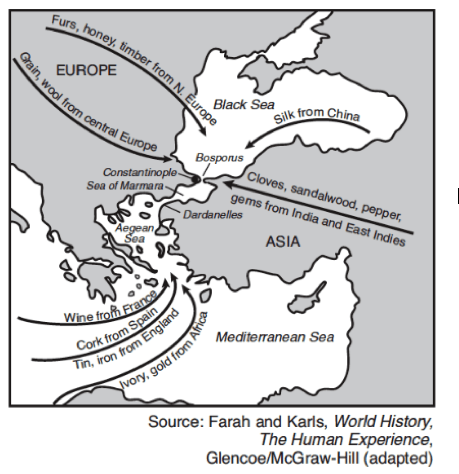
What can you conclude about the city of Constantinople?


What was a monastery in the Middle Ages?
A store that sold and repaired shoes
A place where monks lived and practiced their religion
A place that studied science
A hospital with doctors and nurses
What job did monks have while living at the monastery?
Copying manuscripts
Washing clothes
Farming and cooking food
All of the above
None of the above
What was the second strategy of the Normans against the English?
They came at the English from behind
They fooled the English to believe that they were in retreat
They pretended to be dead
They pretended to surrender

Who was Empress Wu?
the only male empress to reign over China
the only female empress to reign over China
the only First Lady of the United States
the first female Prime Minister of Japan

What major construction project by the Sui Dynasty helped improve national transportation and trade in China?
Silk Road
Panama Canal
Brightline
Grand Canal

How did the Tang Dynasty manage their empire?
using transportation and military force
by completing the Great Wall
through central government, network of roads, trade, and civil service system
restored the caste system and democracy

What was the new component that was added to Confucianism to make it neo-Confucianism?
movement that contained a religion component that traditional Confucian philosophy did not
movement that included Christianity that traditional Confucian philosophy did not
movement that encouraged violence that traditional Confucian philosophy did not
movement that was more concerned with politics and considered a response to Buddhism

Which achievements are most closely associated with the Tang and Song dynasties?
wheel and stirrup
domes and buildings
gunpowder and movable wooden type
iphones and computers

Surrendered without a fight
How did Kublai Khan’s empire differ from the Mongol Empire built by Genghis Khan?
Khan’s empire did not conquer China’s capital.
Khan’s empire did not expand past ancient China.
What capital city did Kublai Khan establish after defeating the Sung dynasty?
Khanbaliq
Xiangyang
How did Confucianism influence emperors of the late Yuan dynasty?
They required civil service exams based on Confucianism.
They required all servants to practice Confucianism.
How did Marco Polo’s stories influence the Silk Road trade?
They led to an increase in European trade with Asia.
They led to a decrease in Asian trade.

