wayground logo

Free Printable Worksheets

Font size

S
M
L
XL
Worksheets

Environmental Science Final Exam

Total questions: 46

Worksheet time: 15mins

Name
Class
Date
1.
Your Ecological or Carbon Footprint is the ratio of 
a)
the amount of resources you use to the amount of resources available
b)
how many people there are on earth to how much space we have on earth
c)
people to cars
d)
robots available to robots needed
2.

3.3-3.4 An organism that uses an outside source of energy like the sun to create energy-rich food molecules.

a)

Consumer

b)

Producer

c)

Decomposer

d)

Parasite

3.

3.3-3.4 An organism that obtains energy by eating other organisms.

a)

Consumer

b)

Producer

c)

Decomposer

d)

Detriov

4.

3.3-3.4 What is the original source of almost all energy in most ecosystems?

a)

carbohydrates

b)

sunlight

c)

water

d)

carbon

5.

3.3-3.4 The efficiency of energy transfer from a lower trophic level to the next highest level is roughly

a)

1%

b)

10%

c)

100%

d)

1000%

6.

3.3-3.4 What is the term for each step in the transfer of energy and matter within a biological community?

a)

energy path

b)

food web

c)

trophic level

d)

food pyramid

7.

6.2 Fresh water makes up what percent of the Earth's water?

a)

5%

b)

10%

c)

4%

d)

3%

8.

6.4 What nutrients are responsible for eutrophication in water? Select all that apply.

a)

Carbon

b)

Nitrogen

c)

Oxygen

d)

Phosphorous

9.

6.4 __________________ pollution is harder to control, because it can't be traced back to a single source

a)

point-source

b)

nonpoint-source

10.

7.1 Which of the following is an example of a nonrenewable natural resource?

a)

wind energy

b)

sunlight

c)

natural gas

d)

geothermal energy

11.

7.1-7.2 Energy can be classified into..

a)

Renewable and non renewable

b)

Natural and non renewable

c)

Renewable and Natural

d)

All of them

12.

7.3-7.4 Which human activity contributes the most carbon dioxide to the atmosphere?

a)

fishing

b)

breathing

c)

burning fossil fuels

d)

farming

13.

8.2 During which period in human history were most of our modern environmental problems introduced?

a)

Hunter-gatherer

b)

Agricultural

c)

Industrial Revolution

d)

Biotechnology Era

14.

9.1-9.3 Gases such as water vapor and carbon dioxide that trap heat near Earth are known as

a)

global gases.

b)

greenhouse gases.

c)

proxy gases.

d)

offset gases.

15.

9.1-9.3 What is the definition of "Greenhouse Effect?"

a)

Gases that increase Earth's temperature

b)

when the gases in Earth’s atmosphere trap heat from the Sun and keep the planet warm

c)

the pattern of weather that occurs over time

d)

When our climate changes

16.

9.1-9.3 Increase in which gas is primarily responsible for increased global warming?

a)

Carbon dioxide

b)

Water vapor

c)

Methane

d)

Nitric oxides

17.

9.2 What happens to the temperature if more greenhouse gases are released into the atmosphere?

a)

Temperature goes up

b)

Temperature goes down

18.
Your Ecological or Carbon Footprint is the ratio of 
a)
the amount of resources you use to the amount of resources available
b)
how many people there are on earth to how much space we have on earth
c)
people to cars
d)
robots available to robots needed
19.

Sustainability is making sure that the planet and its resources can continue to provide life.

a)

True

b)

False

20.
The conditions in an area over a long period of time?
a)
Climate
b)
Weather
21.
Which best describes the role of decomposers in an ecosystem?
a)
Decomposers eat consumers and pass along energy.
b)
Decomposers eat scavengers and pass along energy.
c)
Decomposers get energy from the sun to help producers.
d)
Decomposers get energy by breaking down decaying matter.
22.
2/3 of freshwater on Earth is "locked away" in what water source location?
a)
atmosphere
b)
rivers and lakes
c)
underground
d)
ice and glaciers
23.
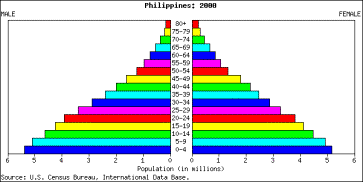
According to the population pyramid of this country, its population is most likely...
a)
growing slowly.
b)
growing rapidly.
c)
decreasing.
d)
not changing.
24.
Name the type of pyramid in the picture.
a)
slow growth
b)
fast growth
c)
zero growth
d)
decline
25.
Water pollution that comes from many sources is considered...
a)
point source pollution
b)
nonpoint source pollution
c)
thermal pollution
d)
ocean pollution
26.
Water pollution that comes from a single source is considered...
a)
point source pollution
b)
nonpoint source pollution
c)
thermal pollution
d)
ocean pollution
27.
Cars with oil leaks are what kind of pollution?
a)
Point Pollution
b)
Nonpoint pollution
28.
What happens if there are more births than deaths in a country?
a)
The population decreases.
b)
This results in an increase in population.
c)
The population stays the same but there are more children.
29.

Which has NOT been a major cause of the population explosion?

a)

improved medical care and modern medicines

b)

people are living lonoger

c)

improved waste management

d)

increase in recycling and reusing products

30.
Climate change causes extreme weather conditions such as:
a)
excessive heat
b)
drought
c)
extreme storms
d)
all of these
31.

2.6-2.8 Biotic or abiotic things that control the size of a population

a)

Limiting factor

b)

density- dependent factor

c)

density- independent factot

d)

tolerance

32.
What may happen if the snowshoe hare was removed from the food web pictured?
a)
The insects in the habitat would increase.
b)
The shrew population would decrease due to being only hawk food source.
c)
The willow tree population would decrease.
d)
Foxes would dies due to no food source. 
33.

A species that plays a critical role in the health, maintenance, growth, or definition of an ecosystem.

a)

keystone

b)

invasive

c)

engineer

d)

predator

34.
Money granted by the government to assist an industry, business or group of people so that the price of items or services may remain low or competitive.
a)
suffrage
b)
servitude
c)
speculation
d)
subsidy
35.

What happens if a population grows past its carrying capacity?

a)

The population keeps growing

b)

The population starts to die off

c)

The entire species will go extinct

d)

The carrying capacity just increases

36.

The largest number of individuals that an environment can support long term is...

a)

carrying capacity

b)

emigration

c)

immigration

d)

population density

37.

According to this image, in which continent does the ecological footprint exceed capacity by the largest amount?

a)

Europe

b)

North America

c)

South America

d)

Australia

38.
Industrialized agriculture is often referred to as "high input" because it requires a great deal of:
a)
pesticides
b)
fertilizers
c)
fossil fuels
d)
all of these 
39.
Traditional farmers grow several crops on the same plot of land in a practice referred to as
a)
monoculture
b)
polyculture
c)
aquaculture
d)
slash and burn
40.
Repeated application of irrigated water in dry climates leads to...
a)
a drop in productivity of the land by more than 10%, leading to desertification
b)
a build up of nutrients, leading to increased levels of erosion
c)
a build up of salts in the soil, leading to salinization
d)
decreased phosphorus and nitrogen, leading to eutrophication
41.
The use of synthetic fertilizers can increase crop yield, but also
a)
destroy nitrifying bacteria in the soil
b)
increase nutrient runoff into nearby surface waters
c)
slow the release of organic nutrients from compost
d)
increase fish populations in nearby streams
42.

Which organism in the food web shown to the right would

contain the lowest concentration of chemical pollutants?

a)

producers

b)

primary consumers

c)

secondary consumers

d)

tertiary consumers

43.

The phenomenon by which toxins concentrate in the organisms at higher trophic levels within an ecosystem is known as...

a)

Biotoxicity

b)

Biomagnification

c)

Eutrophication

d)

Predation

44.
Which of these is a MAJOR cause of acid rain?
a)
spraying pesticides on crops
b)
burning fossil fuels for energy
c)
dumping sewage in river systems
d)
using uranium to generate electricity
45.

What do you call the process of drilling and injecting fluid into a ground at a high pressure in order to break or fracture the shale rocks to release natural gas inside?

a)

Drilling

b)

Fracking

c)

Perforation

d)

Sedimentation

46.

Polar Ice Caps are melting due to an increase in Earth's temperature. This lowers the albedo of Earth, which in turn increases Earth's temperature. This is an example of what type of feedback?

a)

Negative

b)

Neutral

c)

Positive

d)

Ecosystem