Wayground logo

Free Printable Worksheets

Font size

S
M
L
XL
Worksheets

Midterm Review - Physical Science 2021

Total questions: 75

Worksheet time: 4hrs 45mins

Name
Class
Date
1.
In Dalton's Atomic Theory, all elements consist of __________ that cannot be divided.
a)
Atoms
b)
Parts
c)
Molecules
d)
Hydrogen
2.
In the Thomson Model, he discovered the existence of what particle?
a)
Electrons
b)
Protons
c)
Neutrons
d)
Quarks
3.
Which model is this?
a)
Thomson Model
b)
Cloud Model
c)
Bohr Model
d)
Rutherford Model
4.
While making his model of an atom, what structure did Rutherford discover (containing protons and neutrons)?
a)
the Nucleus
b)
the Electron Cloud
c)
the quarks
d)
the atomic mass
5.
The nucleus is made up of protons and what other particle?
a)
Electrons
b)
Nothing else
c)
Neutrons
d)
Atomic Number
6.
Which of these particles was discovered first?
a)
Protons
b)
Electrons
c)
Neutrons
d)
Quarks
7.

Who was the Greek philosopher who called the smallest particle of matter as "atom"?

a)

Democritus

b)

Aristotle

c)

J.J Thomson

d)

Einstein

8.

Which scientist developed the plum pudding/chocolate chip cookie model

a)

Dalton

b)

Thomson

c)

Rutherford

d)

Democritus

9.
This number gives the number of protons in each atom of an element.
a)
mass number
b)
atomic number 
c)
atomic mass
10.
The positive particles of an atom are 
a)
electrons 
b)
positrons 
c)
neutrons 
d)
protons 
11.

Who was the first person to come up with the Atomic Theory which included four parts.

a)

John Dalton

b)

Democritus

c)

Ernest Rutherford

d)

Niels Bohr

12.
Particles in an atom that are neutral and have no charge are 
a)
negatrons 
b)
electrons 
c)
neutrons 
d)
protons 
13.
How many protons are in Beryllium?
a)
4
b)
9
c)
5
d)
2
14.
How many neutrons are in a Gold atom?
a)
79
b)
196
c)
118
d)
275
15.

How many electrons does a Copper atom have?

a)

63

b)

29

c)

92

d)

34

16.

How many electrons does an Iodine atom have?

a)

53

b)

126

c)

73

d)

179

17.

How many electrons are in a gold atom?

a)

79

b)

196

c)

117

d)

275

18.

What does the topmost number (3) represent?

a)

Mass Number

b)

Atomic Number

c)

Atomic Mass

d)

Number of Neutrons

19.

How many electrons does a Hydrogen atom have?

a)

1

b)

2

c)

3

d)

0

20.
A proton is a _____ charged particle.
a)
Negatively
b)
Positively
21.
An electron is a _____ charged particle.
a)
Positively
b)
Negatively
22.

The number of neutrons equals...

a)

atomic number - mass number

b)

Protons - neutrons

c)

Electrons - protons

d)

mass number - atomic number

23.
The atomic number of Titanium is
a)
22
b)
23
c)
20
d)
24
24.
The atomic number of Lithium is
a)
3
b)
4
c)
5
d)
6
25.
The atomic number of Nitrogen
a)
7
b)
6
c)
8
d)
9
26.

Which element has a mass number of 12 and contains 6 neutrons?

a)

Gallium

b)

Copper

c)

Carbon

d)

Sodium

27.

Is this a metal, metalloid, or nonmetal?

a)

Metal

b)

Metalloid

c)

Nonmetal

28.

Is this a metal, metalloid, or nonmetal?

a)

Metal

b)

Metalloid

c)

Nonmetal

29.

Is this a metal, metalloid, or nonmetal?

a)

Metal

b)

Metalloid

c)

Nonmetal

30.

Is this a metal, metalloid, or nonmetal?

a)

Metal

b)

Metalloid

c)

Nonmetal

31.

Is this a metal, metalloid, or nonmetal?

a)

Metal

b)

Metalloid

c)

Nonmetal

32.

Is this a metal, metalloid, or nonmetal?

a)

Metal

b)

Metalloid

c)

Nonmetal

33.

Is this a metal, metalloid, or nonmetal?

a)

Metal

b)

Metalloid

c)

Nonmetal

34.
Name group 1 on the periodic table.
a)
alkali metals
b)
alkaline earth metals
c)
noble gases
noble gases
d)
halogens
35.
Name group 2 on the periodic table.
a)
alkali metals
b)
alkaline earth metals
c)
noble gases
d)
transition metals
36.
Name group 18 on the periodic table.
a)
alkali metals
b)
alkaline earth metals
c)
transition metals
d)
noble gases
37.
Name groups 3 - 12 on the periodic table.
a)
noble gases
b)
halogens
c)
metalloids
d)
transition metals
38.
Name group 17 on the periodic table.
a)
transition metals
b)
metalloids
c)
halogens
d)
alkali metals
39.
Where are the nonmetals located on the periodic table?
a)
top left corner
b)
bottom left corner
c)
top right corner
d)
bottom left corner
40.
Which atom has the largest atomic radius?
a)
potassium
b)
rubidium 
c)
francium
d)
cesium
41.
As you move down the periodic table atoms get bigger.  This is because ____________.
a)
The atoms have more mass.
b)
The atoms have more protons.
c)
The atoms have more energy levels
d)
The atoms have more nuetrons
42.

As you move across the periodic table the atomic radius tend to get smaller because, ______________.

a)

the atoms have more mass.

b)

the atoms have less mass

c)

the atoms have more protons.

d)

the atoms have less electrons.

43.
Atoms that have a high electronegativity, _______________.
a)
give up their electrons more easily.
b)
hold on to their electrons more tightly.
c)
have more electron shells.
44.
Electronegativity is...
a)
how good an atom is at attracting electrons
b)
the ability of an atom to lose electrons
c)
the energy required to remove an electron from a specific atom
d)
how easy it is to make friends. 
45.
Ionization energy is...
a)
the energy required to add an electron to a specific atom
b)
how much energy it takes to remove an electron from an atom
c)
the energy required to shield the outer electrons from the nucleus
d)
a measure of the ability of an atom to attract electrons
46.
The atom with the largest atomic radius in Group 18 is - 
a)
Ar
b)
He
c)
Kr
d)
Rn
47.
The element with the largest electronegativity in the halogens is - 
a)
At
b)
F
c)
Cl
d)
Br
48.

The element with the lowest electronegativity in Period 3 is -

a)

Na

b)

Cl

c)

Al

d)

Mg

49.
Electronegativity __________ from left to right within a period and __________ from top to bottom within a group.
a)
decreases, increases 
b)
increases, increases
c)
increases, decreases 
d)
stays the same, increases
50.
Atomic radius generally increases as we move __________.  
a)
down a group and from right to left across a period 
b)
up a group and from left to right across a period 
c)
down a group and from left to right across a period 
d)
up a group and from right to left across a period 
51.

Of the halogens, which has the smallest radius?

a)

F

b)

Br

c)

He

d)

At

52.

Of the halogens, which has the smallest electronegativity?

a)

F

b)

Cl

c)

At

d)

Ne

53.
Which has the greater Electronegativity: 
N or C?
a)
C
b)
N
54.

Which of the alkaline-earth metals has the smallest electronegativity

a)

Be

b)

Sc

c)

Ra

d)

Sr

55.

Which has the greatest electronegativity?

a)

V

b)

Cr

c)

Se

d)

Zn

56.

On the periodic table, Groups are

a)

Horizontal rows

b)

Vertical columns

57.

On the periodic table, Periods are

a)

Horizontal rows

b)

Vertical columns

58.

Which element is this?

a)

Nickel

b)

Neon

c)

Sodium

d)

Nitrogen

59.

Name this element.

a)

Argon

b)

Chlorine

c)

Aluminum

d)

Boron

60.

Name this element.

a)

Neon

b)

Magnesium

c)

Sodium

d)

Manganese

61.

Elements in Group number 17 are known as

a)

Alkai Metals

b)

Alkaline Metals

c)

Halogens

d)

Noble Gases

62.

Which group includes non-reactive gasses that have a full outer electron shell?

a)

Alkai Metals

b)

Alkaline Metals

c)

Halogens

d)

Noble Gases

63.
How many electrons can the first energy level hold?
a)
1
b)
2
c)
8
d)
0
64.
What is the maximum number of electrons in the second energy level?
a)
18
b)
8
c)
32
d)
2
65.
What atom matches this electron configuration?
1s2 2s2 2p6 3s2
a)
Neon
b)
Magnesium
c)
Aluminum
d)
Potassium
66.
Which is the electron configuration for an oxygen atom?
a)
1s22s22p63s23p64s2
b)
1s22s22p4
c)
1s22s22p6
d)
1s22s22p63s23p6
67.
What atom matches this electron configuration?
1s22s22p63s23p64s23d10
a)
Zinc
b)
Copper
c)
Nickel
d)
Germanium
68.
What electron configuration matches an oxygen atom?
a)
1s22s22p63s2, 3p64s23d104p5
b)
1s22s22p4
c)
1s22s22p6
d)
1s22s22p63s23p64s23d1
69.
Which element is pictured?
a)
neon
b)
fluorine
c)
magnesium
d)
argon
70.
Which electron configuration belongs to Chlorine (Cl)?
a)
1s2 2s2 2p6 3s2 3p5
b)
1s2 2s2 2p6 3s2 3p6
c)
1s2 2s2 2p6 3s2 3p7
71.
What is the noble gas configuration for phosphorus?
a)
[Ar] 3p5
b)
[He] 3s2 3p5
c)
[Ne] 3s2 3p3
d)
[Na] 3s2 3p5
72.
[Ne]3s23p5 is the noble gas configuration for which element?
a)
chlorine
b)
fluorine
c)
sulfur
d)
aluminum
73.
What is the correct electron configuration for Selenium
a)
1s22s22p63s23p64s24d104p4
b)
1s22s22p63s23p64s23d104p4
c)
1s22s22p63s23p64s23d104p3
d)
1s22s22p63s23p64s24d104p43
74.

Calculate the average atomic mass of silver.

a)

107.38649amu

b)

108.91896amu

c)

107.8677amu

d)

108

75.
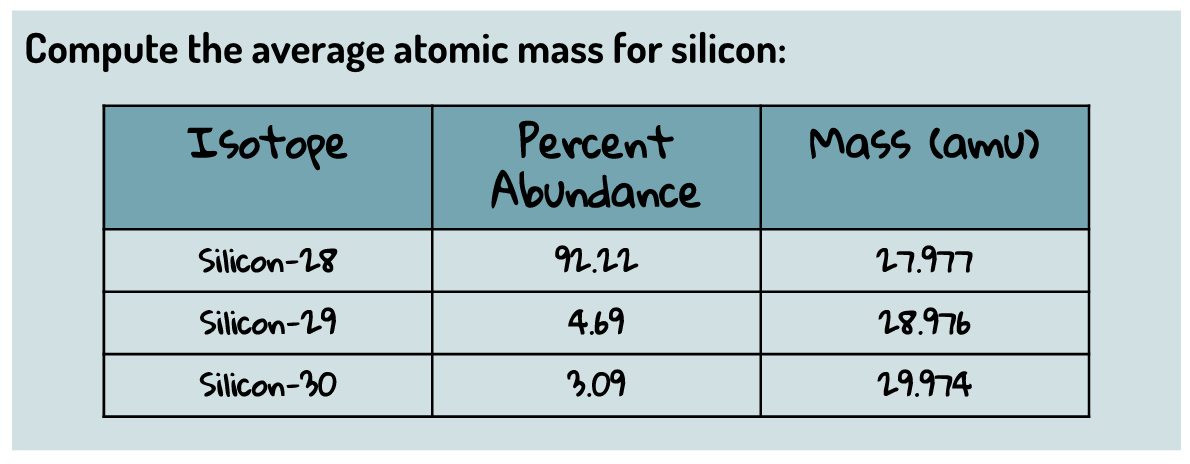
Compute the average atomic mass for silicon:
a)
27.977
b)
28.09
c)
28.976
d)
The average mass cannot be determined from provided information.