wayground logo

Free Printable Worksheets

Font size

S
M
L
XL
Worksheets

Freshman Physics Final Review

Total questions: 129

Worksheet time: 2hrs 54mins

Name
Class
Date
1.

A standard unit of measurement used by scientists, based on 10, and used by most countries in the world except for the USA

a)

customary system

b)

Fahrenheit system

c)

solar system

d)

metric system

2.

How far it is between two positions in space.

a)

distance

b)

mass

c)

volume

d)

temperature

3.

The tool used to measure distance

a)

triple beam balance

b)

meter stick or ruler

c)

graduated cylinder

d)

spring scale

4.

The unit used to measure distance

a)

grams (g)

b)

seconds (sec)

c)

milliliter (mL)

d)

meter (m)

5.

The amount of matter in an object

a)

time

b)

mass

c)

volume

d)

density

6.

The average amount heat energy in a substance

a)

mass

b)

length

c)

force

d)

temperature

7.

Metric unit used to measure temperature

a)

Celsius (c)

b)

Fahrenheit (f)

c)

grams (g)

d)

minutes (min)

8.

The amount of space something takes up

a)

mass

b)

volume

c)

time

d)

force

9.

How tightly packed together the molecules in an object are

a)

mass

b)

density

c)

temperature

d)

force

10.

Preferred unit used to measure time

a)

meters

b)

degrees Celsius

c)

hours

d)

seconds

11.

The base unit for length in the Metric System is:

a)

Meter

b)

Liter

c)

Gram

12.

The base unit for mass in the Metric System is:

a)

Meter

b)

Liter

c)

Gram

13.

A cyclist rides 3 km west and then turns around and rides 2 km east. What is his displacement?

a)

5 km

b)

1 km

c)

5 km east

d)

1 km east

e)

1 km west

14.

What is a difference between distance and displacement

a)

Distance is measured in seconds and displacement is measured in meters

b)

Distance is always shorter than displacement

c)

Displacement can be equal to zero if the object ends in the place it began in

d)

Distance can be equal to infinite when only a small distance has been travelled

15.

What is the average speed of a cheetah that sprints 100 m in 4 s?

a)

25 m/s

b)

0.04 m/s

c)

25 s

d)

104 m/s

16.

Read this Problem:

Timmy tied his tricycle to a truck and it pulled him down the road at 25 mph. About 0.12 hr into the trip he fell off. How far did Timmy go?

The speed is measured in what units in this problem?

a)

miles

b)

hours

c)

miles per hour

d)

kilometers

17.

Read this Problem:

Timmy tied his tricycle to a truck and it pulled him down the road at 25 mph. About 0.12 hr into the trip he fell off. How far did Timmy go?

What quantity are they wanting you to calculate?

a)

distance

b)

time

c)

speed

d)

velocity

18.

A box at rest starts sliding down an inclined plane for 3 seconds, until it reaches a velocity of 27 m/s. What is the boxes acceleration?

a)

30 m/s

b)

24 m/s2

c)

9 m/s2

d)

81 km/hr

19.

An object and rest will stay at rest and an object in motion will stay in motion unless acted on by a force, is which one of Newton's Laws of Motion?

a)

4th Law of Motion

b)

1st Law of Motion

c)

3rd Law of Motion

d)

2nd Law of Motion

20.

When an object resists change, like a body in a turning car, it is called ________________.

a)

inertia

b)

force

c)

friction

d)

drag force

21.
The force that pulls objects towards Earth.
a)
Gravity
b)
Friction
c)
Inertia
d)
Force
22.
 What is the unit called that measures force?
a)
Isaac
b)
Yee
c)
Newton
d)
kilogram
23.

A push or pull on an object, causing it to move, stop, or change direction.

a)

motion

b)

gravity

c)

force

d)

inertia

24.

A force that slows down an object when it rubs against another object.

a)

gravity

b)

velocity

c)

inertia

d)

friction

25.

The speed and direction of an object.

a)

inertia

b)

velocity

c)

gravity

d)

push

26.

The change of speed and direction over time.

a)

inertia

b)

velocity

c)

gravity

d)

acceleration

27.

Equal forces that do not cause a change in an objects motion

a)

Unbalance force

b)

Push or a pull

c)

Balanced force

d)

Average speed

28.

According to Newton's Laws, for every action there is an ....

a)

equal and opposite reaction.

b)

equal and parallel reaction.

c)

unequal and opposite reaction.

d)

unequal and unrelated reaction.

29.
If net force acting on object is 0, then the force is considered to be..
a)
Balanced
b)
Unbalanced
c)
Equal in Direction
d)
Distance/Time
30.
Which type of force(s) will cause a change in an object's motion?
a)
gravity
b)
zero net force
c)
balanced forces
d)
unbalanced forces
31.
Which of the following objects has the least acceleration?
a)
a. an empty shopping cart pushed with a hard force
b)
b. a full shopping cart pushed with a hard force
c)
c. an empty shopping cart pushed with a light force
d)
d. a full shopping cart pushed with a light force
32.
Speed is different from velocity because
a)
Velocity has a direction
b)
Speed uses Distance /Time
c)
Velocity doesn't include time
d)
Velocity doesn't include distance
33.
The faster an object moves, the ________ kinetic energy it has. 
a)
more
b)
less
c)
none of the above
d)
all of the above 
34.
Which is the best example that something has kinetic energy?
a)
a. a car parked on a steep hill 
b)
b. a tennis ball rolling across the court
c)
c. a picture hanging on the wall 
d)
d. a piece of coal before it's burned 
35.

What two factors affect an object's kinetic energy?

a)

area and volume

b)

mass and weight

c)

weight and height

d)

mass and speed

36.
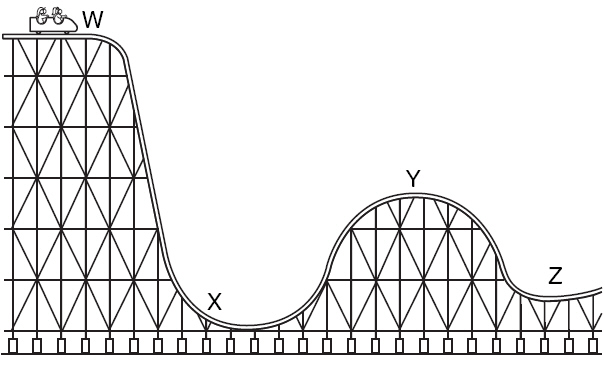
At which point is potential energy greatest?
a)
W
b)
X
c)
Y
d)
Z
37.
Explain what happens to the potential energy of a rock as it falls off the side of a cliff.
a)
The kinetic energy decreases as the potential energy increases.
b)
The kinetic energy decreases as the potential energy decreases.
c)
The potential energy decreases as the kinetic energy increases.
d)
The potential energy decreases as the kinetic energy decreases. 
38.

Which is NOT a true statement about energy?

a)

it can change into another form of energy

b)

it can cause a temperature change

c)

it can cause movement

d)

it can be completely used up

39.
This is the energy of moving electrons. 
a)
nuclear 
b)
electricity 
c)
potential 
d)
sound 
40.

What type of energy do we get from the food we eat?

a)

light

b)

thermal

c)

chemical

d)

sound

41.
gravitational potential energy is defined as
a)
the energy an object has due to its height above the ground
b)
the energy an object has due to its motion
c)
the energy a spring has due to its stretch
d)
the chemical energy stored in the molecules of atoms
42.

What is the definition of Energy?

a)

a change in speed or direction

b)

the ability to cause changes, apply a force, or do work

c)

a force that works against motion as surfaces rub together

d)

the energy an object has because of its motion

43.

What is the sum of kinetic energy and potential energy of a system?

a)

mechanical energy

b)

electrical energy

c)

moving energy

d)

nuclear energy

44.

if you push a cart with a force of 60 N for 2 m... how much work have you done

a)

120 J

b)

30 J

c)

120 N

d)

30 N

45.

Two people shove on a wall with 100 N. The wall doesn’t move. How much work is done?

a)

100J

b)

100N

c)

0J

d)

0N

46.

What is the energy transformation that occurs in an electric pencil sharpener?

a)

mechanical energy to electrical energy

b)

electrical energy to mechanical energy

c)

radiant energy to sound energy

d)

chemical energy to mechanical energy

47.

The picture showing the energy conversion

Chemical → kinetic

is:

a)
b)
c)
d)
48.
Which situation is work not done?
a)
lifting a 20 pound box off the floor
b)
holding a 20 pound box above the floor
c)
sliding a 20 pound box across the floor
d)
sliding a 20 pound box up an inclined plane
49.

the measurement of the force of gravity on an object

a)

mass

b)

speed

c)

weight

d)

motion

50.
A barefoot student steps on a hot concrete surface. Most of the heat transferred to the student’s skin by this contact is by the process of—
a)
convection
b)
conduction
c)
vaporization
d)
radiation
51.
How do molecules at warm temperatures differ from molecules at cool temperatures? 
a)
a.  At warm temperatures, molecules move around more
b)
b.  At warm temperatures, molecules grow in siz
c)
c.  At warm temperatures, molecules exchange electrons more easil
d)
d.  At warm temperatures, molecules combine with each other more easil
52.
What materials would be good insulators for a handle on a pan or pot that would be used on the stove?
a)
wood or plastic
b)
metal or rubber
c)
wood or rubber
d)
copper or steel
53.
Conduction can only occur between two objects when –
a)
one object is less dense than the other.
b)
both objects are in physical contact with each other.
c)
one of the objects is made of a metal.
d)
both objects are exactly the same temperature.
54.
The particles of a gas move ____than the particles of the same substance in the liquid or solid state.
a)
faster
b)
slower
c)
same speed
55.
Which of the following are kinds of heat transfer.
a)
Conduction
b)
Convection
c)
Radiation
d)
All of the above
56.
When the 2nd story of a house is warmer than the 1st floor of a house is heat transfer through 
a)
conduction
b)
convection
c)
radiation
d)
thermal equilibrium
57.
What would be the effect on the particles if more heat is supplied to the system?
a)
They would slow down
b)
They would stop moving
c)
They would speed up
d)
There would be no effect
58.

_____________ is the form of energy that is transferred between systems or objects with different temperatures.

a)

Temerature

b)

Heat

c)

Specific Heat

d)

Mechanical Energy

59.
What is the definition of CONDUCTION?
a)
When heat is transferred from objects like rays of light or electromagnetically.
b)
a  hot liquid or air that  expands, becomes less dense, and rises or becomes more dense, and sinks.
c)
When heat transfers from objects that are touching.
d)
When heat transfers through the heater or AC in your house.
60.

What is the definition of CONVECTION

a)

When heat transfers through waves.

b)

When heat transfers from objects that are touching.

c)

Heat transfer when a liquid or gas heats up, expands, becomes less dense and rises; or cools, becomes more dense, and sinks.

d)

Heat traveling from the sun

61.
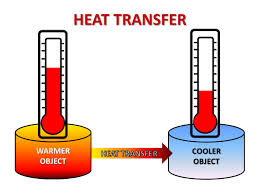
Heat transfers from an area of ____temperature to an area of ___ temperature.
a)
high to low
b)
low to high
c)
high to high
d)
It can travel high to low and low to high. 
62.

_________________ is the transfer of energy through or by electromagnetic waves.

a)

Conduction

b)

Convection

c)

Radiation

63.

As water in a freezer turns into ice,

a)

a. the water absorbs energy from the air in the freezer.

b)

b. the water absorbs the coldness from the air in the freezer.

c)

c. the freezer air absorbs heat from the water.

d)

d. the water neither absorbs nor releases energy

64.

You pick up a can of soda off of the countertop. The countertop underneath the can feels colder than the rest of the counter. Which explanation do you think is the best?

a)

The cold has been transferred from the soda to the counter.

b)

There is no heat energy left in the counter beneath the can.

c)

Some heat has been transferred from the counter to the soda.

d)

The heat beneath the can moves away into other parts of the countertop.

65.

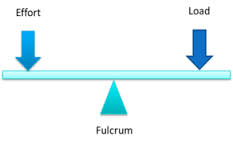
Susan and Jake’s truck gets stuck in the mud. They used a tree branch as a

lever to lift the truck out of the mud. They applied an effort force of 700N to

the branch and the back of the truck weighs 2100N. What is the mechanical advantage of the tree branch lever?

(a)  

66.

What is effort (input) force?

a)

the force one exerts on a machine

b)

the force which an effort force must overcome in order to do work on an object via a simple machine.

c)

the force the machine exerts on a object

d)

the output work times the input distance

67.
If the weight of the block is 10N, how much force does one have to apply to lift it using this pulley (MA=2)?
a)
2N
b)
5N
c)
10N
d)
15N
68.
if a load of a lever is 100 newtons and the force you apply is 20 newtons, what is your mechanical advantage?
a)
120 N
b)
5 N
c)
2000 N
d)
80 N
69.

A simple machine that consists a rigid bar that pivots on a fixed point

a)

lever

b)

pulley

c)

wheel and axle

d)

fulcrum

70.
Which of the following is NOT a simple machine?
a)
lever
b)
pulley
c)
inclined plane
d)
ring
71.
The place where a lever pivots is called the _______.
a)
Load
b)
Force/Effort
c)
Fulcrum
d)
Rigid Bar
72.
Which type of lever is this?
a)
First Class Lever
b)
Second Class Lever
c)
Third Class Lever
d)
Coach  Class Lever
73.
A wheelbarrow is an example of a:
a)
1st class lever
b)
2nd class lever
c)
3rd class lever
74.
For a lever to be a first class lever the fulcrum needs to be ..
a)
between the load and the effort
b)
on one side and the load and effort on the other side 
c)
on the same side as the load arm. 
75.

What class lever is a nutcracker?

a)

1st

b)

2nd

c)

3rd

76.
The amount a machine multiplies force is...
a)
Mechanical Advantage
b)
Slope and Rise
c)
Effort
d)
Simple Machine
77.
The longer the inclined plane, the ___________________ to move the object
a)
the less input force you need
b)
the more input force you need
c)
the more output force you need
d)
the less output force you need
78.
What is a disadvantage of using an inclined plane to lift a heavy object?
a)
The object must be moved a greater distance.
b)
It takes less effort to move the object.
c)
Many objects are difficult to lift straight up.
d)
Heavy object usually take up more space.
79.
How can you decrease the effort force needed to push a weight to the top of the ramp? 
a)
cover the surface with carpet
b)
increase the length of the ramp
c)
increase the height of the ramp
d)
decrease the length of the ramp
80.
Identify this simple machine
a)
Lever
b)
Wheel & Axle
c)
Inclined Plane
d)
Screw
81.
Which of the following does a simple machine do?
a)
allows the users to apply less force over a longer distance
b)
reduce the amount of force needed to do work
c)
change the direction of the applied force
d)
all of the above
82.
An inclined plane wrapped around a rod forms this simple machine 
a)
lever
b)
pulley
c)
screw
d)
wedge 
83.
How much work is done in holding a 15 N sack of potatoes while waiting in line at the grocery store for 3 minutes?
a)
15 J
b)
45 J
c)
0 J
d)
5 J
84.
How much work is produced when 350 N is used to move a car 5 m (W=Fd)?
a)
70 J
b)
1750 J
c)
355 J
d)
175 J
85.

What is mechanical advantage?

a)

The advantage a machine has over a bicycle

b)

A measure of how much a simple machine reduces work

c)

A measure of when is the best time to use a simple machine

d)

the number of times a machine increases input force

86.

What are some other terms that can be used to refer to resistance force?

a)

load, resistance, and weight.

b)

resistance, effort force, and weight

c)

weight, mechanical advantage, and efficiency

d)

load, mechanical advantage, and ideal machine

87.

A machine with a ratio greater than 1:

a)

multiplies the input force so the machine would be good to help move heavy objects.

b)

does not multiply the force, but increases distance and speed.

c)

is good for lifting and moving objects quicker.

d)

Is not good for lifting or moving objects quicker.

88.

Using an inclined plane to move a piano into a truck:

a)

does not reduce the amount of work, but does make the work easier by using less force to move the piano.

b)

does not reduce the amount of force, but does make the work easier to move the piano.

c)

does reduce the amount of work and makes the work easier by using less force to move the piano.

d)

increases the amount of work by using more force to move the piano.

89.

What is transferred from place to place by waves?

a)

matter

b)

energy

c)

particles

d)

light

90.

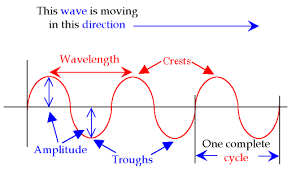
What does the arrow in the picture represent?

a)

amplitude

b)

wavelength

c)

frequency

d)

trough

91.

Waves that require a medium to travel are:

a)

mechanical waves

b)

transverse waves

c)

electromagnetic waves

d)

light waves

92.

What happens when you increase the amplitude of a sound?

a)

it makes the sound louder

b)

it makes the sound travel faster

c)

it makes the sound softer

d)

it changes the pitch or note of the sound

93.

What kind of wave is pictured below?

a)

compressional wave

b)

transverse wave

c)

longitudinal wave

d)

mechanical wave

94.

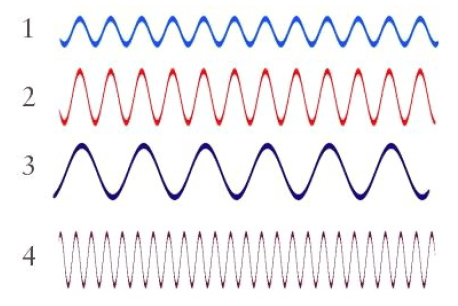
Which wave in the diagram has the greatest frequency?

a)

1

b)

2

c)

3

d)

4

95.

Which wave in the diagram has the longest wavelength?

a)

1

b)

2

c)

3

d)

4

96.

If a wave has a greater frequency, what happens to the wavelength?

a)

increases

b)

decreases

c)

stays the same

97.

One hertz is equal to:

a)

1 cycle or wave per second

b)

the distance from crest to crest or trough to trough

c)

the distance from one rarefaction to the next rarefaction.

d)

the maximum displacement of the wave

98.

Longitudinal waves move __________ to the energy of the wave (select all that apply).

a)

Parallel

b)

Perpendicular

c)

At a 90 degree angle

d)

In the same direction

99.

Transverse waves move __________ to the energy in the wave (select all that apply).

a)

Parallel

b)

Perpendicular

c)

At 90 degree angle

d)

In the same direction

100.

The area of a longitudinal wave where particles are pushed close together are called:

a)

rarefactions

b)

compressions

c)

amplitude

d)

wavelength

101.

When a crest and a trough interfere, what occurs?

a)

They combine to create a higher amplitude wave.

b)

They counteract and the wave either lessens or stops completely.

c)

The wave changes into a longitudinal wave.

102.

When light waves bounce off a surface we call this:

a)

Reflection

b)

Refraction

c)

Absorption

103.
The combination of two waves to form a larger amplitude is what type of interference?
a)
Constructive
b)
Destructive
c)
Diffractive
d)
Refractive
104.

Which tile is transmitting the light wave?

a)

The black tile

b)

The white tile

c)

The clear tile

d)

None of the tiles

105.

Which tile is reflecting the light wave?

a)

The black tile

b)

The white tile

c)

The clear tile

d)

None of the tiles

106.

Which tile is absorbing the light wave?

a)

The black tile

b)

The white tile

c)

The clear tile

d)

None of the tiles

107.

Insulator

a)

A material that resists the flow of

electricity.

b)

Caused by the flow of electrons.

c)

The charge that attracts electrons.

d)

A material that does not resist electricity.

108.

Static electricity

a)

A unit in measuring amount of

charge

b)

A buildup of charge on an object.

c)

An object that has equal amounts

of positive and negative charges.

d)

Property of matter responsible for

electrical events; it has two forms,

positive and negative.

109.
A particle that carries a negative electric charge is called a(n) ______.
a)
neutron
b)
atom
c)
proton
d)
electron
110.
An example of a voltage source is a _____.
a)
voltmeter
b)
battery
c)
resistance
d)
switch
111.
The potential difference that causes charges to move in a circuit is ___.
a)
voltage
b)
resistance
c)
current
d)
electric discharge
112.
A circuit that is connected to Earth is said to be _____.
a)
series
b)
parallel
c)
grounded
d)
discharged
113.
Which best describes a parallel circuit?
a)
Electricity flows along one pathway.
b)
The flow of electricity comes from one source. 
c)
Electricity flows along more than one pathway. 
d)
The flow of electricity comes from more than one source. 
114.
What is one problem with using a series circuit? 
a)
It has a lot of series. 
b)
If one goes down, they all go down! 
c)
It doesn't work properly.
d)
There are no problems. 
115.
What is one benefits of using a parallel circuit?  
a)
It gets confusing.
b)
There are no problems.
c)
If one goes down, it does not affect the others. 
d)
Porque es para llelio. 
116.
This is an example of a _______ circuit
a)
open
b)
series
c)
parallel
d)
square
117.
What kind of circuit is this?
a)
Series
b)
Consecutive
c)
Parallel
d)
Training
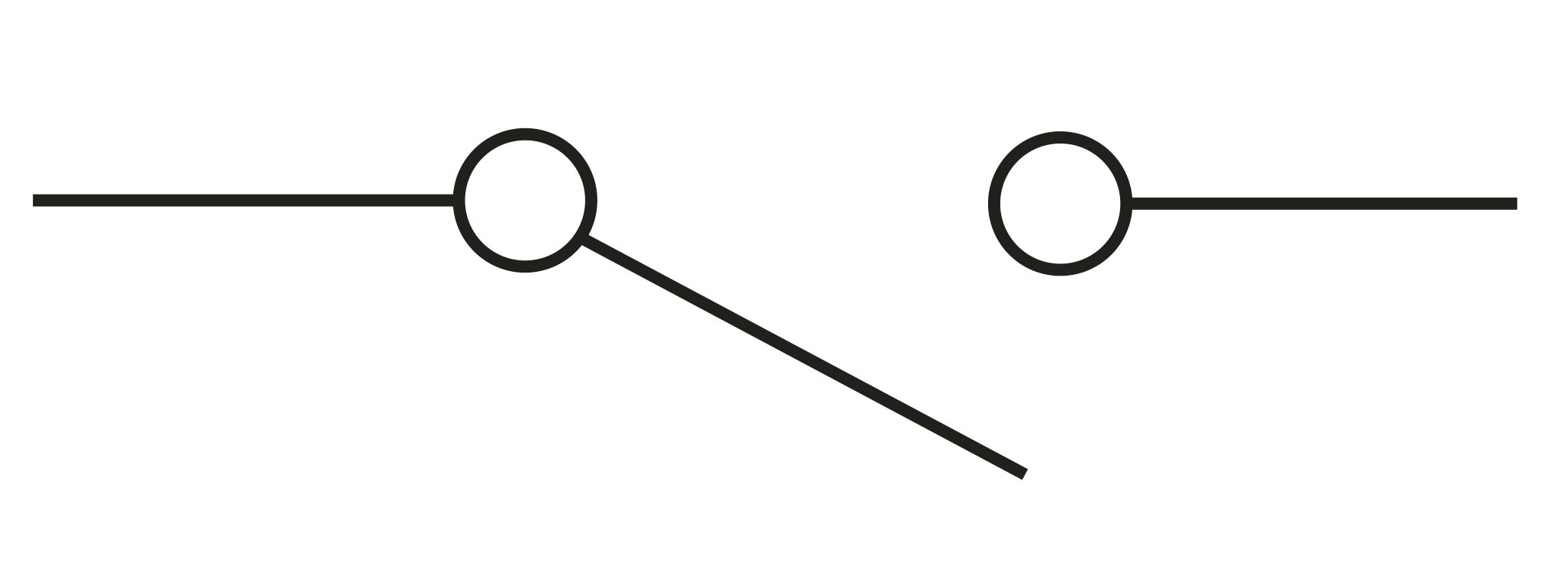
118.
this is the symbol for a _____?
a)
switch
b)
light 
c)
battery
d)
wires
119.
In an electrical circuit, electrons move from the __________.
a)
Negative pole to negative pole
b)
Negative pole to positive pole
c)
Positive pole to positive pole
120.
A material in which electrons are able to move easily
a)
Circuit
b)
Insulator 
c)
Resistance 
d)
Conductor 
121.
The process of transferring charge by touching or rubbing 
a)
Induction 
b)
Conduction 
c)
Friction 
d)
Conductor 
122.
Electric current that flows in only one direction. 
a)
Voltage 
b)
Direct Current 
c)
Alternating Current
d)
Series Circuit 
123.
Electric current that reverses its direction of flow in a regular pattern  
a)
Voltage 
b)
Direct Current 
c)
Alternating Current 
d)
Parallel Circuit 
124.
The flow/movement of electric charges 
a)
Voltage
b)
Resistance 
c)
Current 
d)
Circuit 
125.
A closed path that electric current follows 
a)
Voltage
b)
Current
c)
Resistance 
d)
Circuit
126.
The tendency for a material to oppose the flow of electrons, changing electrical energy into thermal energy and light.
a)
Voltage
b)
Current
c)
Resistance
d)
Circuit 
127.
According to this law, the current in a circuit equals the voltage difference divided by the resistance. 
a)
Law of Conservation of Energy 
b)
Ohm's Law 
c)
Law of Conservation of Charges
d)
Newton's First Law 
128.

Which of the following is the SI unit for electric current?

a)

Ohm

b)

Watt

c)

Ampere

d)

Volt

129.

A higher resistance in a circuit causes a _____________.

a)

higher voltage

b)

larger current

c)

smaller current

d)

lower voltage