Wayground logo

Free Printable Worksheets

Font size

S
M
L
XL
Worksheets

Weather Review

Total questions: 91

Worksheet time: 45mins

Name
Class
Date
1.

What is the cloud cover?

a)

sunny

b)

partly cloudy

c)

1/4 cloudy

d)

1/4 clear

2.

What is the temperature?

a)

100 degrees

b)

66 degrees

c)

-13 degrees

d)

75 degrees

3.

What type of weather is this area experiencing?

a)

thunderstorm

b)

hail

c)

fog

d)

snow

4.
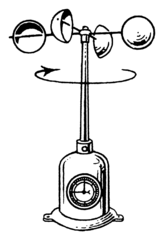
This weather instrument is an...
a)
wind vane
b)
anemometer
c)
barometer
d)
thermometer
5.
This weather instrument is a...
a)
anemometer
b)
barometer
c)
wind vane
d)
thermometer
6.
This weather instrument is a...
a)
thermometer
b)
anemometer
c)
rain gauge
d)
barometer
7.
This weather instrument is a...
a)
anemometer
b)
Christmas ornament
c)
wind vane
d)
barometer
8.
This is the symbol for a... 
a)
Occluded Front
b)
Stationary Front
c)
Warm Front
d)
Cold Front 
9.
This is the symbol for a... 
a)
Cold Front
b)
Warm Front
c)
Stationary Front
d)
Occluded Front 
10.
Identify the type of front that is shown in the image.
a)
Occluded Front
b)
Cold Front
c)
Stationary Front
d)
Warm Front
11.
Based on the weather map, which city will most likely experience increasing temperatures during the next 24 hours? 
a)
Denver, because it is raining there
b)
Minneapolis, because a cold front is approaching
c)
Atlanta, because a warm front is approaching
d)
Houston, because it is in a high pressure area
12.
What is the temperature in New York?
a)
84
b)
86
c)
60
d)
67
13.
Based on the weather map, what will most likely happen to the weather in Hewitt, TX?
a)
Clear skies and warmer
b)
Dry air and sunny
c)
Thunderstorms and lower temperatures
d)
Calm breezes
14.
what are isotherms?
a)
lines connecting places of equal temperature
b)
lines drawn connecting places of equal pressure
c)
lines drawn to places of different temperatures
d)
lines drawn to places of different pressures
15.
What type of map is shown?
a)
satelite
b)
radar
c)
isobar
d)
isotherm
16.
a)

cold front

b)

warm front

c)

high pressure

d)

low pressure

17.
a)

cold front

b)

warm front

c)

high pressure

d)

low pressure

18.

Which cities are probably experiencing stormy or rainy weather?

a)

Los Angeles and Charleston

b)

Seattle and Chicago

c)

Chicago and Little Rock

19.
How do we name air masses?
a)
Water and temperature
b)
Air pressure
c)
Humidity and temperature
d)
Cold and warm
20.
How do we characterize an air mass that forms over land?
a)
Dry
b)
Wet
c)
Cold
d)
Warm
21.
A wet and cold air mass would be a...
a)
Maritime polar
b)
Continental polar
c)
Maritime tropical
d)
Continental tropical
22.
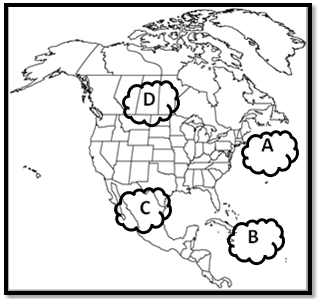
Which type of air would you find at air mass A?
a)
cold, dry
b)
warm, humid
c)
warm, dry
d)
cold, humid
23.
What kind of breeze is this & what time of day/night would it form?
a)
Land breeze - daytime
b)
Land breeze - nighttime
c)
Sea breeze - daytime
d)
Sea breeze - nighttime
24.
Type of cloud seen here?
a)
cirrus
b)
stratus
c)
cumulus
d)
cumulonimbus
25.
Type of cloud seen here?
a)
cirrus
b)
stratus
c)
cumulus
d)
cumulonimbus
26.

A(n) _____________ is the boundary where two air masses meet.

a)

air mass

b)

storm

c)

collision

d)

front

27.
A tropical climate in the US would be?
a)
Virginia
b)
New York
c)
California
d)
Florida
28.
The _________________ climate has cool summers, bitterly cold winters and permafrost.
a)
desert
b)
tropical
c)
marine continental
d)
tundra
29.

What are the main greenhouse gases?

a)

carbon dioxide, oxygen, water vapor, nitrous oxide, methane

b)

carbon dioxide, methane, nitrous oxide, water vapor, sulfur dioxide

c)

methane, water vapor, carbon dioxide, oxygen

d)

methane, water vapor, carbon dioxide, nitrous oxide

30.

A tornado begins as a ___________ cloud that pokes through the bottom of a cumulonimbus cloud.

a)

cirrus

b)

cumulus

c)

funnel

d)

stratus

31.

A _________ can from when a rapidly spinning column of low pressure air, called a funnel cloud touches the ground.

a)

thunderstorm

b)

hurricane

c)

tornado

32.

If the conditions for a tornado are predictable, how could these tornadoes have formed in these two states? (Alabama and Georgia)

a)

Warm moist air meets cold coast air

b)

Canadian air meets west moving air

c)

Warm moist air meets cold dry air

d)

Northeastern air mass drops

33.

How do you define severe weather?

a)

a series of waves in a water body caused by the displacement of a large volume of water, generally in an ocean

b)

a prolonged period of abnormally low rainfall, leading to a shortage of water

c)

dangerous weather conditions that can cause damage and/or a loss of human life

d)

very high temperatures that lead to a drought

34.

Why do hurricanes rotate?

a)

the coriolis effect

b)

continental deflections

c)

global winds

d)

the sun

35.

What type of severe weather is this?

a)

Hurricane

b)

Blizzard

c)

Tornado

d)

Severe Thunderstorm

36.

What is the primary cause of wind?

a)

Cloud formation

b)

Precipitation

c)

Temperature differences

d)

Humidity levels

37.

Which of the following instruments measures atmospheric pressure?

a)

Hygrometer

b)

Barometer

c)

Anemometer

d)

Thermometer

38.

What type of precipitation occurs when raindrops freeze before hitting the ground?

a)

Snow

b)

Sleet

c)

Hail

d)

Freezing rain

39.

Which layer of the atmosphere contains the ozone layer?

a)

Thermosphere

b)

Mesosphere

c)

Stratosphere

d)

Troposphere

40.

Which of the following is a characteristic of a high-pressure system?

a)

Strong winds

b)

Calm weather

c)

Cloudy skies

d)

Heavy precipitation

41.
What is weather?
a)
The state of the atmosphere at any particular time
b)
The amount of moisture in the air
c)
The number of clouds in the sky
d)
The speed of the wind
42.
Why is the temperature lower at night than during the day?
a)
There is less water in the air at night
b)
The temperature depends on energy from the sun
c)
Winds blow harder at night
d)
There are more clouds at night to block the sun's rays
43.
Which of the following instruments measures air pressure?
a)
thermometer
b)
barometer
c)
wind vane
d)
anemometer
44.
If it's a hot day outside, what can you conclude?
a)
The wind will blow extremely fast
b)
The air will be able to hold very little moisture
c)
There will probably be a lot of clouds
d)
The air be able to hold a lot of moisture
45.
Why can't you see the water vapor in the air?a
a)
There is very little of it
b)
It exists as a clear, colorless gas
c)
It's all far away, in the upper atmosphere
d)
It's all been condensed
46.
What is the difference between absolute humidity and relative humidity?
a)
Absolute humidity is expressed as a percentage; relative humidity is expressed as a whole number
b)
Absolute humidity is how much water the air can hold; relative humidity represents how much water the air actually holds
c)
Relative humidity makes the air sticky;  absolute humidity makes the air dry
d)
Relative humidity is how much water the air can hold; absolute humidity represents how much water the air actually holds
47.
Why does it tend to be cool at the Earth's poles?
a)
They have the worst weather
b)
The are furthest from the sun
c)
Sunlight strikes them at extreme angles
d)
They have high absolute humidity
48.
What are the characteristics of a high-pressure system?
a)
Wind and rain
b)
Clear skies and sun
c)
Humidity and thunder
d)
Extremely hot temperatures
49.
If the air is only holding one-third as much moisture as it can possibly hold, what is the relative humidity?
a)
50%
b)
25%
c)
33%
d)
67%
50.
What will happen if the relative humidity is 100%, and the temperature begins falling?
a)
The air will be sticky and uncomfortable
b)
It will start to rain
c)
The temperature will rise
d)
The aromatic pressure will rise
51.

What is weather?

a)

The amount of moisture in the air

b)

The number of clouds in the sky

c)

The speed of the wind

d)

The state of the atmosphere at any particular time.

52.

What are the characteristics of a high-pressure system?

a)

Wind and rain

b)

Humidity and thunder

c)

Extremely hot temperatures

d)

Clear skies and sun

53.

If the air is only holding one-third as much moisture as it can possibly hold, what is the relative humidity?

a)

25 percent

b)

50 percent

c)

33 percent

d)

67 percent

54.

What will happen if the relative humidity is 100 percent, and the temperature begins falling?

a)

It will start to rain

b)

The air will be sticky and uncomfortable

c)

The temperature will rise

d)

The barometric pressure will rise

55.

This tool measures the wind speed.

a)

barometer

b)

anemometer

c)

thermometer

d)

psychrometer

56.
Someone who studies the weather.
a)
rain gauge
b)
taxonomists
c)
meterologist
d)
satellites
57.

What kind of weather would you expect in a low pressure system?

a)

Warm temperatures

b)

Cool temperatures

c)

Clear conditions

d)

Cloudy/rainy conditions

58.
The amount of water vapor present in the air is called ________________.
a)
weather
b)
humidity
c)
air mass
d)
dew point
59.
Rain, snow, sleet, and hail are all forms of _____.
a)
precipitation
b)
condensation
c)
evaporation
d)
climate
60.
This is sometimes called a thunderhead cloud. It looks very tall like mountains and heavy rain comes from it. 
a)
Cumulus
b)
Cirrus
c)
Stratus
d)
Cumulonimbus
61.
Warm air rises because it is __________ dense then cold air.
a)
More
b)
Less
62.
Which weather tool measures air pressure?
a)
thermometer
b)
barometer
c)
anemometer
d)
psychrometer
63.
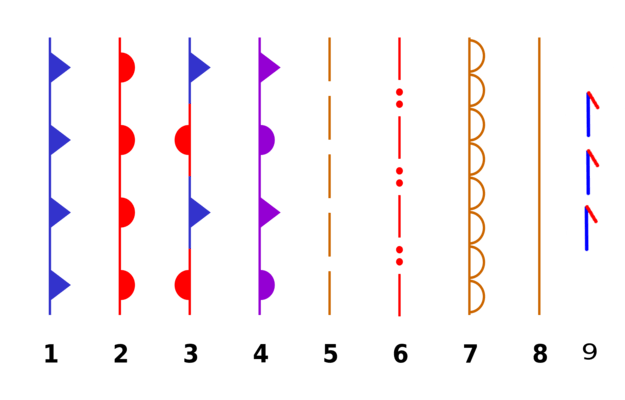
What does symbol # 3 mean?
a)
stationary front
b)
occluded front
c)
warm front
d)
cold front
64.
A front is
a)
where warm air is cooling at earth's surface
b)
a line where hot and cold air are separating
c)
a line where two different air masses meet
d)
where cold air is rising and forming rain clouds
65.
What symbol is this?
a)
warm front
b)
cold front
c)
stationary front
d)
occluded front
66.

What is weather?

a)

The amount of moisture in the air

b)

The number of clouds in the sky

c)

The speed of the wind

d)

The state of the atmosphere at any particular time.

67.

Match the following weather conditions with their characteristics.

a)

Wind and rain

1.

Low-pressure system

b)

Humidity and thunder

2.

Thunderstorm

c)

Extremely hot temperatures

3.

Heatwave

d)

Clear skies and sun

4.

High-pressure system

68.

If the air is only holding one-third as much moisture as it can possibly hold, what is the relative humidity?

a)

25 percent

b)

50 percent

c)

33 percent

d)

67 percent

69.

If the relative humidity is 100 percent, and the temperature begins falling, (a)   .

Choose from the below words
It will start to rain
The air will be sticky and uncomfor
The temperature will rise
The barometric pressure will rise
70.

This tool measures the wind speed: (a)  

Choose from the below words
barometer
anemometer
thermometer
psychrometer
71.
Someone who studies the weather.
a)
rain gauge
b)
taxonomists
c)
meterologist
d)
satellites
72.

What kind of weather would you expect in a low pressure system?

a)

Warm temperatures

b)

Cool temperatures

c)

Clear conditions

d)

Cloudy/rainy conditions

73.

The amount of water vapor present in the air is called (a)   .

Choose from the below words
weather
humidity
air mass
dew point
74.

Rain, snow, sleet, and hail are all forms of (a)   .

Choose from the below words
precipitation
condensation
evaporation
climate
75.

Match the following cloud types with their descriptions.

a)

Cumulus

1.

These clouds are fluffy and white with a flat base.

b)

Cirrus

2.

These clouds are thin and wispy, high in the sky.

c)

Stratus

3.

These clouds form in layers and cover the sky like a blanket.

d)

Cumulonimbus

4.

This is sometimes called a thunderhead cloud. It looks very tall like mountains and heavy rain comes from it.

76.

Warm air rises because it is (a)   dense than cold air.

Choose from the below words
More
Less
77.

Match the following weather tools with their functions.

a)

thermometer

1.

Measures temperature

b)

barometer

2.

Measures air pressure

c)

anemometer

3.

Measures wind speed

d)

psychrometer

4.

Measures humidity

78.
What does symbol # 3 mean?
a)
stationary front
b)
occluded front
c)
warm front
d)
cold front
79.
A front is
a)
where warm air is cooling at earth's surface
b)
a line where hot and cold air are separating
c)
a line where two different air masses meet
d)
where cold air is rising and forming rain clouds
80.
What symbol is this?
a)
warm front
b)
cold front
c)
stationary front
d)
occluded front
81.

What is the primary cause of wind?

a)

Earth's rotation

b)

Differences in air pressure

c)

Ocean currents

d)

Sun's radiation

82.

Which cloud type is typically associated with fair weather?

a)

Cumulus

b)

Stratus

c)

Nimbostratus

d)

Cirrostratus

83.

What instrument is used to measure humidity?

a)

Hygrometer

b)

Barometer

c)

Anemometer

d)

Thermometer

84.

What type of cloud is known for its thin, wispy appearance and is often seen high in the sky?

a)

Cumulus

b)

Cirrus

c)

Stratus

d)

Cumulonimbus

85.

Which weather phenomenon is characterized by a rapid drop in temperature and a sudden increase in wind speed?

a)

Cold front

b)

Heatwave

c)

Warm front

d)

Stationary front

86.

What is the term for the boundary where two different air masses meet?

a)

Isobar

b)

Jet stream

c)

Front

d)

Thermocline

87.

What type of precipitation occurs when rain falls through a layer of freezing air near the ground?

a)

Snow

b)

Sleet

c)

Freezing rain

d)

Hail

88.

Which instrument is used to measure atmospheric pressure?

a)

Thermometer

b)

Hygrometer

c)

Anemometer

d)

Barometer

89.

What is the term for a large body of air with uniform temperature and humidity?

a)

Thermocline

b)

Isotherm

c)

Jet stream

d)

Air mass

90.

What is the term for the process by which water vapor turns into liquid water?

a)

Evaporation

b)

Condensation

c)

Precipitation

d)

Sublimation

91.

Which layer of the atmosphere is closest to the Earth's surface?

a)

Thermosphere

b)

Stratosphere

c)

Mesosphere

d)

Troposphere