Wayground logo

Free Printable Worksheets

Font size

S
M
L
XL
Worksheets

Environmental Science MP2 Study Guide

Total questions: 93

Worksheet time: 3hrs 6mins

Name
Class
Date
1.
What are the 3 major types of rocks?
a)
Igneous, Metamorphic, Sedimentary
b)
Metamorphic, Igneous, Cementation
c)
Brown, Red, Gray
d)
Streak, Hardness, Breakage
2.
This rock formed when bits of other rocks became pressed into a solid. What type of rock is it?
a)
Sedimentary Rock
b)
Metamorphic Rock
c)
Igneous Rock
3.
This rock was formed when molten rock cooled into a solid. What type of rock is it?
a)
Igneous Rock
b)
Metamorphic Rock
c)
Sedimentary Rock
4.
When you watch a volcano erupt molten rock, you are seeing _____
a)
Lava
b)
Magma
c)
Mineral Crystals
d)
Igneous Rocks
5.
When sediments are pressed together tightly, this is called ____________.
a)
Compaction
b)
Cementation
c)
Weathering
d)
Erosion
6.
The process when rocks break into smaller pieces due to exposure to natural elements is called
a)
erosion
b)
weathering
c)
sediments
7.
The process by which igneous rocks are formed...
a)
heat and pressure
b)
melting and cooling
c)
weathering and erosion
8.
The process by which metamorphic rocks are formed...
a)
heat and pressure
b)
erosion and deposition
c)
melting and cooling
9.
_______ rock forms from magma/lava
a)
Metamorphic
b)
Sedimentary
c)
Igneous
10.
Sedimentary rocks may contain fossils.
a)
True
b)
False
11.

All water below the surface of land is called__________.

a)

water table

b)

watershed

c)

groundwater

d)

runoff

12.

Rapid growth of algae in a pond is often the result of -

a)

loss of habitat due to commercial building.

b)

flooding that causes water levels to rise.

c)

excess nutrients from fertilizer runoff.

d)

clogged river tributaries entering a lake.

13.
What is a watershed?
a)
Land that collects and channels water froma small body of water to a larger body of water
b)
the shape of the land determined by elevation
c)
A natural stream of water of considerable  volume
d)
a river and all its tributaries
14.

Erosion carries away soil from the land.

a)

True

b)

False

15.

What is a riparian buffer?

a)

A zone of vegetation around a waterway.

b)

A zone of concrete that channels a waterway to prevent flooding.

c)

A zone of pasture land where animals can contribute manure and other nutrients to the water.

d)

A zone of water inside a forest or grassland.

16.

Which of the following is a way in which vegetation supports a watershed?

a)

provides habitat & nutrients to animals

b)

slows runoff

c)

slowly releases water back into atmosphere

d)

speeds up erosion

e)

absorbs runoff and releases it back into the ground

17.

Buffer strips & riparian zones along waterways are beneficial to those waterways because:

a)

they trap and hold soil nutrients

b)

they filter possible contaminents

c)

they hold soil and prevent erosion

d)

they provide shade

e)

all of the above

18.

Newport News Park has a reservoir from where we get our drinking water. Why is it important to maintain the trees and plants around our reservoir?

a)

To keep humans from getting near the water.

b)

To help filter the pollutants from getting into the water.

c)

To provide a good supply of firewood for the campers.

d)

To provide a great place to hide your trash under the leaves.

19.
A(n) ____________ is a special type of scientific investigation that is performed under controlled conditions.
a)
experiment
b)
lab
c)
inquiry
d)
hypothesis
20.
An educated guess or possible answer to a question 
a)
data
b)
theory
c)
hypothesis
d)
fact
21.
In a proper experiment, how many variables should be changed at a time? 
a)
one
b)
none
c)
two or more
d)
how ever many makes sense.
22.
This variable in an experiment is the one being deliberately changed by the scientist. Think of it as the cause of change in the experiment.
a)
dependent variable
b)
independent variable
c)
data
d)
control group
23.

This variable is the data that is collected during the experiment. It is what is measured. If the independent variable is the cause, this is the effect.

a)

independent variable

b)

dependent variable

c)

control group

d)

data group

24.
An experiment is performed on plants to see how different liquids affect plant growth. Each plant in the experiment is given a different liquid; water, apple juice, or milk. Each plant is in the same type of pot and has the same amount of soil and sunlight. What is the independent variable?
a)
The type of plant
b)
The amount of sunlight
c)
The type of pot the plant is in
d)
The type of liquid the plant gets
25.
An experiment is performed on plants to see how different liquids affect plant growth. Each plant in the experiment is given a different liquid; water, apple juice, or milk. Each plant is in the same type of pot and has the same amount of soil and sunlight. What is the dependent variable?
a)
The growth of the plant
b)
Water, apple juice, milk
c)
Amount of sunlight
d)
Type of plant
26.
The summary at the end of an experiment that explains the results. 
a)
conclusion
b)
procedures
c)
materials
d)
variable
27.
This group does NOT get the change to the independent variable.  This is the group that is not actually experimented on and is used as a comparison to "normal". 
a)
experimental group
b)
control group
c)
data
d)
variables
28.

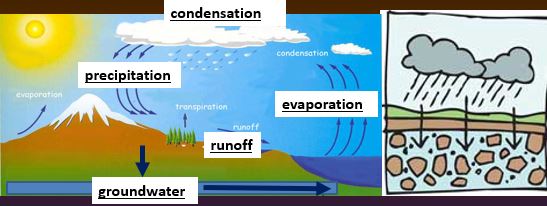
What process transforms the water vapor in the atmosphere to the liquid water in a cloud?

a)

evaporation

b)

infiltration

c)

precipitation

d)

transpiration

e)

condensation

29.

What process causes liquid water to evaporate from plant leaves and enter the atmosphere as water vapor?

a)

evaporation

b)

infiltration

c)

precipitation

d)

transpiration

e)

condensation

30.

Look at the diagram of the water cycle. When heat from the sun turns water into water vapor this is called:

a)

Evaporation

b)

Condensation

c)

Precipitation

d)

Runoff

31.

Rain, snow, sleet, hail are all types of:

a)

Evaporation

b)

Condensation

c)

Precipitation

d)

Runoff

32.

Water that flows over the land to streams, rivers, and lakes

a)

Evaporation

b)

Condensation

c)

Precipitation

d)

Runoff

33.

Water that is found underground in the cracks and spaces in soil, sand and rock is called:

a)

Groundwater

b)

River

c)

Surface water

d)

Snow

34.

A natural, underground area where large quantities of groundwater fill the spaces between rocks is a/an:

a)

ocean

b)

river

c)

aquifer

35.
What two elements make up water?
a)
Helium and oxygen
b)
Hydrogen and oxygen
c)
helium and carbon
d)
oxygen and carbon
36.
What word describes when water is attracted to other substances?
a)
cohesion
b)
adhesion
c)
capillary action
d)
surface tension
37.
When water molecules stick easily to other water molecules, this is called what?
a)
cohesion
b)
adhesion
c)
solution
d)
polar molecule
38.
Water beads up on the surface of a penny because of what property?
a)
Adhesion
b)
High Surface Tension
c)
Universal Solvent
d)
Changes in Density
39.
The fact that ice floats on liquid water is due to the fact that water's solid is ___________ than it's liquid form
a)
less polar
b)
more polar
c)
less dense
d)
more dense
40.
Which statement explains why water molecules stick together?
a)
both sides are negative
b)
one side has a positive charge and the other side has a negative charge
c)
one side has a negative charge adn the other side has a neutral charge
d)
both sides are positive
41.
Where is most of the freshwater found on Earth?
a)
lakes
b)
glaciers
c)
oceans
d)
rivers
42.
Approximately what percentage of Earth's water is SALT water?
a)
97 %
b)
71%
c)
30%
d)
3%
43.

Eutrophication is defined as a change that occurs to an aquatic ecosystem. This change is mainly due to what?

a)

Newly introduced fish

b)

Depletion of the ozone layer

c)

Increased nutrient concentration

d)

Increase in atmospheric carbon dioxide.

44.
The layer of atmosphere closest to the Earth is called the
a)
mesosphere
b)
stratosphere
c)
troposphere
d)
proctosphere
45.
Air in the atmosphere is 78%
a)
Einsteinium
b)
nitrogen
c)
oxygen
d)
carbon dioxide
46.
The ozone layer
a)
is green and purple
b)

absorbs dangerous solar ultraviolet radiation

c)
smells like sulphur
d)
is made of carbon dioxide
47.
The ozone layer occurs in the 
a)
troposphere
b)
thermosphere
c)
stratosphere
d)
exosphere
48.
The _________________ is the process by which gases in the atmosphere absorb and give off heat
a)
ozone layer
b)
greenhouse effect
c)
coriolis effect
d)
thermosphere
49.
Most of Earth's weather occurs in the 
a)
troposphere
b)
stratosphere
c)
mesophere
d)
thermosphere
50.
Look up pictures of the Aurora Borealis on google.  The Aurora Borealis occurs in the
a)
troposhere
b)
stratosphere
c)
mesosphere
d)
thermosphere
51.

Renewable energy resources produce less_____________ than fossil fuels in the atmosphere.

a)

carbon pollution

b)

energy

c)

wind

d)

light

52.
_____________ power is electricity produced by flowing water.
a)
Solar 
b)
Wind 
c)
Hydroelectric 
d)
water
53.
Wind Energy is...
a)
 Energy that comes from harnessing the movement of the air
b)
Energy that comes from the Sun
c)
A source of renewable energy, such as solar, wind, or geothermal energy
d)
Fuel from plant material
54.
Oil is a __________ energy resource.
a)
Renewable
b)
Nonrenewable
55.

Energy created from wood, peat moss, and manure is called __________________ energy.

a)

biomass

b)

geothermal

c)

natural

d)

solar

56.

Which type of energy produces Carbon Dioxide, which can be harmful to our planet and cause pollution?

a)

Solar Energy

b)

Wind Energy

c)

Fossil Fuels (Coal, oil, and gas)

d)

Nuclear Energy

57.
What is a disadvantage of wind power?
a)
We have too many rainy days in US
b)
It is not always windy in some places
c)
Companies charge too much to make the wind blow
d)
The sun is not always out
58.

Any significant change in measures of climate, such as temperature lasting for an extended period of a decade or longer.

a)

BIOTECHNOLOGY

b)

CLIMATE CHANGE

c)

CONVECTION

d)

COMPOST

59.

Energy from the sun.

a)

HYDRO & TIDAL POWER

b)

SOLAR ENERGY

c)

WIND ENERGY

d)

NUCLEAR ENERGY

60.

A resource that can be replaced when needed.

a)

Fossil Fuels

b)

Nonrenewable Energy

c)

Exhaustible Energy

d)

Renewable Energy

61.

What are the main fossil fuels?

a)

Coal

b)

Oil

c)

Natural Gas

d)

Nuclear Energy

62.

A disadvantage of nuclear energy is that it creates...

a)

fossil fuels

b)

hydroelectric

c)

radioactive waste

d)

biomass

63.

South America and Africa look to fit together like a puzzle

a)

does not support the theory of Pangaea

b)

does support the theory of Pangaea

64.

When a fossil of an animal is found on almost all continents, then it supports

a)

the idea of a traveling animal

b)

the idea of a connected original continent

c)

the idea of a flying animal

65.

In some areas of the world, like California and Japan, earthquakes are a common occurrence. How can this best be explained?

a)

The strong ocean currents are undermining both areas causing earthquakes.

b)

Both areas are located near the edge of the Pacific Ocean, the unstable sand causes earthquakes.

c)

Both areas are subjected to strong ocean wind and waves that causes earthquakes.

d)

Both areas are on the boundary of active plates, the motion of the plates causes earthquakes.
66.
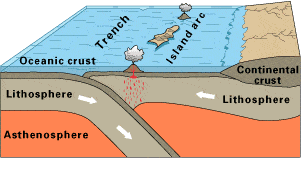
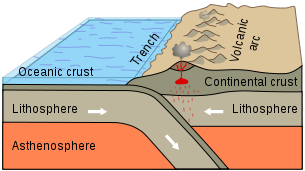
Subduction zones occur on Earth where dense oceanic crust dives under more buoyant continental crust. These boundaries are characterized by a deep ocean trench next to a high continental mountain range, large numbers of earthquakes and volcanoes. All of this is further evidence for the
a)
big bang theory.
b)
theory of plate tectonics.
c)
origin of the species.
d)
theory of natural selection.
67.

Observe this diagram of a plate boundary. One statement BEST describes what is happening. It is that

a)

the oceanic crust is melting.

b)

the denser ceanic crust is subducting under the less dense oceanic crust

c)

volcanic islands are forming.

d)

the tectonic plates are moving away from each other.
68.
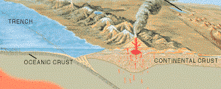
What geological forces might be responsible for this range of mountains?
a)
diverging tectonic plates
b)
erosion of the land by the ocean
c)
converging tectonic plates
d)
deposition of sediments by the ocean
69.

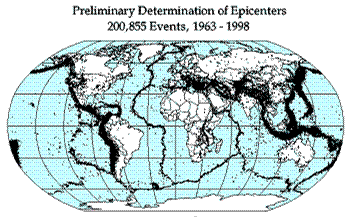
Earthquake epicenters (center of where the earthquakes started) were mapped for a 35 year period in the diagram above. The black dots indicate these epicenters. The black dots appear along what feature on Earth?

a)

hot spots

b)

plate boundaries

c)

rift zones

d)

sea floor spreading

70.
The Earth’s surface is not a solid surface but is divided into
a)
several oceanic plates.
b)
continental and crustal plates.
c)
seven continental plates.
d)
continental and oceanic plates.
71.

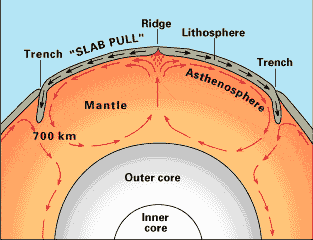
What is the source of energy that drives plate movement?

a)

the subducton of the sea floor

b)

the different densities of the oceanic and crustal plates

c)

convection currents in the asthenosphere

d)

the friction force between the plates that move past each other

72.
What are the two types of crust
a)
continental and oceanic
b)
ocean and upper
c)
lower and upper
d)
pizza and subway
73.

a)

divergent boundary

b)

convergent boundary

c)

transform boundary

74.

a)

divergent boundary

b)

convergent boundary

c)

transform boundary

75.

a)

divergent boundary

b)

convergent boundary

c)

transform boundary

76.

When oceanic and continental crust collide what feature would form?

a)

volcanic island arc

b)

folded mountain

c)

volcanoes on the continent

77.

Subduction means.....

a)

one plate goes under another plate

b)

two plates slide past each other

c)

two plate collide and form folded mountains

78.

Which two are likely to result from global warming?

a)

increase in surface temperatures

b)

reduction in greenhouse gases

c)

rise in ocean levels

d)

decrease in air pollution

79.

Which best explains how livestock farming contributes to global warming ? Animals __________

a)

waste pollutes the soil

b)

are consuming too much grass

c)

decayed matter emits too much carbon dioxide

d)

produce methane when they are digesting food

80.
Which human activity contributes the MOST carbon dioxide to the atmosphere?
a)
Fishing
b)
Breathing
c)
Burning Fossil Fuels
d)
Farming
81.

Possible human solutions for limiting global warming and climate change are...

a)

being more energy-efficient

b)

using renewable sources of energy

c)

removing carbon from fossil fuel emissions

d)

all of the above

82.

MAIN greenhouse gas responsible for Climate Change is:

a)

nitrogen

b)

carbon

c)

carbon dioxide

d)

methane

83.
The average temperature of the surface of Earth has increased approximately 1°C in the past century. Which reason best explains this increase in temperature?
a)
lower levels of ozone in the atmosphere
b)
lower levels of nitrogen in the atmosphere
c)
higher levels of carbon dioxide in the atmosphere
d)
higher levels of oxygen in the atmosphere
84.

How do scientist think that early atmosphere was probably formed?

a)

Gases from volcanoes

b)

Lava from volcanoes

c)

Gases released from bacteria

d)

They are unsure how it is formed

85.

What are micro-plastics?

a)

small plastic pieces less than five millimetres long which can be harmful to our ocean and aquatic life.

b)

small plastic pieces less than five centimetres long which can be harmful to our ocean and aquatic life.

c)

small plastic pieces less than five metres long which can be harmful to our ocean and aquatic life.

d)

small plastic pieces less than five kilometres long which can be harmful to our ocean and aquatic life.

86.

Our castaway plastic bags and plastic bottles get weakened by sunlight and then ............

a)

torn apart in the wind and the waves into small plastic bits.

b)

torn apart by sea animals into small plastic bits

c)

carried away to sea shores.

d)

eaten by small fish.

87.

What happens to plastic that has broken into smaller pieces?

a)

spread out in the ocean

b)

stay at the same spot in the ocean

c)

disappear after 1 year

d)

decomposed by microorganisms

88.

Where can we find micro-plastics?

a)

Arctic and Antarctic

b)

seafloor and sea surface

c)

only in the deepest sea

d)

everywhere in the ocean

89.
Which of these is a MAJOR cause of acid rain?
a)
spraying pesticides on crops
b)
burning fossil fuels for energy
c)
dumping sewage in river systems
d)
using uranium to generate electricity
90.
When harmful substances build up in the air to unhealthy levels, it is called
a)
Smog
b)
Primary pollutant
c)
Secondary pollutant
d)
Air pollution
91.

What part of an organism is most likely to become a fossil?

a)

heart

b)

bones

c)

skin

92.
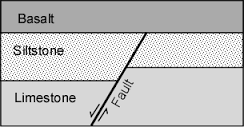
What are the relative ages of the features in order from oldest to youngest?
a)
Limestone, Basalt, Fault, Siltstone
b)
Siltstone, Fault, Basalt, Limestone
c)
Limestone, Fault, Basalt, Siltstone
d)
Limestone, Siltstone, Fault, Basalt
93.

Which layer is OLDER? Fault E or Intrusion D?

a)

Fault E

b)

Intrusion D