
 Worksheets
Unit 4: Meiosis and Genetics Review
Total questions: 51
Worksheet time: 57mins
An organism that has the same alleles for a trait (TT or tt)
An organism that has different alleles for a trait (Tt)
When neither allele is fully dominant; offspring is a mixture of both
the different forms of a trait (hair color--> brown, blonde, red
Which of the following is a homozygous recessive genotype?
Aa
aa
AA

What is a phenotype?
The physical trait that we see.
When an organism has two dominant alleles
A version of a gene
Two brown eyed parents (Bb) have a baby. What is the chance the baby is blue eyed? (HINT: Make a Punnett square)
0 %
25%
50%
75%
W=white hair w= non-white hair
If you cross a homozygous dominant horse (WW) with a homozygous recessive (ww) horse, what fraction of the offspring would be expected to have white hair?
none
3/4
1/2
all


T - tall and t = short In the punnett square below, which of the following genotypes is missing?
tt
Tt
Bb
TT

Solve the punnett square. What would be the genotypic ratio for this cross?
1 TT : 2 Tt: 1 tt
all tall
3 TT: 0 Tt: 1 tt
0 TT: 4 Tt: 0 tt
In fruit flies, eye color is a sex linked trait. Red (R) is dominant to white (r). What is the sex and eye color of a fly with the following genotype: X R X r ?
male with white eyes
female with red eyes
male with red eyes
female with white eyes
In fruit flies, eye color is a sex linked trait. Red (R) is dominant to white (r). What is the sex and eye color of a fly with the following genotype: X r Y ?
male with red eyes
female with red eyes
male with white eyes
female with white eyes
Create a punnett square for this P generation: XB XB x Xb Y
What proportion/percent of the male children are colorblind?
100%
75%
25%
0%
Males are more likely to suffer from a sex-linked disease or disorder because:
Males are the weaker sex
Males have less DNA
Males have one X chromosome, so the disorder is more likely to be expressed
During meiosis, cytokinesis is uneven in males.

In a pedigree, what does a filled/shaded in square represent? (Hint: affected means the person HAS the disease)
Unaffected female
Unaffected male
Affected male
Affected female


Objective #13
This is a pedigree that follows blue eyes which is a recessive trait. What is the genotype of the father (square) in generation 1?
Aa
AA
aa
A?

In a pedigree, what does an unshaded circle represent? (HINT: affected means the person HAS the disease).
Unaffected male
Unaffected female
Affected male
Affected female
In radishes, R = Red, r = white, and Rr = pink.
Cross a white radish with a pink radish. What is the phenotypic ratio of the offspring?
0 red: 4 pink: 0 white
1 red: 2 pink: 1 white
0 red: 2 pink: 2 white
1 red: 1 pink: 2 white
If a father is IAIA and a mother is IAIB, what is the probability for a child with AB blood?
If two parents have type AB blood, what is the probability that their child will have type O blood? (HINT: Create a punett square)
0%
25%
50%
100%
If a father is IAIA and a mother is IAIB, what is the probability for a child with AB blood type?
0%
25%
50%
75%
Laney is the universal donor, what blood type does she have?
O
AB
B
A

Which genotype belongs in box 3 of this dihybrid cross?
Aabb
AABB
AAbb
aaBb

Based off this dihybrid punnett square, what fraction of the offspring will have wrinkled, yellow seeds?
9/16
3/16
1/16
16/16
Based off this dihybrid punnett square, what fraction of the offspring will have wrinkled, green seeds?
9/16
3/16
1/16
16/16
Which of the following is one of the three big factors in increasing variety among sexually reproducing organisms?
Crossing over
Gene linkage
Mitosis
Oogenesis
Which option best describes the end results of the process of meiosis?
2, genetically identical haploid gametes
4, non-identical haploid gametes
4, genetically identical diploid cells
2, genetically identical diploid cells
What is crossing over?
When chromatids are separated during Anaphase II
The egg that is released each month and the sperm that reaches that egg are random
Refers to the randomness of assortment during Metaphase I
Pairs of homologous chromosomes exchange segments of DNA during Prophase I
How is oogenesis (meiosis in females) different than spermatogenesis (meiosis in males)?
Spermatogenesis produce four functional sperm while oogenesis produce only one functional egg
Spermatogenesis produce only one functional sperm while oogenesis produces four functional eggs.
Spermatogenesis produce four genetically identical sperm while oogenesis produces four genetically different eggs.
Spermatogenesis produces four genetically different sperm while oogenesis produces four genetically identical eggs.
An organism has 36 chromosomes in its somatic cells. What would be the correct haploid number in its gametes?
36
72
18
2
Before meiosis can occur, the DNA must be replicated/copied in which phase?
Interphase (S Phase)
Prophase I
Telophase I
Metaphase I
Crossing over occurs in what phase of Meiosis?
Prophase I
Prophase II
Metaphase I
Interphase
Homologous pairs (pairs of X's) line up in the middle of the cell in what phase of Meiosis?
Metaphase I
Metaphase II
Mitosis
Prophase II

What phase of Meiosis is the picture showing?
Metaphase I
Telophase I
Anaphase II
Telophase II

What phase of Meiosis is the picture showing?
Telophase I
Telophase II
Prophase I
Metaphase II

What phase is shown in the picture?
Prophase I
Prophase II
Telophase II
Anaphase I

What phase is in the picture?
Anaphase I
Anaphase II
Telophase I
Metaphase II

What phase is in the picture?
Metaphase I
Metaphase II
Prophase I
Prophase II

What phase is in the picture?
Prophase I
Prophase II
Telophase II
Metaphase I


Name this phase of meiosis.
Prophase I
Metaphase II
Metaphase I
Anaphase I

Name this phase of meiosis.
Metaphase II
Prophase I
Anaphase I
Metaphase I

What stage of meiosis is pictured here?
Prophase II
Metaphase I
Prophase I
Interphase

What stage of meiosis is pictured here?
Telophase II
Cytokinesis
Telophase I
Metaphase II

What stage of meiosis is pictured here?
Metaphase II
Telophase II
Prophase I
Prophase II

What stage of meiosis is pictured here?
Metaphase I
Metaphase II
Telophase I
Mitosis

What phase of meiosis is pictured here?
Prophase II
Telophase II
Metaphase I
Telophase I

What is the final result in meiosis?
Two new daughter cells with the exact same chromosomes.
Four new cells, each with half the chromosomes.
Four new cells, each with twice the chromosomes.
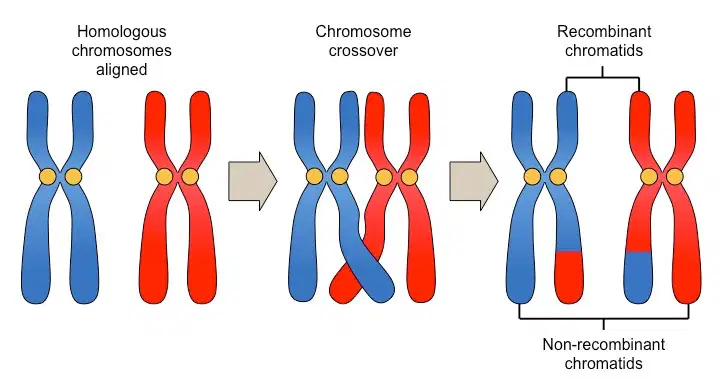
In Prophase I, crossing over occurs. What is the outcome of crossing over in terms of genetic material?
Identical genetic material in daughter cells
Exchange of genetic material between non-homologous chromosomes
Exchange of genetic material between homologous chromosomes
Exchange of genetic material between cells

