
 Worksheets
Water Cycle
Total questions: 37
Worksheet time: 37mins
What is not a stage in the water cycle?
Evaporation
Precipitation
Drizzle
Runoff
How does the water cycle begin?
Condensation
Runoff
Sublimation
Evaporation
Where can the cycle begin
Ocean
Sand
Mountain
Lake
What is needed for the water cycle?
Moon
Venus
Mars
Sun
Another name for the Water Cycle is the
Moisture Cycle
H2O Cycle
Hydrologic Cycle
Drenched Cycle
What is a run-off?
Where two or more main or independent clauses are joined without a word to connect them or a punctuation mark to separate them
A further competition after an inconclusive result
I forget
The movement of land water to the oceans
What is the water cycle
A bike made of water
The movement of water on, above, or below the surface of the Earth
Rain falling from clouds
Something we learn in Envi Sci

What part of the water cycle does this picture show?
condensation
precipitation
evaporation
transpiration

Which best explains why runoff is important?
It returns water to other locations on Earth
It increases the chance of flooding
It makes evaporation occur faster
It increases condensation
When water changes from a liquid to a solid it is known as...
melting.
condensation.
freezing.
evaporation.

When water changes from a liquid to a gas in plants it is called...
condensation.
evaporation.
sublimation.
transpiration.
As a part of the water cycle, water from Earth's surface enters the clouds and finally falls back to the ground in the form of rain. What is the correct sequence of processes water undergoes in this example?
Evaporation, Condensation, Precipitation
Precipitation, Condensation, Evaporation
Condensation, Evaporation, Precipitation
Evaporation, Precipitation, Condensation

What is another name or synonym for the water cycle?
Geologic cycle
Hydrologic cycle
Geosphere
Carbon cycle
On Earth, what process generates most of the water vapor?
Condensation
Evaporation
Precipitation
Transpiration
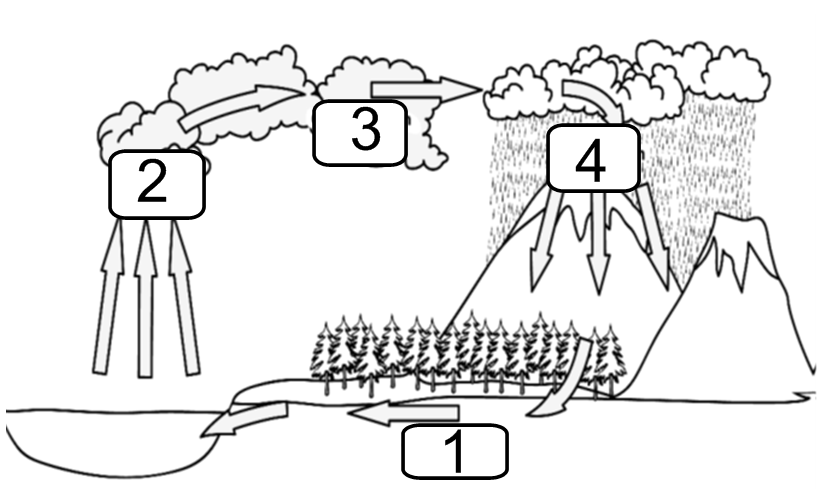


What is it called?
2.Groundwater
2. The remains of the water is soaked into the ground.
2. Transpiration happens to the plants.
2. Evaporation

According to this diagram, what are two methods by which water on land (in lakes and streams) returns to the oceans? (Select TWO answers)
Surface runoff
Groundwater
Evaporation
Precipitation
According to this diagram, what are two methods by which water is converted to vapor? (Select TWO answers)
Condensation
Transpiration
Evaporation
Precipitation
Precipitation might contribute to the addition of pollutants to rivers, lakes, and oceans because...
it carries pollutants from the atmosphere into bodies of water
it collects any pollutants that are in or on the ground in the water supply
Runoff might contribute to the addition of pollutants to rivers, lakes, and oceans because...
it carries pollutants from the atmosphere into bodies of water
it collects any pollutants that are in or on the ground in the water supply
Which of the processes associated with the water cycle might be responsible for helping to clean or filter the water? (Select TWO answers)
Infiltration (also called percolation)
Transpiration
Precipitation
Runoff

