wayground logo

Free Printable Worksheets

NEW

Font size

S
M
L
XL
Worksheets

Earth Science Unit Review

Total questions: 62

Worksheet time: 5hrs 40mins

Name
Class
Date
1.

1. The Himalayan Mountains are some of the highest

mountain peaks in the world. They are located

in the northeast portion of India. They

are at the plate boundary between the Indo-Australian Plate and the Eurasian

Plate. These mountains are the are a

result of which type of boundary?

a)

A divergent plate boundary

b)

A transform fault

c)

A subduction zone

d)

A convergent plate boundary

2.

The surface of the Earth is made of several tectonic plates that move at a very slow rate. What causes the plates to move?

a)

explosions within the

Earth's mantle

b)

convection currents within the Earth's mantle

c)

expansion of the

Earth's core pushing on the tectonic plates

d)

contraction of the Earth's core pulling on the tectonic plates
3.
What happens to pressure as we move from the crust to the inner core?
a)
Pressure Decreases
b)
Pressure Increases
c)
Nothing
4.
What happens to pressure as we move from the crust to the inner core?
a)
Pressure Decreases
b)
Pressure Increases
c)
Nothing
5.
What happens to temperature as we move from the crust to the inner core?
a)
Decreases
b)
Increases
6.
This layer of Earth is solid Iron and Nickel
a)
Outer Core
b)
Mantle
c)
Inner Core
d)
Crust
7.
What are the two types of crust
a)
continental and oceanic
b)
ocean and upper
c)
lower and upper
d)
pizza and subway
8.
Which layer of the earth has the lowest temperature?
a)
Crust
b)
Mantle
c)
Outer Core
d)
Inner Core
9.
Which layer of the earth is under the highest pressure?
a)
Crust
b)
Mantle
c)
Outer Core
d)
Inner Core
10.
Heat transfer within a fluid takes place by...
a)
convection currents
b)
radiation
c)
conduction
d)
density
11.
Earth's magnetic field results from movements in the
a)
mantle
b)
outer core
c)
inner core
d)
crust
12.
A deep well or mine shaft goes through which layer or layers of Earth?
a)
crust only
b)
mantle only
c)
crust and mantle
d)
mantle and core
13.
Geologists' main evidence about the structure of Earth's interior comes from
a)
temperature measurements in deep mines
b)
observations of other planets
c)
exploration of caves
d)
rock samples and seismic waves
14.
What kind of heat transfer happens when the sun is heating your body?
a)
Conduction
b)
Radiation
c)
Convection
d)
Density
15.
Ironing a shirt is an example of...
a)
condensation
b)
conduction
c)
convection
d)
radiation
16.
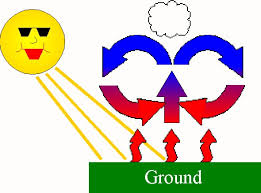
Warm air rises and the cool air sinks demonstrates this type of heat transfer. 
a)
conduction
b)
convection
c)
radiation
d)
Insolation 
17.
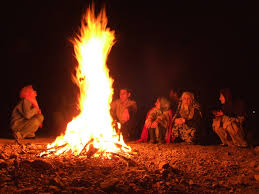
A group of friends gather around a fire to stay warm.
a)
conduction
b)
convection
c)
radiation
18.
What two specific continents fit together most noticeably?
a)
Africa and North America
b)
South America and Europe
c)
South America and Africa
d)
 Antartica and Africa
19.
What must happen in order for a metamorphic rock to be transformed into an igneous rock?
a)
It must be compressed by high temperatures and pressure within Earth's crust
b)
It must be soaked in water until it dissolves and reforms in a different shape
c)
It must be pulled under Earth's crust, melted, and forced out above the crust to cool
d)
It must be weathered into sand grains and compressed into multiple layers
20.
In some places, timber companies remove all the trees from entire hillsides when they are harvesting logs, and farmers till the soil in the fall and leave the ground bare of plants until it is time to plant in spring. What is the most likely effect of doing either of these things?
a)
plants will sprount better
b)
erosion will happen faster
c)
soil will stay cooler
d)
decompostion will speed up
21.
Gravity, water, wind, and heat can all contribute to erosion. Which of the following natural landforms are primarily formed by wind erosion?
a)
deep river canyons
b)
desert sand dunes
c)
mudslides
d)
sinkholes
22.
Weathering is the division and separation of particles by both mechanical and chemical forces. What is an example of a mechanical force in nature that could cause weathering in rocks?
a)
rapid temperature change
b)
mining operations
c)
acid rain
d)
passage of time
23.
The processes involved in the rock cycle take place over millions of years. Which of the following describes a phase of the rock cycle that takes longer to produce results?
a)
rocks are eroded by wind and rain
b)
eroded rocks travel by wind or moving water
c)
rocks from layers of sedimenta nd solidfy into new rocks
d)
Rocks are pushed to Earths surface by tectonic forces
24.

Why is it most likely that fossils will be found in sedimentary rock rather than igneous or metamorphic rock?

a)

Molten sedimentary

rock burns up living organisms and fossilizes them as it cools.

b)

Animals can dig into

sedimentary rock, and some are trapped inside and fossilize.

c)

Sedimentary rock breaks apart most easily, so fossils inside are seen more often

d)

Organisms can get trapped and fossilize as the layers of sedimentary rock form

25.

He found one fossil embedded in the rock near the top of the outcrop and another embedded in the rock almost at the bottom of the outcrop. What do their positions tell him about the two fossils?

a)

The lower fossil is older than the upper fossil

b)

The upper fossil is older than the lower fossil

c)

The upper fossil must be that of a climbing animal

d)

The lower fossil must have washed down from the top

26.

With the use of satellites, we are able to measure the exact heights of landforms such as mountains. Scientists have discovered that mountains in the Himalayas get taller by several centimeters each year. What is causing this?

a)

The continued force of two tectonic plates colliding pushes the mountains higher each year.

b)

Large amounts of sediment get blown to the tops of the mountains each year

c)

The volcanoes in the mountains add layers of lava each year when they erupt

d)

Underground roots from continued tree growth at the mountain base increases their height over time

27.

The Earth is made up of several large, slow-moving tectonic plates that sometimes cause earthquakes. Which layer of the Earth contains these large plates?

a)

lithosphere

b)

mantle

c)

molten core

d)

solid core

28.
Which layer of Earth is the thinnest? 
a)
Crust
b)
Mantle
c)
Inner Core
d)
Outer Core
29.
What is the name of the layer that contains the uppermost mantle and crust
a)
Asthenosphere
b)
Mesosphere
c)
Lithosphere
d)
Transosphere
30.
This layer of Earth is solid Iron and Nickel
a)
Outer Core
b)
Mantle
c)
Inner Core
d)
Crust
31.
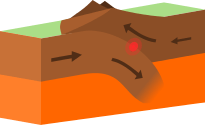
What type of event will occur at this boundary?
a)
Earthquake
b)
Volcano Eruption
c)
Tornado
d)
Mountain Building
32.
What type of plate boundary is this?
a)
Plate
b)
Divergent
c)
Convergent
d)
Transform
33.
How does growth in the soil affect the rate of erosion?
a)
It doesn't affect erosion.
b)
It decreases erosion.
c)
It increases erosion.
34.
What is the main cause of weathering and erosion to make a canyons?
a)
wind
b)
ice
c)
glaciers
d)
moving water
35.
What happens when weathering and erosion work together?
a)
New Mountains are formed
b)
The climate changes overtime
c)
Metal pieces become rusty
d)
They change the Earth's surface
36.
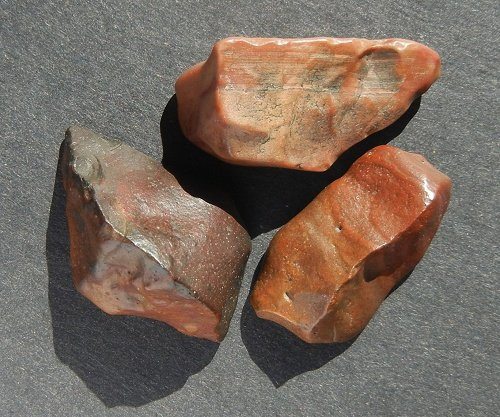
These rocks were made smooth by wind blowing smaller rock particles across their surface.  This is an example of:
a)
ice wedging
b)
chemical weathering
c)
acid rain
d)
abrasion
37.
The process by which water, ice, wind or gravity moves weathered rock and soil from one place to another.
a)
weathering
b)
erosion
c)
deposition
d)
dumptruck
38.
The natural chemical or physical processes that breaks down rock on Earth's surface.
a)
weathering
b)
erosion
c)
deposition
d)
jackhammering
39.

The surface of the Earth is made of several tectonic plates that move at a very slow rate. What causes the plates to move?

a)

explosions within the

Earth's mantle

b)

convection currents within the Earth's mantle

c)

expansion of the

Earth's core pushing on the tectonic plates

d)

contraction of the Earth's core pulling on the tectonic plates
40.

The Earth is made up of several different layers, and each layer has different properties. Which layer of the Earth is the least dense?

a)

the mantle

b)

the crust

c)

the molten core

d)

the solid core

41.

The tectonic plates that make up the surface of the Earth slowly move and interact with each other. Which of the following is NOT a result of tectonic plates moving on the surface of the Earth?

a)

earthquakes

b)

volcanoes

c)

mountain ranges

d)

erosion

42.

In some places on Earth, large tectonic plates are moving toward each other and collide with great force. One such place is where the Indian plate and the Eurasian plate meet. What type of formation might occur where two tectonic plates collide?

a)

a canyon

b)

a rift valley

c)

a mountain range

d)

an eartquake

43.
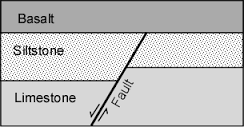
What are the relative ages of the features in order from oldest to youngest?
a)
Limestone, Basalt, Fault, Siltstone
b)
Siltstone, Fault, Basalt, Limestone
c)
Limestone, Fault, Basalt, Siltstone
d)
Limestone, Siltstone, Fault, Basalt
44.
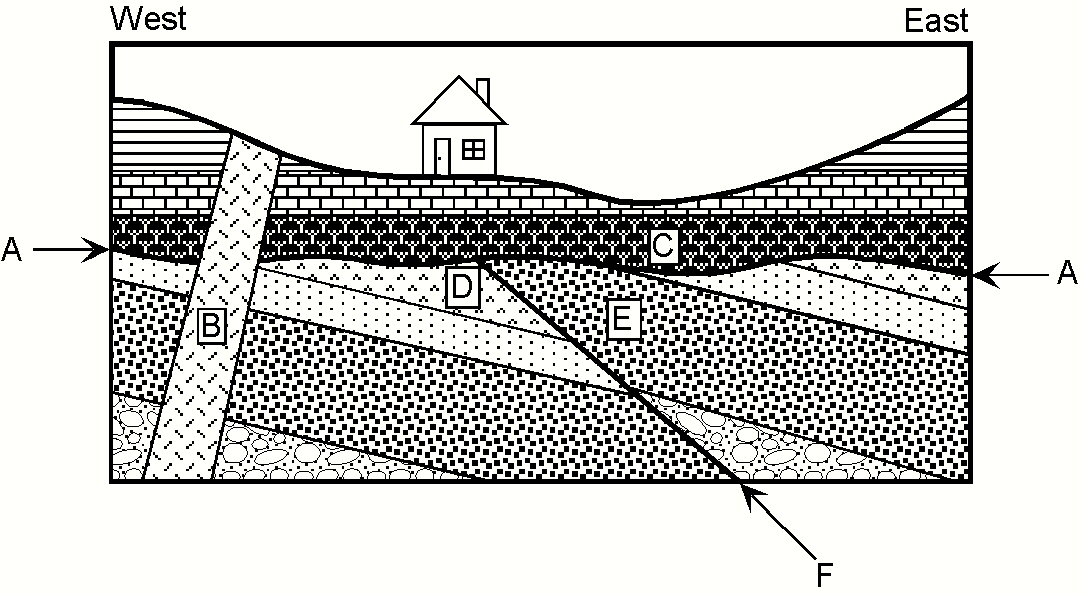
Letter "F" is a....
a)
inclusion
b)
intrusion
c)
fault
d)
unconformity 
45.
Relative age dating is used to determine the...
a)
actual age of an event
b)
length of time between two events
c)
age of one event in comparison with other events
d)
rate at which a gologic process occurs
46.
The Principle of Cross-Cutting Relationships states that an igneous intrusion is 
a)
always younger than the layers it cuts across
b)
always older than the layers it cuts across
c)
the same age as the rock it melted
d)
none of the answers are correct
47.
The statement that the oldest layer will be at the bottom in an undisturbed sequence of rock layers is called the Principle of ....
a)
Inclusions
b)
Unconformities
c)
Cross-Cutting Relationships
d)
Superposition
48.
The length of time required for half of the radioactive atoms in a sample to decay is its...
a)
era
b)
age
c)
half-life
d)
eon
49.
The diagram shows fossils in different rock layers. Which of these statements about the age of these fossils is most likely correct?
a)
Fossil A and C are the same age
b)
Fossil B is older than fossil C
c)
Fossils A is older than fossil B
d)
Fossil D is older than fossil C
50.
Which of the following correctly lists the layers in order from oldest to youngest?
a)
A, B, C, D, E
b)
E, B, C, D, A
c)
E, D, C, B, A
d)
C, B, A, D, E
51.
Relative age dating is used to determine the...
a)
actual age of an event
b)
length of time between two events
c)
age of one event in comparison with other events
d)
rate at which a gologic process occurs
52.

Based on the law of superposition, what is the order of these rock layers, from oldest to youngest?

a)

1, 2, 3, 4

b)

2, 1, 4, 3

c)

3, 2, 1, 4

d)

4, 3, 2, 1

53.
The three groups of rocks are classified by
a)
How they form
b)
Color
c)
Grain size
d)
Chemical Composition
54.

With the use of satellites, we are able to measure the exact heights of landforms such as mountains. Scientists have discovered that mountains in the Himalayas get taller by several centimeters each year. What is causing this?

a)

The continued force of two tectonic plates colliding pushes the mountains higher each year.

b)

Large amounts of sediment get blown to the tops of the mountains each year

c)

The volcanoes in the mountains add layers of lava each year when they erupt

d)

Underground roots from continued tree growth at the mountain base increases their height over time

55.

He found one fossil embedded in the rock near the top of the outcrop and another embedded in the rock almost at the bottom of the outcrop. What do their positions tell him about the two fossils?

a)

The lower fossil is older than the upper fossil

b)

The upper fossil is older than the lower fossil

c)

The upper fossil must be that of a climbing animal

d)

The lower fossil must have washed down from the top

56.
The processes involved in the rock cycle take place over millions of years. Which of the following describes a phase of the rock cycle that takes longer to produce results?
a)
rocks are eroded by wind and rain
b)
eroded rocks travel by wind or moving water
c)
rocks from layers of sedimenta nd solidfy into new rocks
d)
Rocks are pushed to Earths surface by tectonic forces
57.
What must happen in order for a metamorphic rock to be transformed into an igneous rock?
a)
It must be compressed by high temperatures and pressure within Earth's crust
b)
It must be soaked in water until it dissolves and reforms in a different shape
c)
It must be pulled under Earth's crust, melted, and forced out above the crust to cool
d)
It must be weathered into sand grains and compressed into multiple layers
58.
What type of rock do fossils form in?
a)
Igneous
b)
Sedimentary
c)
Metamorphic
d)
Classic
59.
The Law of Superposition helps scientists to determine what?
a)
The absolute age of rock layers
b)
The age of fossils
c)
The relative age of rock layers
d)
the super powers of rocks
60.

The fossil record shows part of the history of life on Earth and can tell scientists about environmental changes over time. Which of the following statements explains what fossils of palm fronds found in Antarctica tell us about what the climate was once like?

a)

Palm fronds indicate an aquatic environment was once present

b)

Palm fronds indicate a period of drought once existed

c)

Palm fronds indicate a tropical climate was once present

d)

Palm fronds indicates Antarctica has always had a polar climate

61.
Mountains are created when....
a)
Two continental plates collide
b)
Two oceanic plates pull apart
c)
An Oceanic plate subducts under a Continental Plate
d)
Two continental plates pull apart
62.
How is it possible for new crust to be formed without increasing the surface area of the Earth?
a)
Crust is destroyed at the same time it is created
b)
New crust is underwater where it sinks
c)
New crust breaks more easily than old crust