wayground logo

Free Printable Worksheets

Font size

S
M
L
XL
Worksheets

Fossils and Relative Age Quiz

Total questions: 45

Worksheet time: 4hrs 45mins
Name
Class
Date
1.
Relative age is different from absolute age because
a)
relative age compares rock with surrounding rock while absolute age is how many years since the rock was formed
b)
relative aging is more accurate than absolute aging
c)
absolute age compares rock with surrounding rock while relative age is how many years since the rock was formed.
d)
Relative age is used to determine rock age and absolute age is used to determine age of fossils
2.
The Law of Superposition helps scientists to determine what?
a)
The absolute age of rock layers
b)
The age of fossils
c)
The relative age of rock layers
d)
the super powers of rocks
3.
According to the law of superposition, the oldest fossils are found 
a)
At the top of the rock layers
b)
Near the bottom of the rock layers
c)
In the middle of the rock layers
d)
Somewhat near the surface
4.
The rock formation labeled "P" is a(n)...
a)
fault
b)
intrusion
c)
inclusion
d)
unconformity
5.
In this rock layer diagram there are two unconformities, a fault at E and an intrusion at D. Which unconformity occurred first?  How do you know?
a)

Intrusion D occurred first because the intrusion has been moved by the fault.

b)
The fault occurred first because it has moved the intrusion D.
c)
Intrusion D occurred first because it can be seen in all of the rock layers.
d)
Fault E occurred first because it is a normal fault.
6.
An archaeologist made the following diagram of a dig site. What can be said about the pottery as compared to the skull found in the site?
a)
The rock layer with the pottery is more recent than the rock layer with the skull.
b)
The rock layer with the skull is more recent than the rock layer with the pottery.
c)
The rock layer with the skull is approximately the same age as the rock layer with the pottery.
d)
The rock layer with the skull has an absolute date of 17,000 years.
7.
The age of a rock compared to the ages of other rocks is the rock's
a)
absolute age
b)
geologic age
c)
sedimentary age
d)
relative age
8.
The number of years that have passed since the rock formed is the rock's
a)
relative age
b)
law of superposition
c)
absolute age
d)
index fossil
9.

Trilobites are good __________ fossils because they were abundant, unique, lived only a short period of time, and widespread geographically.

a)

mold/cast

b)
index
c)
preserved
d)

carbonized

10.
Based on the Law of Superposition, what can be concluded about fossils?
a)
fossils give clues about past climate patterns
b)
Fossils form from the hard parts of organisms
c)
The oldest fossils are found in the lowest rock layers
d)
The most recent fossils were advanced organisms
11.
An intrusion will made up of what type of rock?
a)
Sedimentary
b)
Igneous
c)
Metamorphic
d)
Clastic
12.
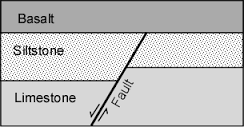
What are the relative ages of the features in order from oldest to youngest?
a)
Limestone, Basalt, Fault, Siltstone
b)
Siltstone, Fault, Basalt, Limestone
c)
Limestone, Fault, Basalt, Siltstone
d)
Limestone, Siltstone, Fault, Basalt
13.
Gaps in rock layers caused by erosion are called
a)
law of superposition
b)
unconformities
c)
uniformitarianism
d)
relative dating
14.
Which would be best for determining the age of dinosaurs?
a)
Uranium-234
b)
Lead-214
c)
Polonium-214
d)
Thorium-230
15.
What percent of the original C-14 is left after 11,480 years.
a)
1
b)
1/2
c)
1/4
d)
1/8
16.

The theory that undisturbed layers of rock have the oldest layers on the bottom and the youngest on the top is called ______

a)

fossil record

b)

rock cycle

c)

law of superposition

d)

stratum

17.
This type of fossil forms when sediments bury an organism and then sediments change into rock; the organism decays leaving a cavity in the shape of the organism.
a)
mold
b)
cast
c)
petrified
d)
trace
18.
This type of fossil forms when a mold is filled with sand or mud that hardens into the shape of the organism.
a)
mold
b)
cast
c)
trace
d)
preserved
19.
This type of fossil forms when minerals soak into the buried remains, replacing the remains, and changing them into rock.
a)
mold
b)
cast
c)
petrified
d)
preserved
20.
This type of fossil forms when organisms or parts, like leaves, stems, flowers, fish, are pressed between layers of soft mud or clay that hardens squeezing almost all the decaying organism away leaving the carbon imprint in the rock.
a)
trace
b)
preserved or original remains
c)
carbonized or carbon film
d)
permineralized or petrified
21.
This type of fossil forms when entire organisms or parts of organisms are prevented from decaying by being trapped in rock, ice, tar, or amber.
a)
trace
b)
preserved or original remains
c)
carbonized or carbon film
d)
index
22.
This type of fossil forms when the mud or sand hardens to stone where a footprint, trail, or burrow of an organism was left behind. 
a)
carbonized or carbon film
b)
trace
c)
permineralized or petrified
d)
mold
23.
By studying fossil records scientists can make inferences about 
a)
the diversity of plants and animals, past climates and geological events, and how organisms have evolved
b)
the diversity of plants and animals, how different rocks form, and past volcanic eruptions
c)

the similarities of plants and animals, how different rocks form and past volcanic eruptions

d)
the similarities of plants and animals, past climates and geological events, how different rocks form
24.
A geologist hiking through the woods in Ohio finds rocks containing fossils in a stream bank. The fossils look similar to animals currently living in the ocean. Which conclusion should the geologist make based on the discovery of these fossils?
a)
Fossils washed upstream from the ocean
b)
Animals that live in the stream today lived in the ocean long ago.
c)
The area of the woods and stream was an ocean long ago.
d)
The area with the stream will become part of the ocean in the future.
25.
Which best describes fossils?
a)
They are the preserved remains or evidence of ancient living things
b)
They are the preserved remains or evidence of ancient living and nonliving things
c)
They are the preserved bones of ancient animals
d)
They are impressions of plant leaves in ancient rocks
26.
Which animal part would MOST LIKELY form a fossil?
a)
fur
b)
lung
c)
bone
d)
muscle
27.
This is petrified wood - a fossil of a tree where the original materials were replaced by silica minerals. What type of fossil is most likely shown in this picture?
a)
Permineralized or petrified
b)
Cast Fossil
c)
Preserved or original Remains
d)
Carbonized or carbon film
28.
Which type of fossil can tell you about the BEHAVIOR of ancient organisms?  (ex. how they hunted, what kind of home they created, etc.)
a)
mold fossil
b)
cast fossil
c)
trace fossil
d)
preserved or original remains
29.
Most fossils are found in sedimentary rock and not igneous or metamorphic because
a)
fossils form at the surface where plants and animals live.
b)
the processes that create igneous and metamorphic rocks, intense heat and pressure would destroy the fossils.
c)
animals and plants don't live near volcanoes
30.

These fossils are distinguishable from other fossils because they were scattered over a large region, very common, and lived during a short span of geologic time. They also help geologists date a particular layer of rock or other fossils found in a similar layer.

a)

trace

b)

index

c)

permineralized

d)

mold and cast

31.
This type of fossil is formed from dung or waste materials and allows scientists to infer the feeding habits of ancient animals.
a)
gastroliths
b)
coprolites
c)
halites
d)
chemo-synthesis
32.
The Burgess Shale fossils were important because
a)
they are the first to show a large variety of species
b)
they were sandwiched between layers of volcanic ash
c)
they were found by Charles Walcott
d)
they were well preserved
33.
The Laetoli footprints were important because
a)
archaeologist
b)
they traveled bipedal and in groups
c)
they were formed from an ancient mud slide
d)
they were trace fossils
34.
Hardened tree sap is called
a)
diamonds
b)
amber
c)
tar
d)
syrup
35.
This type of scientist finds, preserves, and interprets fossils remains.
a)
archeologist
b)
paleontologist
c)
geologist
d)
anthropologist
36.
Remains of animals can be preserved by preventing them from decaying. What substances might help preserve parts or a whole animal
a)
tar, amber, ice
b)
ice, carbonization, trace
c)
rock, amber, ice
d)
tar, carbonization, rock
37.
Shells and skeletons are typically fossilized in this fashion.
a)
mold and cast
b)
trace
c)
carbonized or carbon film
d)
permineralized or petrified
38.

A mosquito caught in amber is an example of

a)

petrified rock

b)

preserved fossil

c)

trace fossil

d)

cast fossil

39.

Intrustions are______________ than the layers they go through. (red is the intrusion in the picture)

a)

older

b)

same age

c)

younger

40.

The difference between a cast and mold is the the mold is _______

a)

empty cavity

b)

made of rock only

c)

a trace fossil

d)

an index fossil

41.
Which layer is oldest?
a)
A
b)
W
c)
G
d)
Z
42.

What are the two key requirements for fossilization? Click 2 choices

a)

Sun

b)

Burial

c)

Hard Parts

d)

Soft Tissue

43.

Why do fossils need hard parts instead of soft parts?

a)

The soft parts decompose faster

b)

They are easier to hide from scavengers

44.

Why do fossils needs to be buried?

a)

To keep them from getting too hot.

b)

To protect them from oxygen, bacteria, and scavengers

45.

Which fossil is the oldest?

a)

Gastropod

b)

Ammonite

c)

Crinoid

d)

Trilobite