wayground logo

Free Printable Worksheets

Font size

S
M
L
XL
Worksheets

Savvas Earth Unit 9 test review

Total questions: 97

Worksheet time: 2hrs 55mins

Name
Class
Date
1.

Draw an arrow showing the Gulf Stream's location and direction of flow. Use red if it is a warm water current. Use blue if it is a cold water current.

2.
Deep Ocean currents are a result of
a)
Global Wind Patterns
b)
Earth's Rotation
c)
Density
d)
All of the above
3.
Due to the Coriolis Effect, water in the northern hemisphere moves
a)
clockwise
b)
counter clockwise
c)
both
d)
neither
4.
Two types of water currents are
a)
local and global
b)
sea and land
c)
surface and deep
d)
warm and cold
5.
A horizontal movement of ocean water that is caused by wind and that occurs at or near the ocean's surface.
a)
Gulf Stream
b)
Global Conveyor Belt
c)
Surface Current
d)
Gyre
6.
The large, circular surface-current pattern found in each ocean.
a)
California Current
b)
Surface Current
c)
Gyre
d)
Global Conveyor Belt
7.
As you go deeper in the ocean, the water is colder and less salty.
a)
True
b)
False
8.
Ocean water is more dense than fresh water at the same temperature due to differences in:  
a)
Wind patterns
b)
 Lifeforms
c)
Currents
d)
Salinity
9.
What causes vertical ocean currents?
a)
The phase of the moon.
b)
The gravitational attraction of the sun
c)
Commercial boating activities.
d)
The temperature and salinity of ocean water
10.
Where is ocean water the densest.
a)
The surface
b)
The middle
c)
The bottom
d)
Lake Michigan
11.
Movements of ocean water in a continuous flow are called?
a)
ocean currents
b)
global winds
c)
air mass
d)
front
12.
Currents that occur at or near the surface of the ocean are called 
a)
Deep Currents
b)
Convection Currents
c)
Surface Currents
d)
Wave Currents
13.
Surface currents are mainly caused by
a)
The Coriolis Effect
b)
Cold and Warm Water
c)
Convection
d)
Wind
14.
Regular movements of water far below the oceans surface are called
a)
Warm Currents
b)
Deep Currents
c)
Shallow Currents
d)
Surface Currents
15.

______ causes surface currents.

a)

The Coriolis Effect

b)

gravity

c)

density differences

d)

wind

16.

______ causes deep ocean currents

a)

The Coriolis Effect

b)

gravity

c)

wind

d)

density differences

17.

Gyres in the southern hemisphere are surface currents that turn _________ due to the Coriolis Effect.

a)

clockwise

b)

counterclockwise

c)

toward the right

d)

toward the bottom of the ocean

18.

Salinity is

a)

The salt content of a substance

b)

The Pepper content of a substance

c)

The circulation of hot and cold matter

d)

the weather pattern of a region

19.

The movement of deep, cold, nutrient filled water to the surface of the ocean is..

a)

Ocean Current

b)

Upwelling

c)

Deep Currents

d)

Surface Currents

20.

What affects the density of water?

a)

Salt

b)

Temperature

c)

The seasons of the year

d)

Both A and B

21.

Why is upwelling important?

a)

Upwelling regulates ocean temperature

b)

Upwelling provides nutrient rich water that sustains life

c)

Upwelling controls the tides

d)

Upwelling helps sailors to navigate the seas

22.
Why are surface currents at the surface of the ocean?
a)
colder temperature
b)
colder temperature & more salinty
c)
warmer temperature & less salinty
d)
less salinty
23.
Where is ocean water the densest.
a)
The surface
b)
The middle
c)
The bottom
d)
Lake Michigan
24.
Regular movements of water far below the oceans surface are called
a)
Warm Currents
b)
Deep Currents
c)
Shallow Currents
d)
Surface Currents
25.
Ocean currents bring warm water from the equator towards Earth's
a)
Southern Hemisphere
b)
Continents
c)
Equator
d)
Poles
26.
What causes surface currents north and south of the equator to move in different directions? 
a)
Gases in the ocean
b)
The rotation of the Earth
c)
Temperature differences
d)
Continental deflection
27.

________ and _______ affect the ocean's density and cause the Global Conveyor Belt to travel

a)

gravity and the Coriolis Effect

b)

temperature and salinity

c)

wind and climate

d)

temperature and the Coriolis Effect

28.

The more scientific name of the Global Conveyor Belt is _____.

a)

halinethermal circulation

b)

thermohaline circulation

c)

thermodensity circulation

29.

Ocean currents affect climates around the world. Based on the map, which area MOST likely has a warmer climate than expected?

a)

1

b)

2

c)

3

d)

4

30.

Surface currents are a result of

a)

Global Wind Patterns

b)

Earth's Rotation

c)

Density

d)

All of the above

31.

Deep Ocean currents are a result of

a)

Global Wind Patterns

b)

Earth's Rotation

c)

Density

d)

All of the above

32.

The Coriolis Effect is caused by

a)

Earth rotating around the sun

b)

Earth rotating on its axis

c)

The tides

d)

Gravity

33.

The Gulf stream carries _____________ water from the east coast of The United States to the West coast of Europe.

a)

Cold

b)

Warm

c)

Freezing

d)

Fresh

34.

Due to the Coriolis Effect, water in the northern hemisphere moves

a)

clockwise

b)

counter clockwise

c)

both

d)

neither

35.

What are a circular system of currents in the Earth's major oceans?

a)

ocean current

b)

gyre

c)

upwelling

d)

conveyor belt

36.

Constantly moving system of deep-ocean circulation driven by temperature and salinity. It moves water around the globe.

a)

California Current

b)

Global Conveyor Belt

c)

Surface Currents

d)

Gulf Stream

37.

When surface currents meet continents they ___?

a)

Stop moving

b)

Are deflected (change paths)

c)

Continue in the direction they were going

38.
Blow drying your wet hair.
a)
conduction
b)
convection
c)
radiation
39.
Why does warm air rise?
a)
Warm air is more dense than cooler air.
b)
Warm air has more pressure than cooler air.
c)
Warm air is less dense than cooler air.
d)
Warm air has a higher dew point than cooler air.
40.
The curving of air to the right in the Northern hemisphere is caused by ___________ and is called the _________ effect.
a)
Earth's rotation...Coriolis
b)
Earth's revolution...Coriolis
c)
Earth's rotation...Doppler
d)
Earth's revolution...Doppler
41.
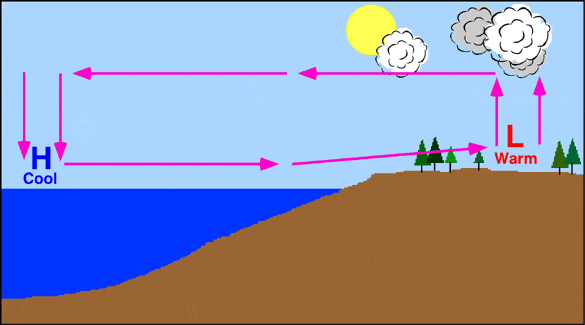
Is this a land or a sea breeze?
a)
land breeze
b)
sea breeze
42.
What type of global wind flows toward the poles from west to east carrying moist air over the United States?
a)
Prevailing Westerlies
b)
Prevailing Easterlies
c)
Polar Easterlies 
d)
Doldrums
43.
Ironing a shirt is an example of...
a)
condensation
b)
conduction
c)
convection
d)
radiation
44.
The man goes to take the hot pot off the stove with his bare hands.
a)
conduction
b)
convection
c)
radiation
45.
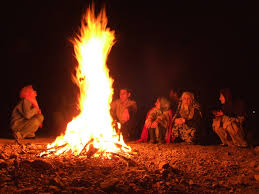
A group of friends gather around a fire to stay warm.
a)
conduction
b)
convection
c)
radiation
46.
In what way does the Sun warm Earth? 
a)
radiation
b)
convection
c)
conduction
d)
condensation
47.
Walking on the warm sand with your bare feet is an example of:
a)
conduction
b)
convection
c)
radiation
48.
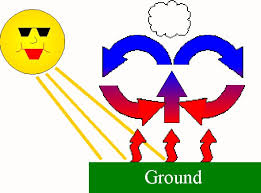
When warm air rises and the cool air sinks, this is:
a)
conduction
b)
convection
c)
radiation
49.
What heat transfer happens when you burn your hand by touching a fire?
a)
Radiation
b)
Conduction
c)
Convection
d)
I don't know!!!!!!!!!!!
50.
What causes wind?
a)
movement of high pressure to low pressure
b)
movement of low pressure to high pressure
51.
At 30o latitude, the winds are ____ and trader ships could not move. This is called the _____. 
a)
strong, Hadley Cells
b)
strong, Horse Latitude
c)
calm, Hadley Cells
d)
calm, Horse Latitude
52.
Warm air ____ and cold air ____.
a)
rises, sinks
b)
sinks, rises
c)
falls, stays
d)
rises, stays the same
53.
High pressure will usually bring what kind of weather?
a)
Sunny
b)
Cloudy
c)
Windy
54.
Low pressure will usually bring what kind of weather?
a)
Sunny
b)
Calm
c)
Stormy
55.
The name of the global winds that move from west to east across the United States is called
a)
Trade Winds
b)
Prevailing Westerlies
c)
Polar Easterlies
d)
Doldrums
56.
Which global winds blow from 30o latitude in both hemispheres almost to the equator?
a)
easterlies
b)
westerlies
c)
trade winds
d)
the doldrums
57.
What is the fundamental cause of air circulation in Earth's atmosphere?
a)
ocean currents
b)
Earth's gravity
c)
energy from the sun
d)
Earth's magnetic field
58.
What is the Coriolis effect?
a)
wind curves across Earth's surface because of Earth's magnetism
b)
global wind patterns occur because of rising and sinking air
c)
global wind patterns occur because of high and low pressure
d)
wind curves across Earth's surface because of Earth's rotation
59.
At the seashore late in the afternoon on a hot day, a person often feels a strong breeze coming from the ocean because...
a)
the pounding waves generate air currents
b)
warm air over the ocean rushes in to replace the cool air that rises over the land
c)
the heavy, cool air over the ocean rushes in to replace the warm air that rises over the land
d)
there are no clouds to block the wind coming in from the ocean
60.
What kind of air pressure does COLD air have?
a)
High pressure
b)
Low pressure
61.
What kind of air pressure does WARM air have?
a)
High pressure
b)
Low pressure
62.
During the day, warm air rises over the land then cools and falls over water in a continuous cycle.
a)
Land breeze
b)
Sea breeze
63.

What is located at 0 degrees on Earth?

a)

North Pole

b)

Doldrums

c)

Horse Latitudes

d)

Polar Easterlies

64.

What global wind is located from 0 to 30 degrees North and South of the Equator?

a)

Trade Winds

b)

Prevailing Westerlies

c)

Polar Easterlies

d)

Doldrums

65.

What weather is caused by low pressure?

a)

Clouds and rain

b)

Clear skies

66.

Wind is caused by . . .

a)

air moving from a low pressure to a high pressure.

b)

air moving from a high pressure to a low pressure.

c)

air moving from the equator to the poles.

d)

the rotation of the Earth.

67.

What causes warm air to rise?

a)

the fact that it's less dense than cold air

b)

The fact that it weighs more than cold air

c)

The fact that it has higher pressure than cold

d)

the fact that its more dense than cold air

68.

The type of heat transfer that happens through direct contact of molecules or particles with each other is ___________________.

a)

Convection

b)

Conduction

c)

Radiation

d)

insulation.

69.

A large house being heated by heater warms a house when the air is circulating.

a)

Convection

b)

Conduction

c)

Radiation

d)

insulation.

70.

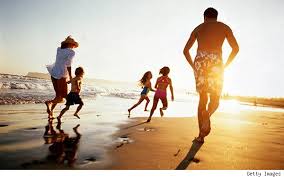
The sun shines down on this family as the play on the beach. This is an example of:

a)

conduction

b)

convection

c)

radiation

71.

Where does the initial source of energy come from that creates winds?

a)

the moon

b)

the sun

c)

the Earth's surface

d)

the rotation of the Earth

72.
How do we characterize an air mass that forms over the ocean?
a)
Dry
b)
Wet
c)
Cold
d)
Warm
73.
How do we characterize an air mass that forms over land?
a)
Dry
b)
Wet
c)
Cold
d)
Warm
74.
How do we characterize an air mass that forms near the poles?
a)
Dry
b)
Wet
c)
Warm
d)
Cold
75.
What types of air masses form over oceans?
a)
Maritime
b)
Continental
c)
Polar
d)
Tropical
76.
What's the humidity and temperature of a continental tropical air mass?
a)
Wet and cold
b)
Dry and warm
c)
Wet and warm
d)
Dry and cold
77.
Which type of front is displayed?
a)
Cold
b)
Warm
c)
Stationary
d)
Occluded
78.
Which type of front is displayed?
a)
Cold
b)
Warm
c)
Stationary
d)
Occluded
79.
Which type of front is displayed?
a)
Cold
b)
Warm
c)
Stationary
d)
Occluded
80.
When two different air masses collide...
a)
A front forms
b)
They casually become one
c)
A new planet evolves
d)
Dinosaurs become extinct
81.
Which type of front is displayed?
a)
Cold
b)
Warm
c)
Stationary
d)
Occluded
82.
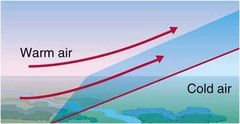
When a cold front is approaching, what happens?
a)
warm air is pushing under cold air causing humid weather and lower temperatures
b)
warm air is pushing under cold air causing humid weather and higher temperatures
c)
warm air rises, cools, and causes rain and thunderstorms
d)
cold air is pushed over warm air causing rain and thunderstorms
83.
What type of storm front is this?
a)
warm front
b)
cold front
c)
stationary front
d)
occluded front
84.
What type of weather would you expect to see after a cold front has passed through an area?
a)
cool and clear skies
b)
warm and humid
c)
thunderstorms
d)
foggy
85.
What type of weather would you expect to see after a warm front has passed through an area?
a)
cool and clear skies
b)
warm and humid
c)
thunderstorms
d)
foggy
86.
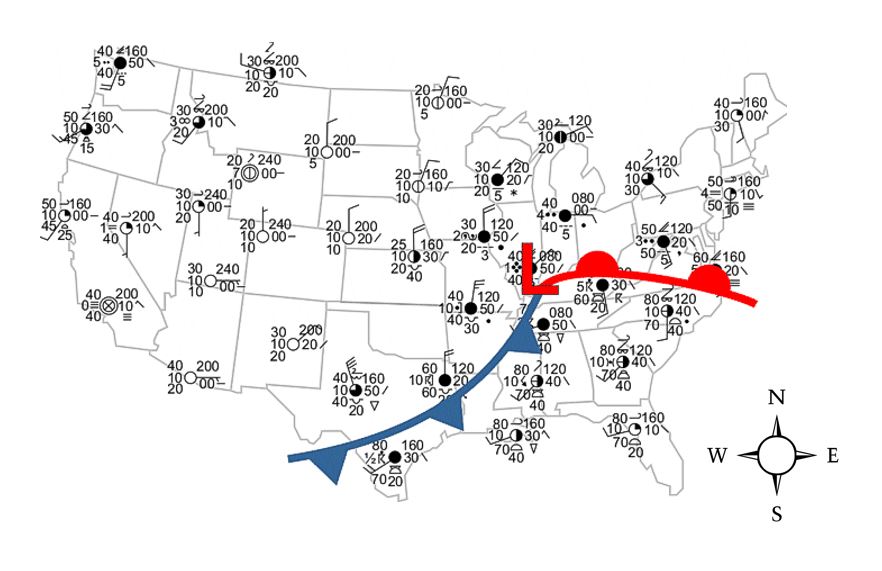
What direction is the warm front moving on the map? 
a)
North
b)
South
c)
East
d)
West
87.
What direction is the cold front moving on the map? 
a)
Southwest
b)
Northwest
c)
Southeast
d)
Northeast
88.

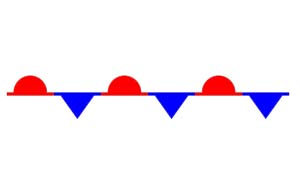
Which is the correct symbol for an occluded front?

a)
b)
c)
d)
89.

Which is the correct symbol for a stationary front?

a)
b)
c)
d)
90.

What type of front occurs when a warm air mass and a cold air mass do not have enough energy to move the other one out of the way?

a)

Warm front

b)

Cold front

c)

Stationary front

d)

Occluded front

91.
What's the humidity and temperature of a continental tropical air mass?
a)
Wet and cold
b)
Dry and warm
c)
Wet and warm
d)
Dry and cold
92.

If the outside air temperature is 10 degrees F and the wind is blowing at 30 miles per hour, what temperature does the outside feel like on our skin?

a)

-4 °\degree  F

b)

-12 °\degree  F

c)

-39 °\degree  F

d)

-22 °\degree  F

93.

Label the location of a warm desert and a cold desert. Use red lettering for the warm desert and blue lettering for the cold desert.

94.

Name two ways that these marshmallow could be roasted.

(a)  

95.

Draw an arrow showing the North Equatorial current, which is the water current that brings hurricanes to Florida. Use a red arrow if it is a warm current and use a blue arrow if it is a cold current.

96.

Crush, in "Finding Nemo" travels on the EAC, the Eastern Australian Current. Draw the EAC using a red arrow where the EAC is warm and a blue arrow where the EAC is cold.

97.

Draw the Antarctic Circumpolar Current. Use a red arrow if it is a warm current and a blue arrow if it is a cold current.