Worksheets
Geologic History and Fossils
Total questions: 37
Worksheet time: 28mins

Which letter best represents an index fossil?
A
B
C
D
What two methods are used to divide and classify the geological time scale?
Living organisms
rock strata or layers
DNA
fossils
Earth is thought to be formed ______ years ago?
200 thousand
3 million
4.6 billion
who knows

What is stratigraphy?
the study of the fossilized remains of plants and animals
the study of the layers of rock
the study of how the continents have moved and are still moving
the study of how carbon is stored in Earth's permafrost

What is the Law of Superposition?
All principle that states that rock layers were formed as horizontal layers
A gap in rock layers due to erosion of a weak layer of rock
A principle that states that an intrusive layer of igneous rock will always be younger than the rock it cuts through.
A principle that states that the deeper a rock is, the older it is unless it has been disturbed or altered.

What is the Law of Original Horizontality?
All principle that states that rock layers were formed as flat layers
A gap in rock layers due to erosion of a weak layer of rock
A principle that states that an intrusive layer of igneous rock will always be younger than the rock it cuts through.
A principle that states that the deeper a rock is, the older it is unless it has been disturbed or altered.

What is the Law of Cross-Cutting Relationships?
All principle that states that rock layers were formed as flat layers
A gap in rock layers due to erosion of a weak layer of rock
A principle that states that an intrusive layer of igneous rock will always be younger than the rock it cuts through.
A principle that states that the deeper a rock is, the older it is unless it has been disturbed or altered.

What is Relative Age Dating?
The dating of rocks in how they compare to the rocks that are around them.
The use of fossils to help find the age of a rock.
The use of radioactive elements in rock to find a highly accurate estimate of the age of the rock.
Dating of a rock layer based on how far it is from Earth's core.

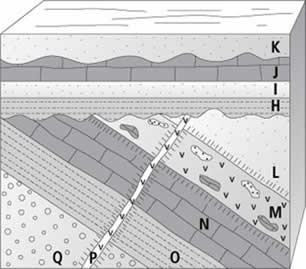
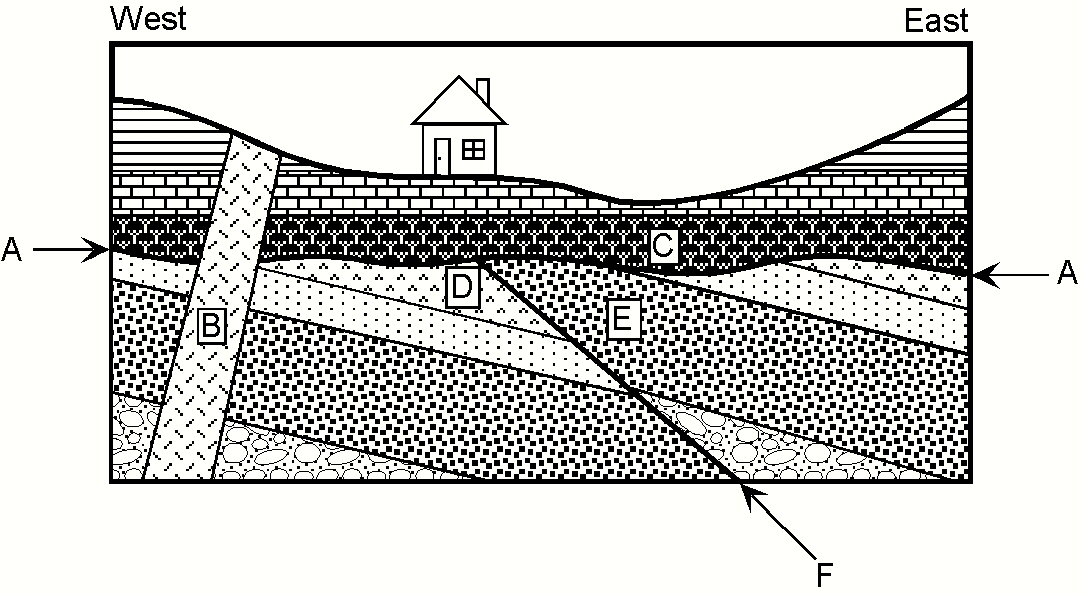
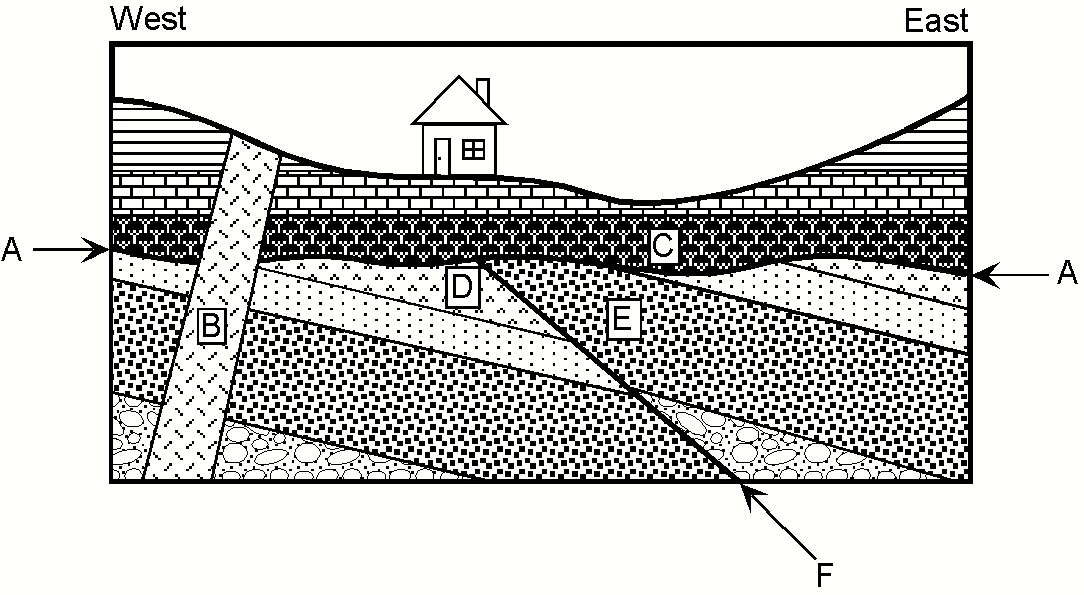
Which layer is the oldest?
E
A
B
C
D
Fossils made from organisms that were fairly common and existed only during a certain span of time, used to determine the age of rock layers.
Index Fossils
Unconformities
Inclusions
Trace Fossils

List from youngest to oldest
BAECD
DCEAB
CEABD
ACEDB

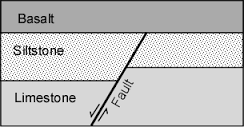
Which layer is the youngest?
Layer G
Layer F
Layer A


Which rock is formed form the cooling of volcanic ash on Earth's surface?
intrusive igneous
foliated metamorphic
extrusive igneous
organic sedimentary
Rocks that form from colling magma inside Earth?
Igneous intrusive
Igneous extrusive
Metamorphic foliated
Metamorphic nonfoliated


What are the oldest fossils and why?
B, C- because they are closest to the top
A, B- because they are closest to the bottom
They are all the same age- because they are all found on layer 2
A, B- because they are found closest to the top

When did fossil A become extinct?
Layer 1
Layer 2
Layer 3
Layer 4

Fossil A is an ancient mollusk, an organism that needs water to survive. Why do you think that the mollusk went extinct in this particular sample of the fossil record?
When the ocean levels rose in layer 4, the mollusk went extinct because they cannot live in water
For some reason, the ocean disappeared causing the mollusk to thrive
For some reason, the ocean disappeared causing the mollusk to go extinct
When the ocean level rose in layer 4, the mollusk thrived because they need water

Do not rush, examine the diagram. How has life evolved starting with the oldest fossils?
Life started in the ocean and over time organism became to appear with no common ancestors. Fish evolved first, then reptiles, then mammals and finally birds.
Life started in the ocean then slowly evolved through natural selection to life on land. Fish evolved first, then reptiles, then mammals and finally birds.
Life started on land and over time humans began to evolve into fish, then reptiles, and birds.
Life started in the ocean as four-legged amphibians which then evolved to palm trees, then to dinosaurs, and eventually into humans.

Why would a FISH fossil be in the DESERT?
A desert formed in an area that was once covered by an ocean.
A bird must have dropped the fish as it flew over the desert.
Water, wind, and ice must have brought the fish to the desert.
The fossil came from a volcano that started on the ocean floor.

Organisms D and C clearly lived in an aquatic (water) environment. Organism A does not look like it lived in the water. What is the most likely explanation for this?
The fossil in layer A died on land and was carried to the water
The fossils in layer C and D did not live in the same location as the fossil in layer A
The environment changed over a long period of time. It used to be under water, but is not anymore

What is a likely event that occurred between fossil layers B and D?
explosion of new species
mass extinction
can not tell from the image
small changes to the environment