wayground logo

Free Printable Worksheets

Font size

S
M
L
XL
Worksheets

Nutrients, Food Tests and Enzymes

Total questions: 35

Worksheet time: 27mins

Name
Class
Date
1.
Which nutrient is our body's MAIN source of energy?
a)
Carbohydrates
b)
Fats
c)
Water
d)
Minerals
2.
You just had a hard work out and your muscles are sore. Which nutrient should you be trying to get to repair your muscles?
a)
carbohydrates
b)
fat
c)
water
d)
protein
3.
__________ can be found in liquid  or solid form, like butter or margarine.
a)
Proteins
b)
Carboydrates
c)
Water
d)
Fats
4.

A substance you need to grow and live is called a

a)

Balanced diet

b)

Nutrient

c)

Calorie

d)

Myplate

5.

This type of nutrient is needed in larger amounts and includes proteins, fats, and carbohydrates

a)

Carbohydrate

b)

Micronutrient

c)

Mineral

d)

Macronutrient

6.

What is a Monosaccharide?

a)

Single molecule sugar

b)

Double molecule sugar

c)

Polysaccharide

d)

Protein

7.

What is a Disaccharide?

a)

Single molecule sugar

b)

Double molecule sugar

c)

Polysaccharide

d)

Protein

8.

Which disaccharide is made up of glucose and fructose?

a)

Galactose

b)

Maltose

c)

Lactose

d)

Sucrose

9.

What are the building blocks of proteins called?

a)

Fatty Acids

b)

Amino Acids

c)

Saturated Fats

d)

Essential fats

10.

Monomers of Lipids include

a)

amino acids

b)

monosaccharides

c)

nucleotides

d)

glycerol and fatty acids

11.

Lipids are made of...

a)

CHO

b)

CHON

c)

CHONP

d)

CHONS

12.
What atoms make up all carbohydrates?
a)
Carbon, Sulfur, Hydrogen
b)
Carbon, Oxygen, Phosphorus
c)
Carbon, Oxygen, Nitrogen
d)
Carbon, Oxygen, Hydrogen
13.
The process of adding water in order to break bonds within a polymer....
a)
Dehydration Synthesis
b)
Hydrolysis
14.
The process of digesting a polysaccharide into individual monosaccharides is called....
a)
Dehydration Synthesis
b)
Hydrolysis
15.

I am used to test for the presence of complex carbohydrates (starch)

a)

Benedict's Test

b)

Biuret Test

c)

Iodine Test

d)

Ethanol Emulsion Test

16.

I am used to test for the presence of simple carbohydrates (sugars)

a)

Benedict's Test

b)

Biuret Test

c)

Iodine Test

d)

Ethanol Emulsion Test

17.

I am used to test for the presence of protein

a)

Benedict's Test

b)

Biuret Test

c)

Iodine Test

d)

Ethanol Emulsion Test

18.

I am used to test for the presence of lipids (fats)

a)

Benedict's Test

b)

Biuret Test

c)

Iodine Test

d)

Ethanol Emulsion Test

19.

If I am positive, I will turn brick-red

a)

Benedict's Test

b)

Biuret Test

c)

Iodine Test

d)

Ethanol Emulsion Test

20.

If I am positive, I will turn dark blue/black

a)

Benedict's Test

b)

Biuret Test

c)

Iodine Test

d)

Ethanol Emulsion Test

21.

If I am positive, I will turn purple (violet)

a)

Benedict's Test

b)

Biuret Test

c)

Iodine Test

d)

Ethanol Emulsion Test

22.

In this experiment, you must put your test tubes into a hot water bath

a)

Benedict's Test

b)

Biuret Test

c)

Iodine Test

d)

Ethanol Emulsion Test

23.

Name the food test and the type of food that was being tested.

a)

Benedict's test

b)

Glucose

c)

Millon's test

d)

Protein

e)

Iodine test

24.
What is a substance called if it speeds up a chemical reaction?
a)
reusable
b)
catalyst
c)
specific
d)
fragile
25.
With what 3 letters do enzymes typically end?
a)
-ose
b)
-ase
c)
-ese
d)
-tic
26.
Each enzyme only has 1 substrate that will fit its active site.  What is this called?
a)
reusable
b)
catalyst
c)
specific
d)
fragile
27.
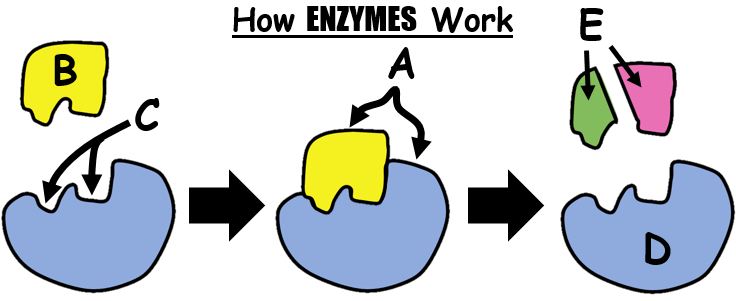
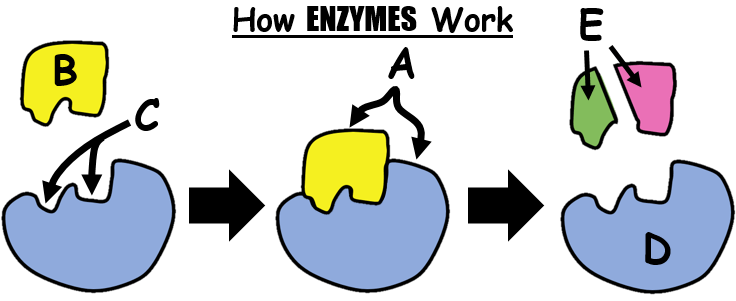
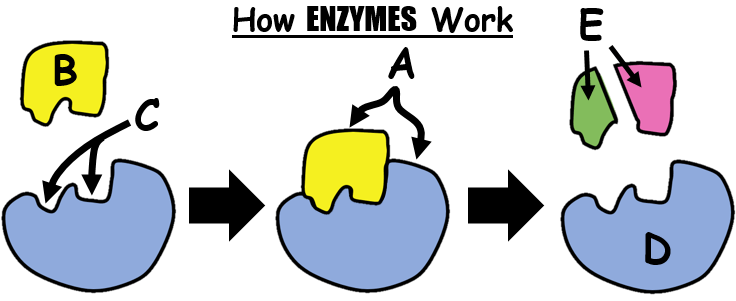
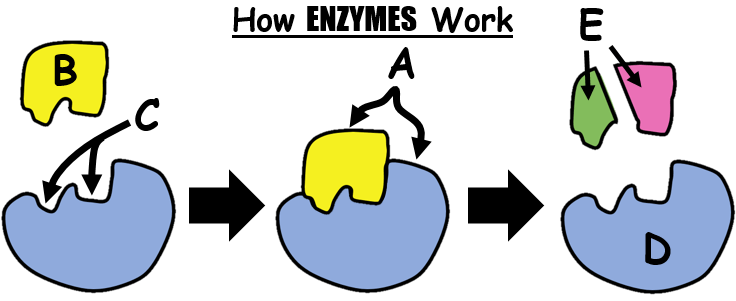
In the diagram, what is letter A? 
a)
product
b)
substrate
c)
enzyme-substrate complex
d)
active site
28.
Letter D...
a)
active site
b)
enzyme
c)
substrate
d)
products
29.
Letter B...
a)
active site
b)
enzyme
c)
substrate
d)
products
30.
Letter C...
a)
active site
b)
enzymes
c)
substrate
d)
products
31.
Letter E...
a)
active site
b)
enzyme
c)
substrate
d)
products
32.

What happens when enzymes are heated to a high temperature?

a)

The enzymes die.

b)

The shape of the enzyme are changed and it denatures

c)

The enzymes' amino acid sequence changes.

d)

The enzymes remain the same

33.
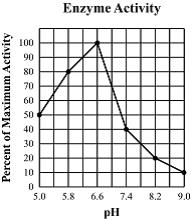
Which of the following conclusions can be drawn from this graph?
a)
The optimum pH of the enzyme is 6.6.
b)
The optimum pH of the enzyme is 5.8
c)
The enzyme’s activity increases as pH increases 5.0 to 9.0
d)
The enzyme’s activity is greater around pH of 8.0 .
34.
Which enzyme is most efficient in a basic solution?
a)
A
b)
B
35.
What factors affect an enzyme's reaction rate?
a)
temperature 
b)
pH
c)
substrate concentration
d)
all of these