
NEW
Font size
 Worksheets
Bio: Unit 3 Test - Ch 10-12
Total questions: 50
Worksheet time: 4hrs 10mins
have the ability to interbreed.

By looking at the genes of some animals we can determine which living species are most closely related to each other. This also reveals which species most recently diverged from their common ancestor.
Based on the partial gene segments shown, which pair of animals are genetically most closely related and therefore most recently diverged from their common ancestor?
Chimpanzee and Mouse
Rat and Mouse
Rat and Chimpanzee

Images of the embryo and adult stages of three different organisms are shown.
Which of the following is the best conclusion that can be drawn from this evidence?
Having similar embryos indicates that these organisms eat the same types of food.
Having similar embryos indicates that these organisms live in a similar environment.
Having similar embryos indicates that these organisms share a recent common ancestor.
Having similar embryos indicates that a certain protein controls how many legs the adult organisms will have.
If a new trait DOES help an organism survive, what may happen to it?
It dies and its DNA is not passed on
It survives and its DNA is passed on
It changes its traits to adapt and survive
A change in a DNA sequence that affects genetic information
mutation
fitness
transformation

In the table shown, the DNA found in five primate species was compared to the DNA found in humans. The number of sequence differences was recorded. Based on the data in this table, what inference could you make about these species compared to humans?
Lemurs are most like humans.
Gorillas are most like humans.
None of the species are similar to humans.
Only the lemur differs from humans in any way.
What word describes a trait that helps an organism survive in its environment?
natural selection
mutation
camouflage
adaptation
What is the adaptation?

Rainfall in a tropical region has been below average for 10 consecutive years. Insect species adapted to dry conditions are much more plentiful at the end of the 10 years. Which of the following statements best explains the increase in the population of these insects?
Biodiversity in the region has increased due to the dry conditions.
Insects with a high tolerance for dry conditions have moved out of the region.
Natural selection has favored insect species with high tolerance for dry conditions.
Natural selection has selected against insect species that are adapted for dry conditions.
If scientists were to compare the fossil of a fern that lived millions of years ago with other fern fossils that were formed later, what would they most likely find?
that plants had bones millions of years ago
that plants change over time
that ferns stopped evolving 25 million years ago
that only animals evolve

Darwin explained the differences in the Galapagos finches was due to
random mutations among the finch populations
the climate on the islands
inherited changes in response to environmental pressures
indicated that these finches were not related
The emergence of new rivers or streams is a type of ____________ isolation.
Temporal
Mechanical
Behavioral
Geographic
Occurs at a slow rate.
Gradual extinction
Mass extinction
Occurs when a catastrophic event changes the environment suddenly.
Gradual extinction
Mass extinction
Bursts of change followed by periods of stability.
Punctuated equilibrium
Gradualism
Extinction
Speciation
Slow changes over a long period of time.
Gradualism
Extinction
Coevolution
Convergent evolution
A number of different species arise from one common ancestor.
Adaptive Radiation (aka, Divergent Evolution)
Gradualism
Coevolution
Speciation
When unrelated species evolve similar characteristics because they live in similar environments.
Convergent Evolution
Coevolution
Adaptive Radiation
Divergent Evolution
Two organisms change in response to each other forming a specialized relationship.
Coevolution
Convergent Evolution
Gradualism
Extinction
Takes two organisms to make offspring; process of meiosis to create gametes.
Sexual Reproduction
Asexual Reproduction
Process of binary fission or mitosis where only one parent produces genetically identical offspring.
Sexual Reproduction
Asexual Reproduction

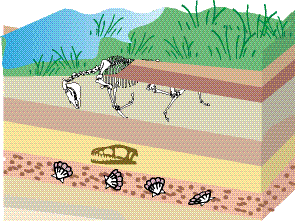
Why are similar fossils found all over the world?
The animals swam to new parts of the world before going extinct
The land masses were once connected
The organisms were transported to different areas of the world
They are not similar fossils.
How do transitional species help show evolution has occurred?
They show the changes that occurred over time
They show that an organism still lives today
They show how an organism died
They show an organism that was poorly adapted to its environment

Earth formed 4.5 billion years ago, but life did not show until around...
3.5 billion years ago
1 million years ago
200,000 years ago
4.2 billion years ago

Which of the following was probably not present in the atmosphere of the primitive Earth?
methane
oxygen
water
carbon dioxide

Miller & Urey and other scientists have shown that:
Life on early Earth required material from space
Cells survived in the primitive atmosphere
Amino acids could be produced from inorganic molecules
Simple cells can be produced in a laboratory

The theory that mitochondria and chloroplasts were once ancient prokaryotic is called
Endosymbiotic Theory
Seed Theory
Mitochloro Theory
Origin of Life

A preserved remnant or impression of an organism that lived in the past
Paleontologist
Mesozoic
Fossil
Half-Life

Primitive prokaryotes that eventually produced enough oxygen to support the formation of ozone
Archaea
Cyanobacteria
Eukaryotic
Prokaryote

1 Paleozoic
2 Cenozoic
3 Precambrian
4 Mesozoic

