Wayground logo

Free Printable Worksheets

Font size

S
M
L
XL
Worksheets

Translation & Mutations

Total questions: 55

Worksheet time: 59mins

Name
Class
Date
1.
Translation takes place in the 
a)
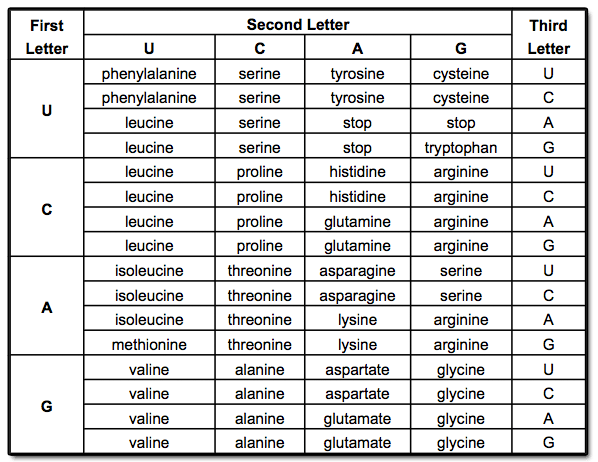
ribosome
b)
chloroplast
c)
nucleus
d)
mitochondria
2.
Brings the amino acids to the ribosome
a)
mRNA
b)
tRNA
c)
rRNA
d)
DNA
3.
What would be the tRNA anticodon for the mRNA codon CAG?
a)
GTC
b)
GUC
c)
CUG
d)
CAG
4.
What is the term for a three-nucleotide sequence that codes for an amino acid?
a)
base
b)
codon
c)
amine
d)
serine
5.
Which phrase best describes translation?
a)
converts mRNA into a polypeptide
b)
catalyzes bonds between amino acids
c)
produces RNA from DNA molecules
d)
recycles tRNA molecules for reuse
6.
What type of bonds are forming during translation?
a)
Peptide bonds
b)
Hydrogen bonds
c)
Acid bonds
7.
How many amino acids are coded for by this sequence of nucleotides:
ATG GGA ACT CCA
a)
4
b)
2
c)
6
d)
12
8.
What would happen if we did not have start codons?
a)
Polypeptide chains would continue to grow
b)
Amino acids would bind to tRNA
c)
Protein synthesis wouldn't occur
d)
mRNA would form a double strand
9.
What is the correct amino acid sequence for the mRNA code AUGCCAGUAUGA
a)
Met-Pro-Ala-Val
b)
Met-Pro-Val
c)
Tyr-Gly-His
d)
Tyr-Gly-Arg-His
10.
What type of macro-molecules are DNA and RNA?
a)
Protein
b)
Carbohydrate
c)
Nucleic Acid
d)
Lipid
11.
In mRNA, each codon specifies a particular 
a)
nucleotide
b)
amino acid
c)
purine
d)
pyrimidine
12.

. What are the building blocks of proteins called?

a)

nucleotides

b)

proteins

c)

amino acids

d)

carbohydrates

13.
How many bases are in one codon?
a)
1
b)
2
c)
3
d)
4
14.
Using the codon identify the amino acid sequence:
AUG-CCA-GUA-GGG-UAA
a)
MET-HIS-ALA-GLY-STOP
b)
MET-PRO-GLY-VAL-STOP
c)
MET-PRO-VAL-GLY-STOP
d)
MET-THR-SER-ASP-STOP
15.
What is the correct sequence?
a)
RNA --> DNA --> Protein
b)
Protein --> RNA --> DNA
c)
DNA --> RNA --> Protein
d)
DNA --> Protein --> RNA
16.
What is this a picture of?
a)
mRNA
b)
tRNA
c)
rRNA
d)
pRNA
17.
Which amino acid is made from the RNA codon UUA?
a)
Phenylalanine
b)
Leucine
c)
Serine
d)
Tyrosine
18.
Process in which amino acids are assembled into proteins at the ribosome?
a)
Translation
b)
Transcription
c)
Meiosis
d)
Replication
19.
If the mRNA sequence is AGA UUU CGA GCC,
what is the complementary tRNA anticodons?
a)
AGA TTT CGA GCC
b)
UCU AAA GCU CGG
c)
TCT AAA GCT CGG
d)
UCU AAA CGA GGG
20.
What type of molecule is the end product of translation?
a)
Glucose
Glucose
b)
Fatty Acid
c)
Glycogen
d)
Protein
21.

What is the correct sequence of protein synthesis?

A. tRNA brings amino acids to the ribosome

B. DNA molecules serve as the templates for mRNA.

C. mRNA molecules move to ribosomes.

D. Polypeptides are formed on ribosomes.

a)

A-B-C-D

b)

B-C-A-D

c)

C-B-A-D

d)

D-B-A-C

22.

WHERE does TRANSLATION occur?

a)

ribosome

b)

cytoplasm

c)

nucleus

d)

cell

23.

Which organelle makes proteins?

a)

ribosome

b)

nucleus

c)

mitochondria

d)

chloroplast

24.

Which of the following is known as the START codon?

a)

UAG

b)

AUG

c)

UGA

d)

UAA

25.

Which type of RNA is the message of the decoded gene from DNA?

a)

mRNA

b)

rRNA

c)

tRNA

d)

rDNA

26.

Which type of RNA reads the coded gene and makes a protein?

a)

mRNA

b)

rRNA

c)

tRNA

d)

DNA

27.

Which type of RNA is the carrier of amino acids?

a)

mRNA

b)

rRNA

c)

tRNA

d)

DNA

28.

The DNA sequence ATC-AGC-GCT-GGC is part of a gene. how many amino acids are coded for by this message?

a)

4

b)

8

c)

3

d)

12

29.

What is the name of a chain of amino acids?

a)

hydrogen bonds

b)

polypeptide

c)

amino acid chain

d)

double helix

30.

Which amino acid matches with the following codon:

GAU

a)

GLU

b)

SER

c)

ASP

d)

ILE

31.

Which amino acid matches with the following codon:

CAC

a)

STOP

b)

HIS

c)

LYS

d)

ARG

32.

Use the mRNA below to select the correct amino acid sequence:

AUG-UCA-AAA-UAG

a)

MET-SER-LYS-STOP

b)

MET-THR-LYS-TYR

c)

LEU-SER-CYS-STOP

d)

ILE-LYS-SER-STOP

33.

What mutation has occurred here?

T-G-A-C-C-A

T-G-A-G-C-A

a)

Substitution

b)

Deletion

c)

Insertion

d)

Frameshift

34.

DNA molecule segment is : TTACGCAAG

The mutated DNA segment is TTACGCAAC. This is an example of ___ mutation.

a)

Substitution

b)

Insertion

c)

Inversion

d)

Translocation

35.
Any change in the sequence of DNA is...
a)
transgenic shift
b)
Single Genotype
c)
Monohybrid Trait
d)
Mutation
36.

ATT-TGA-GCC- Original

ATT-GAG-CC - Mutated

The example above is an example of a

a)

Insertion- Frameshift

b)

Deletion- Substitution

c)

Deletion -Frameshift

d)

All of the above

37.

DNA molecule segment is : TTA-CGC-AAG

The mutated DNA segment is TTC-GCA-AG. This is an example of ___ mutation.

a)

Substitution

b)

Deletion

c)

Insertion

d)

Inversion

38.

Original DNA: CAT GAT CCA

New DNA: CAT TGA TCC A

What mutation occurred?

a)

deletion

b)

substitution

c)

tranverse

d)

insertion

39.
Original: ATC CAT
Mutation: ATC GCAT
What mutation occurred?
a)
deletion
b)
insertion
c)
silent
d)
transverse
40.
Which of the following would result in a frameshift mutation?
a)
Insertions only
b)
Substitution only
c)
Deletion only
d)
Insertions and Deletions
41.

What type of gene mutation has occurred here? Normal-

AGA-TTC-ATA-GCG

Mutant-

AGA-TTC-AAT-AGC-G

a)

deletion frameshift

b)

insertion frameshift

c)

substitution

d)

nonsense

42.
Are all mutations bad?
a)
Yes
b)
No
c)
Maybe?
43.

Why are insertion and deletion mutations so harmful?

a)

They change all of the codons from the mutation on down the line, which changes the amino acid sequence

b)

They insert things that an organism doesn't need.

c)

They often delete things that organisms need.

d)

Insertion and deletions are not any more harmful than substitution mutations.

44.

What do gene mutations change?

a)

DNA

b)

RNA

c)

Proteins

d)

Lipids

45.

which of the following terms refers to the order in which amino acids are linked together in a protein.

a)

Primary

b)

Secondary

c)

Tertiary

d)

Quaternary

46.

The chain of amino acids folds and coils on itself

a)

Primary

b)

Secondary

c)

Tertiary

d)

Quaternary

47.

The entire polypeptide forms a three-dimensional structure

a)

Primary

b)

Secondary

c)

Tertiary

d)

Quaternary

48.

Two or more polypeptides attached together and work as one unit

a)

Primary

b)

Secondary

c)

Tertiary

d)

Quaternary

49.
What is a peptide bond?
a)
Bond that holds two amino acids together.
b)
A bond that holds hydrogen and oxygen molecules together.
c)
A bond that holds the phosphate group of one nucleotide and a sugar of a neighboring nucleotide.
d)
A bond that is formed by the sharing of electrons.
50.
How many different amino acids are there?
a)
15
b)
20
c)
25
d)
30
51.
What is the monomer of proteins?
a)
amino acids
b)
polypeptides
c)
nucleotides
d)
monosaccharides
52.
The two types of folding in the secondary structure are.....
a)
alpha-helix & beta-pleated sheets
b)
polypeptide & nucleotide
c)
globular & fibrous
53.
The main bonding in the secondary structure of a protein is due to.....
a)
covalent bonding
b)
ionic bonding
c)
hydrogen bonding
d)
polar bonding
54.
The tertiary structure folding in proteins is primary due to the interactions of....
a)
the 'R' groups
b)
the 'P' groups
c)
the 'A' groups
d)
the 'S'
55.
What is the name of this molecule?
a)
amino acid
b)
nucleotide
c)
monosaccharide
d)
triglyceride