Wayground logo

Free Printable Worksheets

Font size

S
M
L
XL
Worksheets

Introduction to Anatomy and Physiology

Total questions: 50

Worksheet time: 46mins

Name
Class
Date
1.
The heart is contained within this cavity (most specific)
a)
mediastinum
b)
pericardial
c)
pleural
d)
thoracic
2.
The ___ separates the two sections of the ventral cavity
a)
heart
b)
lungs
c)
spleen
d)
diaphragm
3.
The lungs are located within this cavity
a)
pleural
b)
mediastinum
c)
brachial
d)
pelvic
4.
The __ contains the trachea, esophagus, and large blood vessels such as the aorta
a)
cranial
b)
abdominopelvic
c)
dorsal
d)
thoracic
5.

Armpit area

a)

Acrominal

b)

Axillary

c)

Deltoid

d)

Nasal

6.

Mouth area

a)

Occipital

b)

Orbital

c)

Oral

d)

Vertebral

7.

Spinal column

a)

Acrominal

b)

Vertebral

c)

Thoracic

d)

Deltoid

8.

Nose area

a)

Acrominal

b)

Cubital

c)

Orbital

d)

Nasal

9.

Forehead area

a)

Mental

b)

Otic

c)

Buccal

d)

Frontal

10.

Chin area

a)

Buccal

b)

Mental

c)

Otic

d)

Cephalic

11.

Stomach area (between thorax and pelvis)

a)

Abdominal

b)

Dorsum

c)

Coxal

d)

Flank

12.

Finger area

a)

Carpal

b)

Coxal

c)

Digital

d)

Dorsum

13.

Hip area

a)

Coxal

b)

Pelvic

c)

Pubic

d)

Lumbar

14.

Naval area

a)

Coxal

b)

Abdominal

c)

Umbilical

d)

Pelvic

15.

Upper arm area

a)

Antebrachial

b)

Brachial

c)

Antecubital

d)

Cubital

16.

Genital area

a)

Pelvic

b)

Pubic

c)

Sacral

d)

Coxal

17.

Wrist area

a)

Tarsal

b)

Carpal

c)

Lumbar

d)

Sacral

18.

Front of the knee

a)

Femoral

b)

Popiteal

c)

Patellar

d)

Sural

19.

Identify 1

a)

Ventral cavity

b)

Dorsal cavity

c)

Cranial cavity

d)

Abdominopelvic cavity

20.

Identify 2

a)

Spinal cavity

b)

Dorsal cavity

c)

Orbital cavity

d)

Cranial cavity

21.

What is the point of a feedback loop?

a)

To provide the body with more energy

b)

To provide the body with more food

c)

To make sure the conditions in the body are always changing

d)

To make sure the conditions in the body remain stable

22.

A feedback loop best fits which characteristic of life?

a)

Cells

b)

Organization

c)

Homeostasis

d)

Adaptation

23.

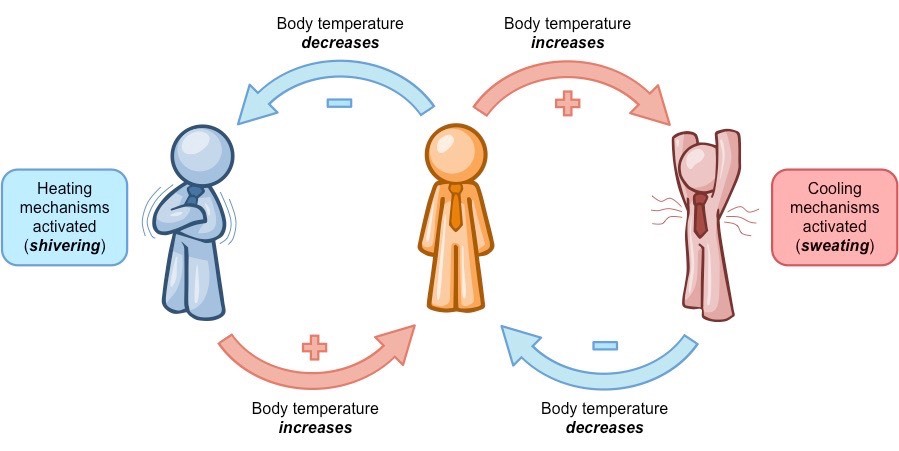
In this body temperature feedback loop, predict what would happen if cooling mechanisms were NOT activated?

a)

The body would not warm up.

b)

The body would not cool down.

c)

Your body would get colder and colder.

d)

Your body would release lots of heat.

24.

According to the feedback loop, what does high blood sugar promote?

a)

Insulin Release

b)

Glucagon Release

c)

Insulin Uptake

d)

Glycogen Uptake

25.

What happens if stretch receptors are activated in the uterus?

a)

Oxytocin will cause uterine muscles to relax

b)

Contractions will get weaker

c)

The baby will be born later than normal

d)

The brain will signal for the release of oxytocin

26.

If the anterior pituitary does not release TSH, what will happen?

a)

Thyroid follicles will not release T3 and T4

b)

The hypothalamus will release TRH

27.
The two types of feedback systems that help organisms maintain homeostasis are:
a)
positive and negative 
b)
receptor and effector
c)
static and dynamic
d)
minor and major
28.
Maintaining body temperature is an example of a:
a)
negative feedback loop
b)
positive feedback loop
29.
The process of childbirth is an example of:
a)
negative feedback loop
b)
positive feedback loop
30.
Humans have ___ for body temperature, blood glucose concentrations, electrolyte concentrations, pH levels, tendon tension and variables.
a)
positive feedback mechanisms
b)
set points
c)
a wide internal range
d)
no regulation
31.
The "cause" for something to happen is the
a)
response
b)
effect
c)
stimulus
d)
homeostasis
32.
The "effect" of a given stimulus is the...
a)
response
b)
stimulus
c)
cause
d)
result
33.
The name for a chemical made by glands that tell cells to make something or respond in some way.
a)
acid
b)
enzyme
c)
perspiration
d)
hormone
34.
When you get cut, your skin cells release hormones that signal platelets to come and stop the bleeding. Platelets then release more hormones that signal even more platelets to help stop bleeding. The hormone signals continue until the cut is closed.
a)
Positive Feedback Response
b)
Negative Feedback Loop 
35.
When glucose levels in the blood rise, your brain sends a signal to your pancreas. The pancreas releases insulin, which opens channels in cell membranes to allow glucose to enter the cell, lowering blood sugar levels. 
a)
Positive Feedback Response
b)
Negative Feedback Loop 
36.
Rapid growth during puberty causes your body to release more and more growth hormones. As you grow, more and more growth hormones are released until puberty is reached, and then the hormones stop.
a)
Positive Feedback Response
b)
Negative Feedback Loop 
37.
If the calcium in your blood decreases below homeostasis levels, a gland in the brain will sense the decrease and send a chemical message to your bones. Your bones will release calcium into the blood, bringing blood calcium levels back up.
a)
Positive Feedback Response
b)
Negative Feedback Loop 
38.
As you get dehydrated, your blood becomes thicker and harder to pump. Your kidneys will respond by stopping urine production, sending the water from urine into your bloodstream to thin your blood back to normal level.
a)
Positive Feedback Response
b)
Negative Feedback Loop 
39.
Negative Feedback Loops:
a)
amplify processes
b)
prevent small changes from getting larger
c)
are initiated during childbirth
d)
are found only in plants
40.
What does the term "steady state" refer to with respect to the process of homeostasis?
a)
balanced external environment
b)
balanced internal environment
c)
changing external environment
d)
changing internal environment
41.

Which of the following is an example of positive feedback?

a)

Thermoregulation

b)

Blood Pressure

c)

Childbirth

d)

Blood Sugar Levels

42.
Homeostasis
a)
allows for a wildly fluctuating internal environment
b)
is impossible in vertebrates
c)
is the maintenance of a relatively stable internal environment and often incorporates a form of feedback regulation
d)
is the maintenance of a relatively stable external environment and often incorporates a form of feedback regulation
43.
When you get cut, your skin cells release hormones that signal platelets to come and stop the bleeding. Platelets then release more hormones that signal even more platelets to help stop bleeding. The hormone signals continue until the cut is closed.
a)
Positive Feedback Response
b)
Negative Feedback Loop 
44.

Which body system controls the body to maintain homeostasis?

a)

excretory

b)

nervous

c)

circulatory

d)

skeletal

45.

The group of organisms that use the process of homeostasis includes

a)

mammals, only

b)

animals, only

c)

plants and animals

d)

all living things

46.
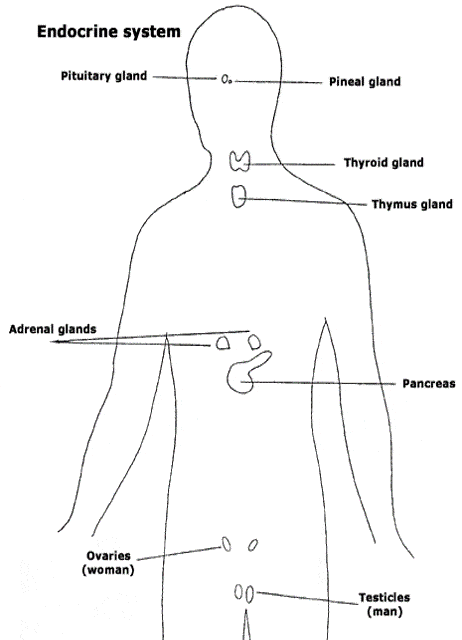
a body system that controls growth and homeostasis by secreting hormones from glands.
a)
skeletal system
b)
nervous system
c)
endocrine sytem
d)
integumentary system
47.
organ of the endocrine system that secretes hormones.
a)
heart
b)
gland
c)
brain
d)
skin
48.
chemical made by glands that tell cells to make something or respond in some way.
a)
acid
b)
enzyme
c)
perspiration
d)
hormone
49.
What is the endocrine system?
a)
senses the hormone levels in the blood
b)
controls all other endocrine glands
c)
A group of glands that work together with the nervous system to coordinate all body functions
d)
decreases bone calcium levels
50.
Name the levels of organization in the human body in order from smallest to largest:
a)
Tissue, organ, organ system
b)
Organ system, tissue, organs, cells
c)
Cells, tissue, organs, organ system
d)
Cells , organs, tissue, organ system