wayground logo

Free Printable Worksheets

Font size

S
M
L
XL
Worksheets

Unit 1 River Valleys/Ancient Greece

Total questions: 64

Worksheet time: 40mins

Name
Class
Date
1.
The ruler of all the Greek gods was... 
a)
Poseidon.
b)
Ares.  
c)
Zeus.
d)
Athena.  
2.
A city-state which favored democracy and a well-rounded education. 
(Also, the largest city-state by a wide margin)
a)
Sparta
b)
Athens
c)
Delphi
d)
Corinth
3.
Who was NOT a Greek philosopher?
a)
Pythagoras
b)
Aristotle
c)
Socrates
d)
Plato
4.
Who was the leader of Athens after the defeat of the Persians and took Athens into a "Golden Age" of prosperity and achievement?
a)
Pericles
b)
Leonidas
c)
Themistocles
d)
Socrates
5.
Athens main rival was the city state of 
a)
Anatolia
b)
Marathon
c)
Sparta
d)
Thermopylae
6.
Who was the main rival of ancient Greece?
a)
The Persian Empire
b)
The Ottoman Empire
c)
The American Empire
d)
The Galactic Empire
7.

Who was Alexander the Great's teacher?

a)

Aristotle

b)

Archimedes

c)

Plato

d)

Darius

8.
Who invented this device?
a)
Archimedes
b)
Plato
c)
Hippocrates
d)
Socrates
9.
A gathering place; a marketplace in Ancient Greece
a)
agora
b)
ephor
c)
oligarchy
d)
polis
10.
What is the term for a Greek city-state?
a)
agora
b)
tyrant
c)
helot
d)
polis
11.
A myth is...
a)
a traditional story that explains the practices or beliefs of a people, or something in the natural world
b)
a government by the people
c)
an absolute ruler unrestrained by law
d)
a story meant to teach a lesson
12.
A person who searches for wisdom or enlightnement
a)
Ephor
b)
Helot
c)
Tyrant
d)
Philosopher
13.
The philosophical method of questioning to gain truth
a)
Hellenistic Era
b)
rhetoric
c)
comedy
d)
Socratic Method
14.
A set of promises about patient care that new doctors make when they start practicing medicine
a)
Hippocratic Oath
b)
Socratic Method
c)
Zoroastrianism
15.
What is the Pythagorean Theorum?
a)
a + b = c
b)
a+ b= c2
c)
c + b + a
d)
all of the above
16.
Which continent is Greece located on?
a)
Antarctica
b)
North America
c)
Europe
d)
South America
17.
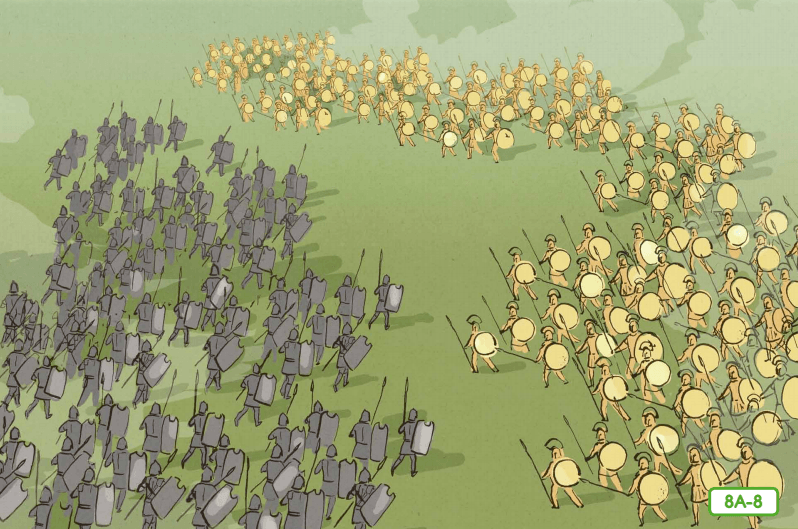
Ten years after the first battle in the Persian Wars, Darius' son Xerxes tried to conquer Greece once more.
Which Greek city-state helped Athens?
a)
Mycenae 
b)
Crete
c)
Sparta
d)
Troy
18.

At the Battle of Marathon, ________________.

a)

the Persian Empire was defeated by Alexander the Great.

b)

Athens was defeated by Persian Empire.

c)

Sparta was defeated by Athens.

d)

the Persian Empire was defeated by Athens.

19.
What was a Greek soldier called and what was the name of the formation in which he fought?
a)
Hoplite, phalanx
b)
Hoplite, trireme
c)
Spartan, greaves
d)
Cuirass, hoplite
20.
During the 2nd Persian War a Spartan force of 300 held off the Persian army for 2 days at a place called __________.
a)
Marathon
b)
Salamis
c)
Thermopylae
d)
Ionia
21.
______________ controlled and dominated the Delian League.
a)
Athens
b)
a peace keeping Sparta
c)
Persia
d)
Macedonia
22.
?
a)
Agora 
b)
Crete 
c)
Sparta 
d)
Parthenon 
23.

The list to the right shows contributions of which famous Greek?

a)

Archimedes

b)

Plato

c)

Pythagoras

d)

Socrates

24.

Name the Greek thinker developed the mathematical theory to the right which we still use today?

a)

Aristotle

b)

Plato

c)

Pythagaros

d)

Socrates

25.
What word best describes the land of the Greek peninsula?
a)
rocky and mountainous
b)
flat
c)
desert
d)
rolling plains
26.
Why was communication difficult between communities in Ancient Greece?
a)
They did not have telephones
b)
Mountains and Water
c)
communication was easy
d)
most people had horses
27.
The ancient Greeks were  
a)
Monotheistic  
b)
Polytheistic
c)
Atheist
d)
Scientologist
28.
What does the word "Democracy" mean?
a)
"rule by the government"
b)
"rule by the many"
c)
"rule by the wealthy"
d)
"rule by the people"
29.
Greek has many _________that are like mini countries.
a)
counties
b)
city-states
c)
provinces
d)
parishes
30.
Which statement is NOT true about how the Greeks honor their gods?
a)
They honored them with rituals.
b)
They honored them with trash.
c)
They honored them with temples.
d)
They honored them with festivals.
31.
Which of these played the biggest role in the economy of ancient Greece?
a)
Persian Gulf
b)
Black Sea
c)
Mediterranean Sea
d)
Nile River
32.
Which of these was a result of the geographic conditions of Greece in their early civilization?
a)
unified political organization
b)
withdrawal from international contact
c)
a society centered around plantations
d)
a reliance of sea-based commerce
33.

What two epics did Homer write?

a)

The Odyessey and The Illiad

b)

The Odyessey and The Aeneid

c)

The Illiad and the Aeneid

d)

Antigone and The Illiad

34.

During the 2nd Persian War a Spartan force of 300 held off the Persian army at a place called __________.

a)

Marathon

b)

Salamis

c)

Thermopylae

d)

Ionia

35.

The Spartan leader who led the Greek army at Thermopylae was

a)

Lycurgus

b)

Themistocles

c)

Leonidas

d)

Pheidippides

36.

This naval battle fought in 480 BCE was a decisive victory for the Greeks

a)

Thermopylae

b)

Marathon

c)

Salamis

d)

Sardis

37.

taught by asking questions; found guilty of corrupting youth and sentenced to death

a)

Homer

b)

Xerxes

c)

Socrates

d)

Aristotle

38.

leader of Athens who was responsible for many building projects including the Parthenon and Acropolis; famous for giving a speech that glorified Athen's achievements and inspired them while they were in the middle of a war

a)

Socrates

b)

Pericles

c)

Herodotus

d)

Homer

39.

known as the Father of History; 1st person to travel around the world to report his accounts

a)

Ptolemy

b)

Homer

c)

Philip II

d)

Herodotus

40.

After he compared 158 governments to find the best one, ____________ wrote the book Politics

a)

Plato

b)

Aristotle

c)

Thucydides

d)

Herodotus

41.

The Greeks performed both types of drama______________ and ___________________

a)

comedy and tragedy

b)

myth and fable

c)

epic and tragedy

d)

comedy and myth

42.

______________ is known as the father of medicine

a)

Hypatia

b)

Aristarchus

c)

Hippocrates

d)

Hipparchus

43.

Who was a student of Socrates?

a)

Plato

b)

Alexander the Great

c)

Aristotle

d)

Pericules

44.

What does the word "Philosopher" mean?

a)

lover of wisdom

b)

smart thinker

c)

brave one

d)

wise one

45.

What planet did he believe was the center of the universe?

a)

Venus

b)

Mercury

c)

Sun

d)

Earth

46.
Predicted the position the planets are in today
a)
Galileo
b)
Ptolemy
c)
Copernicus
d)
Aristotle
47.
This astronomer was convinced this image was accurate.
a)
Ptolemy
b)
Brahe
c)
Copernicus
d)
Galileo
48.
Who was known as the "Father of Geometry"? 
a)
Aristophanes
b)
Euclid
c)
Plato
d)
Pythagoras
49.

What type of animal , named Bucephalus, was Alexander's favourite?

a)

Dog

b)

Bear

c)

Horse

d)

Cat

50.

The culture created by Alexander's empire was called -

a)

Macedonian Culture

b)

Hellenistic Culture

c)

Ptolemic Culture

51.

Which area was NOT part of Alexander's Empire?

a)

Rome

b)

Egypt

c)

India

d)

Persia

52.

What happened to Alex's empire after his death?

a)

His Persian wife became regent.

b)

His son took over but quickly lost control

c)

The empire was split among his major generals

d)

The Persian king, Darius III, reclaimed most of the territory.

53.

Where was Alexander the Great from?

a)

Macedonia

b)

Greece

c)

North Africa

d)

Spain

54.

Macedonia is __________ of Greece.

a)

north

b)

south

c)

east

d)

west

55.

Alexander's father was:

a)

Philip II

b)

Aristotle

c)

Sophocles

d)

Hammurabi

56.

What is the name of Alexander's largest and wealthiest city in Egypt?

a)

Alexandria

b)

Persia

c)

Babylon

d)

Ionia

57.

What city did Alexander the Great die in?

a)

Babylon

b)

Thebes

c)

Kish

d)

Alexandria

58.

When Alexander the Great died, he left no heir to the throne. What happened to his empire?

a)

It was divided into 3 parts.

b)

It was ruled over by Sparta.

c)

It was ruled over by Athens.

d)

It was divided into 5 parts.

59.

This term means: the form of Greek culture spread throughout the ancient world by Alexander the Great

a)

Hellenistic

b)

Futuristic

c)

Greektastic

d)

Alexanderistic

60.

Which were the rivers of Mesopotamia

a)

Nile

b)

Huang He

c)

Yangtze

d)

Euphrates

e)

Tigris

61.

How did surplus agricultural production contribute to the development of large settlements?

a)

It allowed for the growth of specialized labor

b)

It encouraged nomadic lifestyles

c)

 It promoted barter-based economies

d)

 It hindered technological advancements

62.

Which statement best describes the relationship between agriculture and the rise of civilizations?

a)

 Agriculture had no impact on civilization development

b)

Civilizations existed long before the advent of agriculture

c)

 Agriculture was a minor factor in the rise of civilizations

d)

Agriculture was a significant catalyst for the rise of civilizations

63.

What is a notable feature of the urban planning in the Indus River Valley cities?

a)

Pyramid structures

b)

Complex irrigation canals

c)

 Advanced sewage and drainage systems

d)

Lack of advanced drainage systems

64.

What was the earliest known form of writing in Shang China?

a)

Hieroglyphics

b)

Cuneiform

c)

Oracle bones

d)

Pictographs