
Font size
 Worksheets
CH-12 ELECTRICITY
Total questions: 80
Worksheet time: 1hrs 1mins

Two unequal resistances are connected in parallel.
Which of the following statement is true
current in same in both
current is larger in higher resistance
voltage-drop is same across both
voltage-drop is lower in lower resistance
You are given n identical wires, each of resistance R.
When these are connected in parallel, the equivalent
resistance is X. When these will be connected in series,
then the equivalent resistance will be
Xn2
Xn
nX
X/n
A wire of resistance 20 ohm is bent in form of a circle. Find the equivalent resistance between two diametrically opposite ends
40 ohm
20 ohm
10 ohm
5 ohm
A bird perches on a power line that carries current of 160 A . calculate the potential difference between the bird's feet if the resistance of wire is
10μΩm−1 and the birds feet are 4 cm apart1.6×10−5 volt
6.4×10⁻⁵ volt
3.2×10⁻⁵ volt
9.6×10⁻⁵ volt

calculate current through 6 ohm resistor
0.12
0.44
0.51
4.6
two wires A and B of equal masses and of the same material are taken .the lenght of the wire A is half the lenght of wire B . if the resistance of the wire A is 24 ohm , the resistances of wire B will be
96 ohm
12 ohm
48 ohm
4 ohm
resistivity of a metal depends on
lenght
area of cross section
all of the above
none of the above
resistance of alloys decreases with increase in temprature
true
false
Which of the following represents voltage?
work done÷current ×time
work done ×charge
work done ×charge × time
none of the above

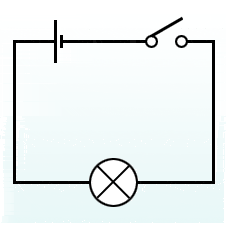
The current flowing in an electric circuit can be increased by:
increasing voltage or decreasing resistance.
decreasing voltage or increasing resistance.
increasing voltage and increasing resistance.
decreasing voltage and decreasing resistance.
6
When the length of a wire increases by 5 times, the resistance of the wire will
also increase by 5 times
decrease by 5 times
remain the same
None of the above
which formula/formulae below can be used to calculate electrical power?
Power = voltage ×current
Power = resistancevoltage2
Power = current2 ×resistance
power = currentvoltage
What does the Voltage vs Current graph for an Ohmic component look like?
A curved graph
A horizontal line
A linear graph
A vertical line
Which type of circuit is used in our homes and allows components to be turned on and off independently?
Series
Parallel
Both a and b
Neither a or b
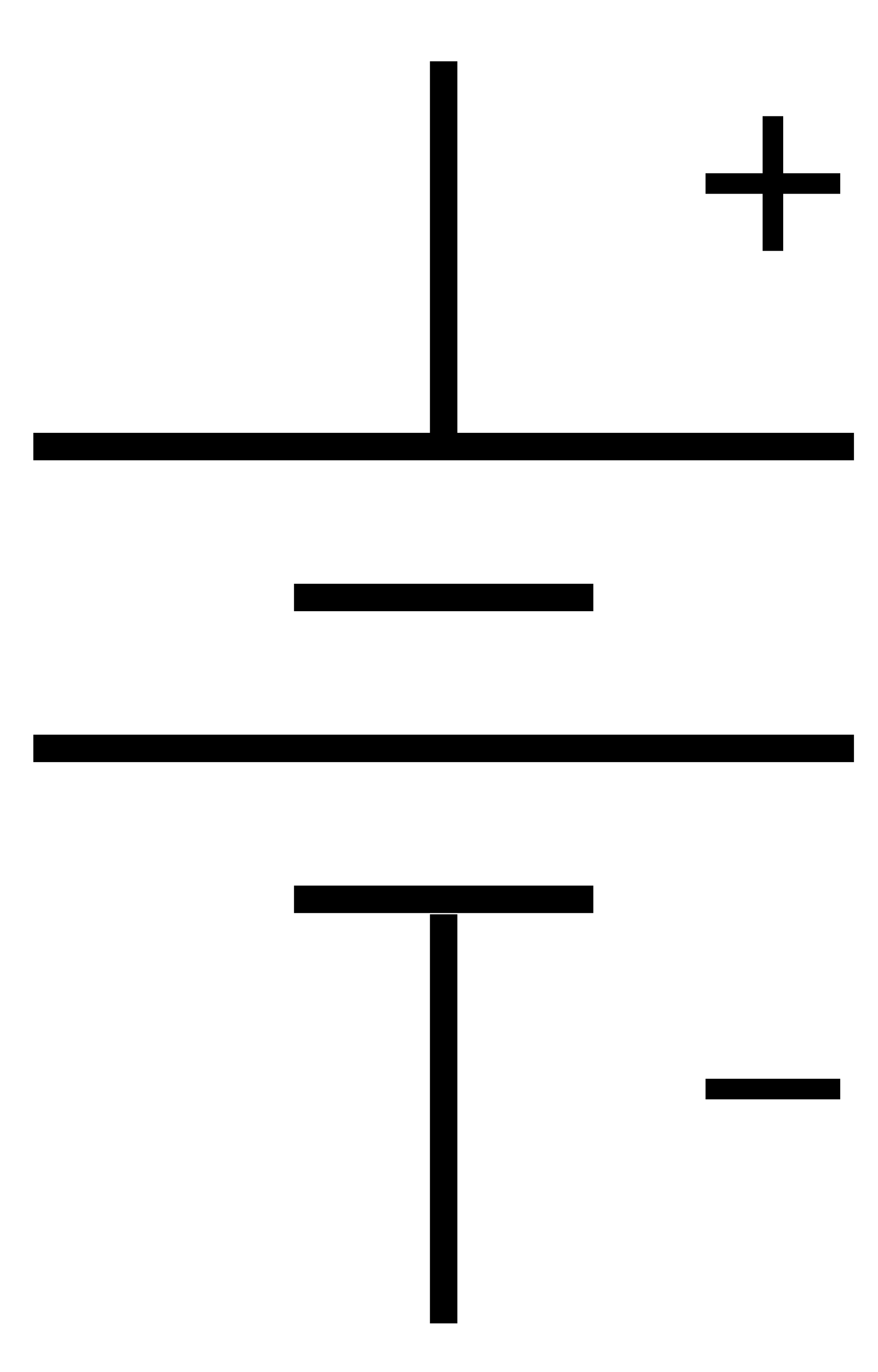
Which of these represents a Battery?


Which of the following is the SI unit for electric current?
Ohm
Watt
Ampere
Volt
An electric kettle is commonly used to heat up water at home. The heating element used is nichrome wire and not copper. Which of the following reasons best explains why nichrome is used instead of copper?
Nichrome conducts more current than copper, so more heat can be generated.
Nichrome has higher resistance than copper, so more heat can be generated.
Nichrome has higher voltage than copper, so more heat can be generated.
Nichrome are cheaper than copper, so it is more economical.
Which of the following materials is used in a light bulb to produce heat and light?
Nichrome
Copper
Tungsten
Steel
A higher resistance in a circuit causes a _____________.
higher voltage
larger current
smaller current
lower voltage
The instrument that measures electric current is called ___________.
a resistor
a voltmeter
an ammeter
an electrometer


A student carries out an experiment and plots the V-I graph of three samples of nichrome wire with resistances R1 R2 and R3 respectively. Which of the following is high ?
R1 = R2 = R3
R1 > R2 > R3
R3 > R2 > R1
none of these

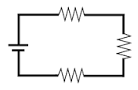
Calculate the current flows through the 10 Ω resistor in the following circuit.
1.2 A
0.6 A
0.2 A
2.0 A

A cell, a resistor, a key and ammeter are arranged as shown in the circuit diagrams of Figure (i), (ii) and (iii). The current recorded in the ammeter will be
maximum in (i)
maximum in (ii)
maximum in (iii)
will be same in all the cases
Coulomb is the SI unit of:
charge
current
resistance
potential difference
Three resistors of 1 Ω, 2 ft and 3 Ω are connected in parallel. The combined resistance of the three resistors should be
greater than 3 Ω
less than 1 Ω
equal to 2 Ω
zero
What is the commercial unit of electrical energy?
Joules
Kilojoules
Kilowatt-hour
watt-hour
Electrical resistivity of any given metallic wire depends upon
its thickness
its shape
nature of the material
its length
The rate of electric energy loss in a thermal device due to resistance R is given by:
A. P = I2/R
B. P = V2/R
C. P = I2/V
D. P = V/I
A and B
B and C
A and D
A and C


The resistance whose V-I graph is given below is
a
b
c
d

what does the image represent
open circuits
don't touch
acidic materials
electric hazard
The SI unit of resistivity is
mho-meter
ohm meter
millimeter
ammeter
An electric bulb is rated 220V and 100W.When it is operated on 110V.The power consumed will be
100W
75W
50W
25W
According to Ohm's Law, the potential difference across the ends of a resistor is directly proportional to the ……… through it, provided its ............ remains constant.
current, temperature
temperature, current
physical condition, temperature
physical condition, current
Electric power is inversely proportional to
voltage
current
temperature
resistance
Electrical resistivity of any given metallic wire depends upon
nature of the material
its thickness
its shape
its length
An electric bulb is connected to a 220V generator. The current is 0.50 A. What is the power of the bulb?
0.0023 W
55 W
110 W
440 W

Quantity of charge can be measured in
time (s)
Ampere (A)
coulombs (C)
Joule (J)
Which equation can be rearranged to calculate the the electric current given?
I = Q ÷ t
Q = It
I = Qt
I = t ÷Q
Electric potential is measured by
Voltmeter
Ammeter
Electroscope
Galvanometer
Formula to find electric potential is
V=QA
V=WQ
V=Q/W
V=W/Q
How many electron constitutet 1C charge
6.25x10⁻¹⁸
6.25x10¹⁸
1.6x10⁻¹⁹
1.6x10¹⁹
Ohm's Law states that:
Current = Voltage x Resistance
Resistance = Voltage x Current
Power = Voltage x Current
Voltage = Current x Resistance
According to Ohm's Law, if you were to triple the voltage of a circuit without changing the resistance, what would happen to the flow of current?
It would stay the same
It would increase by 2x
It would increase by 3x
It would decrease by 3x

A wire has a resistance R.
What is the resistance when both the length and radius of the wire are doubled?
R/4
R/2
2R
4R
Resistivity of a metal depends on
lenght
area of cross section
all of the above
none of the above
When the wire of an electric circuit is stretched to double its length, its resistance will be ……
Doubled
Decreased to half
Increased four times
Remains constant
The unit Coulomb / Ampere represents a quantity of ………………………
Time
Charge
Intensity of current
Resistance

This is the symbol for a _____?
switch
Light
Battery
Wires
What is one problem with using a series circuit?
It has a lot of series.
If one goes down, they all go down!
It doesn't work properly.
It uses high voltage.
What effect do like (similar) charges have on each other?
They attract
They repel
No effect
They reverse each other
A wire of length l, made of material resistivity ρ is cut into two equal parts. The resistivity of the two parts are equal to,
ρ
2ρ
2ρ
4ρ
A battery of 10 volt carries 20,000 C of charge through a resistance of 20 Ω. The work done in 10 seconds is:
2×10⁵ J
2×10³ J
2×10² J
2×10⁴ J
A boy records that 4000 joule of work is required to transfer 10 coulomb of charge between two points of a resistor of 50 Ω. The current passing through it is:
2 A
8 A
4 A
16 A
Two devices are connected between two points say A and B in parallel. The physical quantity that will remain the same between the two points is:
CURRENT
RESISTANCE
VOLTAGE
NONE OF THESE

