

wayground logo

Free Printable Worksheets

NEW

Font size

S
M
L
XL
Worksheets

Electricity and Magnetism

Total questions: 75

Worksheet time: 2hrs 49mins

Name
Class
Date
1.

Electrons flows from

a)

detect electric current

b)

negative terminal to positive terminal

c)

positive terminal to negative terminal

d)

the flow rate of electric charges through a conductor

2.

Electric current flows from

a)

detect electric current

b)

negative terminal to positive terminal

c)

positive terminal to negative terminal

d)

the flow rate of electric charges through a conductor

3.

Electric current is defined as

a)

detect electric current

b)

negative terminal to positive terminal

c)

positive terminal to negative terminal

d)

the flow rate of electric charges through a conductor

4.
Electricity that flows in a closed path is called a
a)
path
b)
current
c)
circuit
5.
What is voltage measured in?
a)
Ω (Ohms)
b)
V (Volts)
c)
A (Amps)
d)
W (Watts)
6.
What is current measured in?
a)
Ω (Ohms)
b)
V (Volts)
c)
A (Amps)
d)
W (Watts)
7.
What is resistance measured in?
a)
Ω (Ohms)
b)
V (Volts)
c)
A (Amps)
d)
W (Watts)
8.
What voltage is needed to cause a 2A current flow through a 10Ω resistor?
a)
5V
b)
0.2V
c)
20V
d)
200V
9.
What voltage is needed to cause a 5A current flow through a 2Ω resistor?
a)
10V
b)
2.5V
c)
7V
d)
0.4V
10.

Which of these materials is a good insulator?

a)

gold

b)

copper

c)

silver

d)

plastic

11.

In a series circuit, what will happen if the path for the electrical current is broken by a burned out bulb?

a)

The electrical current will stop fllowing and none of the bulbs will light up.

b)

The electrical current will continue flowing and the other bulbs will light up.

c)

The energy source will continue to move the electric charge through the circuit.

12.

What is electricity?

a)

an object that electrons do not flow through

b)

energy created by moving charged particles

c)

when two objects repel each other

d)

a circuit that has only one path for electricity to flow

13.

Which of the following is a conductor?

a)

wood

b)

rubber

c)

metal

d)

plastic

14.

A parallel circuit has more than one path for electricity to flow

a)

true

b)

false

15.
During a physics lab, a plastic strip was rubbed with cotton and became positively charged. The correct explanation for why the plastic strip becomes positively charged is that ...
a)
the plastic strip acquired extra protons from the cotton.
b)
the plastic strip acquired extra protons from the charging process 
c)
protons were created as the result of the charging process
d)
the plastic strip lost electrons to the cotton during the charging process 
16.
Insulators are different than conductors in that insulators ____.
a)
do not contain electrons or protons 
b)
 do not contain any charge
c)
have a weaker affinity for electrons 
d)
do not allow charge to freely move 
17.
A glass rod becomes positively charged when it is rubbed with silk. This net positive charge accumulates because the glass rod
a)
gains electrons
b)
loses electrons
c)
gains protons
d)
loses protons
18.
Two like charges
a)
 neutralize each other.
b)
repel each other. 
c)
must be neutrons. 
d)
attract each other.
19.
An atom gains an electron.  What type of charge does it have now?
a)
positive
b)
negative
c)
No charge
20.
An atom loses an electron.  What type of charge does it have now?
a)
positive
b)
negative
21.
Charged objects are not attracted to neutral objects
a)
True
b)
False
22.
Which of the following is not a good insulator?
a)
Copper
b)
Glass
c)
rubber
d)
wool
23.
The law of conservation of charge states that...
a)
all atoms have more protons than electrons
b)
only protons can be rubbed off of an atom
c)
charge cannot be created or destroyed
d)
charge cannot be transferred 
24.

An atom of oxygen has 8 protons and 10 electrons, this means the atom is ____________

a)

positively charged because it has excess electrons

b)

negatively charged because it has excess electrons

c)

positively charged because it has a deficiency of electrons
d)

negatively charged because it has a deficiency of electrons

25.
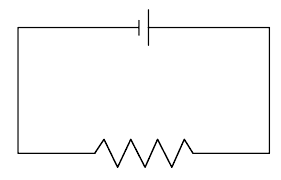
This circuit has a 24 volt battery and the resistor is 8 ohms. How many amps are running through the circuit?
a)
3 Amps
b)
192 Amps
c)
2 Amps
d)
4 Amps
26.
Pick the correct sentence.
a)
This circuit will work because it is a closed circuit.
b)
Energy will freely flow in this circuit.
c)
This circuit will not work because there is no energy source.
d)
This circuit will not work because there is no switch.
27.
The picture shows an electrical circuit. This circuit is a series circuit because: 
a)
It has 3 light bulbs.
b)
The same current flows through all three light bulbs.
c)
It uses a single battery.
d)
The electrical current is divided between the three light bulbs.
28.
What will happen if one light bulb is removed from this circuit?
a)
The other bulbs will go out.
b)
The other bulbs will stay on
c)
The other bulbs will get dimmer.
d)
The battery will become stronger.
29.
Which of the two circuits would have the brightest bulbs? 
a)
A
b)
B
30.
When you remove a bulb from a three bulb circuit, and the other two bulbs go off, then the bulbs must have been connected in __________.
a)
parallel
b)
series
c)
open
d)
closed
31.
Does this statement best describe a parallel or a series circuit.
 
When more light bulbs are added they all remain bright. 
a)
Parallel circuit
b)
Series circuit
32.
Does this diagram represent a series or parallel circuit?
a)
series circuit
b)
parallel circuit
33.
What kind of circuit is this?
a)
Series
b)
Consecutive
c)
Parallel
d)
Training
34.
what is this symbol for?
a)
light bulb
b)
switch
c)
battery
d)
resistor
35.

In which configuration is the current supplied by the battery the greatest?

a)

A

b)

B

c)

C

d)

A, B, and C are the same.

36.

In which configuration is the voltage drop across a single lightbulb the greatest?

a)

A

b)

B

c)

C

d)

A, B, and C are the same.

37.

CIrcuit elements connected in series have the same

a)

voltage drop across them.

b)

current through them.

c)

power dissipation by them.

d)

None of the above.

38.

CIrcuit elements connected in parallel have the same

a)

voltage drop across them.

b)

current through them.

c)

power dissipation by them.

d)

None of the above.

39.

100 Ω resistors are hooked in series. The equivalent resistance will be

a)

less than 100 Ω.

b)

100 Ω.

c)

more than 100 Ω.

d)

More information is needed.

40.

100 Ω resistors are hooked in parallel. The equivalent resistance will be

a)

less than 100 Ω.

b)

100 Ω.

c)

more than 100 Ω.

d)

More information is needed.

41.
A series circuit has how many pathways for the electrons to flow?
a)
Two
b)
One
c)
Many
d)
Zero
42.

Three 8.0-ohms resistors are connected in series. What is their equivalent resistance?

a)

24.0 ohms

b)

8.0 ohms

c)

0.38 ohms

d)

0.13 ohms

43.

Three resistors connected in series each carry currents labeled I1,I2and I3. Which of the following expresses the value of the total current ITin the system made up of the three resistors in series?

a)

IT= I1+ I2+ I3

b)

IT= (1/I1+ 1/I2 + 1/I3)

c)

IT= I1= I2= I3

d)

IT= (1/I1+ 1/I2 + 1/I3)-1

44.

Three resistors connected in series have individual voltages labeled V1, V2and V3, respectively. Which of the following expresses the value of the total voltage DVTtaken over the three resistors together?

a)

VT= V1 + V2+ V3

b)

VT= (1/V1+ 1/V2+ 1/V3)

c)

VT= V1= V2 = V3

d)

VT= (1/V1+ 1/V2+ 1/V3)-1

45.

Which resistor is in series with resistor R?

a)

R1

b)

R2

c)

R3

d)

R4

46.

Resistors of values 8.0 , 12.0 , and 24.0 ohms are connected in series across a battery with a small internal resistance. Which resistor dissipates the greatest power?

a)

12 ohm

b)

8 ohm

c)

24 ohm

d)

all dissipate equal power

47.

Which two resistors are in parallel with each other?

a)

R and R4

b)

R2 and R3

c)

R2 and R4

d)

R and R1

48.

What is the total resistance in this circuit?

a)

15 ohms

b)

9.0 ohms

c)

45 ohms

d)

8.8 ohms

49.

What is the total resistance in this circuit?

a)

25 Ohms

b)

10 Ohms

c)

100 Ohms

d)

50 Ohms

50.

What is the total resistance in this circuit?

a)

2.86 Ohms

b)

32 Ohms

c)

35 Ohms

d)

0.35 Ohms

51.
What will happen when these magnets are brought close together?
a)
They will attract each other.
b)
They will repel each other.
c)
Both magnets will turn to the left
d)
Both magnets will turn to the right
52.
True or False: All metals are attracted to magnet.
a)
True
b)
False
53.

A device that uses a free-moving magnetic needle to show direction is a:

a)

Ruler

b)

magnet

c)

compass

d)

magnetic field

54.
Earth acts like a giant magnet because its center is made up MOSTLY of
a)
granite
b)
limestone
c)
iron
d)
nickel
55.
How is a permanent magnet DIFFERENT from a temporary magnet?
a)
A permanent magnet attracts materials made of iron.
b)
A permanent magnet has poles.
c)
A permanent magnet has a magnetic field.
d)
A permanent magnet keeps its magnetism for a long time.
56.
Where is the force of attraction the strongest on a magnet?
a)
at the poles
b)
in the middle
c)
above the magnet
d)
below the magnet
57.
Why does a compass needle point north?
a)
The compass is a bar magnet
b)
Because north is up
c)
Because it's magic
d)
It lines up with the Earth's magnetic field
58.
The magnet's shown will
a)
not move
b)
attract
c)
repel
d)
all of the above
59.
If you cut a magnet in half, what happens to the poles?
a)
One half gets the North Pole, the other half gets the South Pole
b)
Both halves get only a North Pole
c)
Both halves get only a South Pole
d)
Both halves get a North pole and a South Pole
60.

Magnets have _______ poles

a)

two

b)

three

c)

four

d)

five

61.

The two poles of a magnet are called ...

a)

East and West

b)

North and North

c)

North and South

d)

South and South

62.

____________ metals are magnetic.

a)

No

b)

Some

c)

All

d)

Only shiny

63.
What kind of magnet can be turned on and off? (Man-made magnet)
a)
refrigerator magnet
b)
electromagnet
c)
magnetite
d)
iron
64.
If you wrap more coils around an electromagnet, it will become...(think about the Webquest.)
a)
brighter
b)
stronger
c)
weaker
d)
invisible
65.
Choose the best option to complete this gap:
A magnetic field is the ________ around a magnet in which the magnetic force acts.
a)
pole
b)
electron
c)
area
d)
iron
66.

What happens if you cut a magnet in half?

a)

Nothing

b)

The magnets repel

c)

There will be two magnets

67.

The picture above is an example of what?

a)

Magnetic field

b)

Electric field

c)

Repulsion

d)

Attraction

68.

What does the magnetic field look like on a straight wire?

a)
b)
c)
d)
69.

What type of process is shown?

a)

Electromagnet

b)

Electric motor

c)

Electric generator

d)

Electromagnetic induction

70.
As electrons move, they make
a)
A. electromagnetism.
b)
B. auroras.
c)
C. ferromagnetism.
d)
D. magnetic fields.
71.
A device that increases or decreases the voltage of alternating current
a)
A. magnet
b)
B. magnetic pole
c)
C. transformer
d)
D. magnetic force
72.
A device that converts electrical energy into mechanical energy
a)
A. electromagnet
b)
B. electromagnetic induction
c)
C. electric motor
d)
D. electromagnetism
73.
A device that converts mechanical energy into electrical energy
a)
A. electric generator
b)
B. electric motor
c)
C. electromagnetic induction
d)
D. electric generator
74.
What is created when a magnet moves through a coil of wire?
a)
A. an electromagnet
b)
B. a ferromagnet
c)
C. a solenoid
d)
D. an electric current
75.
What is the flow of electricity?
a)
electric motor
b)
Electric current
c)
Electric eel
d)
electric circuit
