wayground logo

Free Printable Worksheets

NEW

Font size

S
M
L
XL
Worksheets

Q3 - Waves

Total questions: 46

Worksheet time: 46mins

Name
Class
Date
1.
Speed = wavelength x frequency
The speed of a wave on a rope is 50 cm/s and its wavelength is 10 cm. What is the wave's frequency?
a)
50 cm/s
b)
5 Hz
c)
10 cm
2.
The distance from trough to trough or crest to crest
a)
Frequency
b)
Wavelength
c)
Distance
d)
Amplitude
3.
A disturbance that transfers energy from place to place
a)
Energy
b)
Wave
c)
Force
d)
Motion
4.
The material through which a wave travel 
a)
trough
b)
medium
c)
crest
d)
vibration
5.
Waves that move the medium at right angels to the direction in which the wave travel
a)
Longitudinal Waves
b)
Compressional Waves
c)
Transverse Waves
6.
Wave __________ is the number of complete waves that pass a given point in a certain amount of time.
a)
Frequency
b)
Wavelength
c)
Amplitude
d)
Compression
7.
the maximum distance that the particles of the medium carrying the wave  move away from their rest position
a)
frequency
b)
wavelength
c)
hertz
d)
amplitude
8.
Which wave has a greater frequency?
a)
A
b)
B
9.
What is vibration?
a)
how loud a sound is
b)
the back and forth movement of matter
c)
how high or low a sound is
d)
the loudness or softness of a sound
10.

A wave that can only travel through matter is called:

a)

solid waves

b)

longitudinal waves

c)

transverse waves

d)

mechanical waves

11.
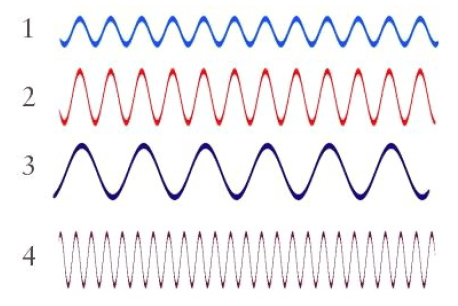
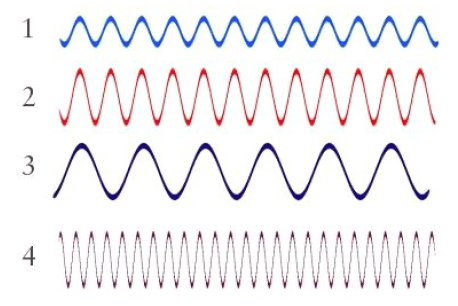
Which wave in the diagram has the greatest frequency?
a)
1
b)
2
c)
3
d)
4
12.
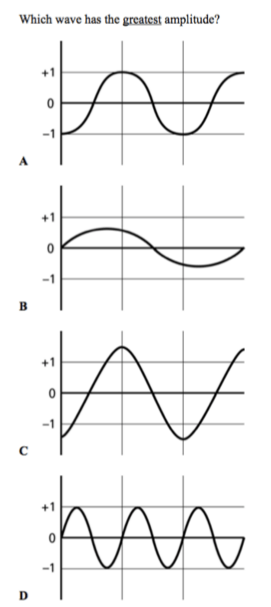
Which wave has the greatest amplitude?
a)
A
b)
B
c)
C
d)
D
13.

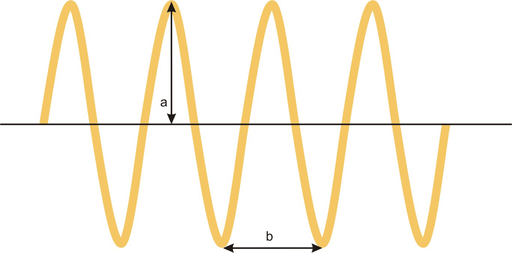
What is the amplitude of this wave?

a)

4

b)

8

c)

2

d)

6.3

14.

What is the wavelength of this wave?

a)

4

b)

8

c)

3.3

d)

6.3

15.
When the frequency of a wave increases, what happens to the wavelength?
a)
The wavelength is not directly affected by the frequency of a wave.
b)
The wavelength increases.
c)
The wavelength decreases.
d)
More specific information is needed to form a conclusion about the wavelength.
16.
The distance from one point to the next corresponding point on a wave is called the ________________.
a)
waveform
b)
peak
c)
amplitude
d)
wavelength
17.
High energy waves have a ____. 
a)
high frequency
b)
low frequency
c)
small amplitude
d)
big wavelength
18.
High frequency waves have _________ wavelength.
a)
varying
b)
high
c)
the same
d)
low
19.
One end of the rope is vibrated to produce a wave with a wavelength of .25 m.  The Frequency of the wave is 3.0 Hz.  What is the speed of the wave?
a)
3.00 m/s
b)
2.50 m/s
c)
.75 m/s
d)
1.25 m/s
20.
What is a medium?
a)
something between a small and a large?
b)
the substance through which a wave can travel
c)
a pattern of vibration that simulates when a wave is standing still
d)
the distance from any point on a wave to an identical point on the next wave
21.
How many waves are in this wave chain?
a)
6
b)
3
c)
4
d)
5
22.
A tennis coach paces back and forth along the sideline 10 times in 2 minutes. The frequency of her pacing is 
a)
5 Hz
b)
5 s
c)
0.08 Hz
d)
0.08 s
23.
Which wave in the diagram has the greatest wavelength?
a)
1
b)
2
c)
3
d)
4
24.

A guitar string vibrates with a frequency of 320 hz. If the wavelength of the vibration is 0.23 meters what is the speed of the wave?

a)

320.23 m/s

b)

1391.3 hz

c)

73.6 m/hz

d)

73.6 m/s

25.
The blue-throated hummingbird flaps its wings 300 times a minute.  What is its frequency?
a)
5 hz
b)
300 hz
c)
300/60 
d)
a lot?
26.

If this wave chain represents 1 second, What is the frequency of the waves?

a)

1 Hz

b)

9 Hz

c)

3 Hz

d)

6 Hz

27.

Which material does light pass through the slowest?

a)

air

b)

water

c)

glass

d)

diamond

28.

What type of wave interaction is shown?

a)

diffraction

b)

reflection

c)

refraction

d)

interference

29.

Standing waves are caused by

a)

reflection

b)

wave interference

c)

refraction

d)

wave speed

30.

Which phenomena of light is shown?

a)

refraction

b)

diffraction

c)

reflection

d)

interference

31.

when a crest of one wave, interacts with a trough of a second wave, what is the result?

a)

constructive interference

b)

superposition

c)

destructive interference

d)

antinodes

32.

What phenomena is pictured?

a)

constructive interference

b)

destructive interference

c)

reflection

d)

diffraction

33.

Which wave has a greater wavelength?

a)

A

b)

B

34.

Which wave has a greater frequency?

a)

A

b)

B

35.

What are the spaced out sections of this wave called?

a)

Reflections

b)

Rarefactions

c)

Wavelength

d)

Compressions

36.

This image depicts which of the following wave behaviors?

a)

Reflection

b)

Refraction

c)

Diffraction

d)

Resonance

37.

The two blue and purple waves will undergo _________________ when they meet.

a)

Constructive interference

b)

Destructive interference

38.

Which of the pictured is responsible for our sky being blue?

a)

Transmission

b)

Reflection

c)

Refraction

d)

Scattering

e)

Absorption

39.

Which of the pictured is responsible for black pavement being hot?

a)

Transmission

b)

Reflection

c)

Refraction

d)

Scattering

e)

Absorption

40.

Which of the pictured is responsible for us being able to see objects?

a)

Transmission

b)

Reflection

c)

Refraction

d)

Scattering

e)

Absorption

41.
Which color absorbs all light?
a)
White
b)
Black
c)
Orange
d)
Green
42.
Waves are disturbances that transfer ______ from one place to another.
a)
matter
b)
energy
c)
heat
d)
light
43.
Why does a purple shirt appear purple?
a)
the shirt material REFLECTS all wavelengths of color 
b)
the shirt material transmits all wavelengths of color except the purple
c)
the material absorbs all wavelengths of color except the purple wavelength
44.

The more energy a wave has, the greater its ____

a)

speed

b)

amplitude

c)

wavelength

45.
The orca uses this behavior of waves to locate food.
a)
Refraction
b)
Reflection
c)
Absorption
d)
Transmission
46.
What is a medium?
a)
something between a small and a large?
b)
the substance through which a wave can travel
c)
a pattern of vibration that simulates when a wave is standing still
d)
the distance from any point on a wave to an identical point on the next wave