

wayground logo

Free Printable Worksheets

Font size

S
M
L
XL
Worksheets

Fusion unit 13 revision

Total questions: 100

Worksheet time: 1hrs 27mins

Name
Class
Date
1.
Something that takes up space and has mass.
a)
volume
b)
matter
c)
mass
d)
density
2.
The amount of space something takes up
a)
density
b)
volume
c)
mass
d)
matter
3.
What are the three states of matter?
a)
solid, volume, mass
b)
density, volume, mass
c)
solid, liquid, gas
d)
density, gas, volume
4.
__________ are the building blocks of life.
a)
solids
b)
gases
c)
atoms
d)
nutrients
5.
Gasoline is a ________________.
a)
liquid
b)
solid
c)
gas
6.
Sand is a ___________________.
a)
liquid
b)
solid
c)
gas
7.
Helium is a ____________.
a)
liquid
b)
solid
c)
gas
8.
I am the smallest whole particle of matter. 
a)
atom
b)
compound
c)
molecule
d)
mixture
9.
I am two or more atoms chemically bonded.
a)
atom
b)
compound
c)
molecule
d)
mixture
10.
I am 2 or more elements chemically bonded.
a)
atom
b)
molecule
c)
compound
d)
mixture
11.
Which 2 kinds of particles make up the nucleus of an atom?
a)
electrons and neutrons
b)
electrons and nuclei
c)
protons and neutrons
d)
protons and kryptons
12.
Which particle carries a negative charge?
a)
protons
b)
neutrons
c)
electrons
13.
A pure substance that cannot be broken down into any other substance by chemical or physical means. There are about 100 of us shown in the Periodic Table
a)
compound
b)
mixture
c)
molecule
d)
element
14.
How can you describe this picture?
a)
liquid
b)
solid
c)
gas
15.
What is an example of gas?
a)
crayons
b)
paper
c)
soda
d)
air
16.
Type of matter made of two or more elements...
a)
element
b)
mixture
c)
compound
17.
What kind of charge do protons have?
a)
positive
b)
negative
c)
neutral
18.
Neutrons have a ________ charge.
a)
positive
b)
negative
c)
neutral
19.
Why is a balloon with air in it heavier than a balloon without air?
a)
it's larger
b)
it has matter in it
c)
it takes up more space
d)
none of the above
20.
Which of these is matter?
a)
energy
b)
air
c)
peace
d)
love
21.
Which of these is LESS dense than air?
a)
styrofoam
b)
sodium hexafluoride
c)
helium
d)
wood
22.
Which property of matter did the team use to figure out which gas was which?
a)
conductivity
b)
magnetism
c)
solubility
d)
density
23.
The amount of matter in an object is a measure of the object's ________________.
a)
volume
b)
density
c)
mass
d)
solubility
24.
What is the volume of the rock? The water level is displaced from 20 mL to 23 mL with the rock.
a)
3 mL
b)
23 mL
c)
20 mL
d)
43 mL
25.
When a gas turns into a liquid, it is called ___________________.
a)
Condensation
b)
Evaporation
c)
Melting
d)
Freezing
26.

A student places an ice cube and a glass marble in a container of water. Which statement best explains what will happen to the ice cube and the glass marble?


a)

The ice cube will sink in water, and the glass marble will float in water.

b)

The ice cube will float in water, and the glass marble will sink in water.

c)

The ice cube and the glass marble will both float in water.

d)

The ice cube and the glass marble will both sink in water
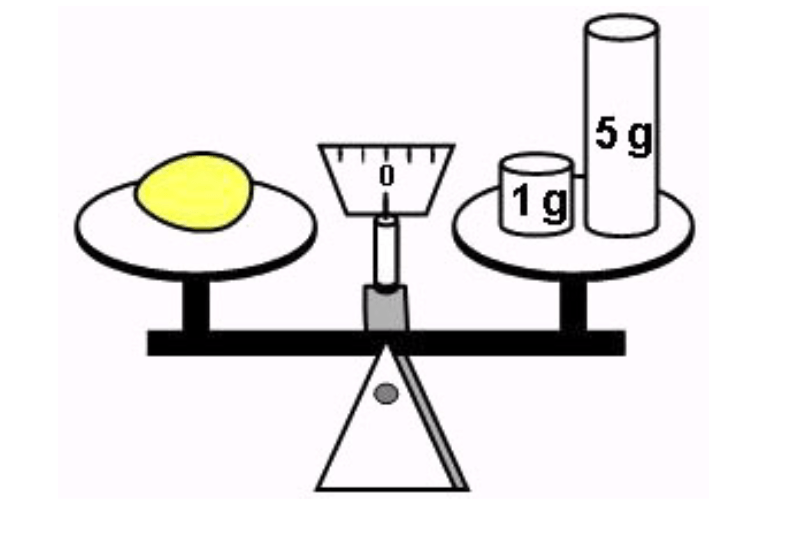
27.

What is the mass of this hollow plastic egg?

a)

15 g

b)

4 g

c)

6 kg

d)

6 g

28.
Something that takes up space and has mass.
a)
volume
b)
matter
c)
mass
d)
density
29.

The center of an atom is called the _________.

a)

electron cloud

b)

atomic center

c)

neutron cloud

d)

nucleus

30.

What two subatomic particles are located in the nucleus?

a)

neutrons and electrons

b)

protons and neutrons

c)

protons and electrons

31.

The periodic table lists all the ___________________________ in order

a)

groups

b)

elements

c)

symbols

d)

letters

32.

An object's mass doesn't change if you cut up the object of change its shape. Scientists say that the object's mass is ______, or kept the same.

a)

lost

b)

gained

c)

conserved

d)

preserved

33.

One of the fundamental states of matter without a definite volume or shape.

a)

Solid

b)

Gas

c)

Liquid

d)

Matter

34.

One of the fundamental states of matter with a definite volume but no definite shape.

a)

Solid

b)

Gas

c)

Liquid

d)

Mass

35.

The amount of matter an object contains.

a)

Matter

b)

Solid

c)

Gas

d)

Mass

36.

One of the fundamental states of matter with a definite shape and a definite volume.

a)

Matter

b)

Volume

c)

Solid

d)

Liquid

37.

The amount of space that an object or substance occupies.

a)

Mass

b)

Gas

c)

Matter

d)

Volume

38.

Made from two or more kinds of matter that a physically blended together.

a)

Mixture

b)

Mass

c)

Dissolve

d)

Liquid

39.

A reaction or a change in a substance produced by a chemical means that forms a new substance.

a)

Gas

b)

Physical Change

c)

Matter

d)

Chemical Change

40.

A change in which the form or shape of a substance changes; does not result in the formation of a new substance

a)

Volume

b)

Physical Change

c)

Liquid

d)

Chemical Change

41.
Measure of the amount of matter 
a)
mass
b)
volume
c)
weight
d)
density
42.
Anything that has mass & takes up space
a)
gravity
b)
force
c)
matter
d)
volume
43.
A 55-gram egg is placed in a pot. After the egg is boiled, which is most likely the mass of the egg?
a)
50 
b)
55 
44.
Jason poured 500 grams of water into a container and tightly sealed it. The water was allowed to freeze. Which is most likely true about the ice that formed?
a)
The mass of the ice is the same as the mass of the water.
b)
The mass of the ice is greater than the mass of the water.
c)
The ice formed is a different substance than the water.
d)
The ice formed is the same temperature as the water.
45.
Which of these is not a chemical reaction?
a)
Burning of wood
b)
Milk going bad
c)
Mixing vinegar and baking soda
d)
Melting of ice
46.

If a physical change occurs...

a)

A new substance has been formed

b)

The substance is the same, but looks different

47.
A student notices that an inflated balloon gets larger when it is warmed by a lamp. Which best describes the mass of the balloon as a result of this change?
a)
The mass of the balloon increases because the size of the balloon has increased.
b)
The mass of the balloon increases because the temperature of the balloon has increased.
c)
The mass of the balloon stays the same because the gas inside the balloon still has the same mass after it warms up.
48.
A 500-gram block of solid cheese is melted in a pot. Which is most likely the mass of the cheese after it is melted?
a)
500 grams, because the cheese does not gain or lose mass just because it was melted
b)
499 grams, because some of the cheese evaporates as it melts
c)
502 grams, because the cheese absorbs heat as it melts
49.
Jamie weighs a glass of water and observes its weight to be 12 ounces. Jamie then adds 6 ice cubes to the glass of water. Each ice cube weighs one ounce. After all of the ice cubes have melted, what will be theapproximate weight of the glass of water?
a)
b)
12 
c)
18 ounces
50.

What are the three states of matter?

a)

solid, volume, mass

b)

density, volume, mass

c)

solid, liquid, gas

d)

density, gas, volume

51.

All matter is made of

a)

energy

b)

atoms

c)

air

d)

chemistry

52.

Matter is made up of tiny _____________ called _________________.

a)

matter, mass

b)

volume, atoms

c)

particles, molecules

d)

theories, atoms

53.

Atoms are made up of what 3 parts?

a)

positive, negative, and neutral

b)

protons, neutrons, and electrons

c)

molecules, atoms, particles

d)

water, hydrogen, oxygen

54.
The smallest unit of a pure substance that has the properties of that substance
a)
element
b)
atom
c)
neutron
d)
compound
55.
The nucleus is made up of -
a)
neutrons and electrons
b)
protons and neutrons
c)
protons and electrons
d)
electrons and quarks
56.
Protons have this charge -
a)
positive
b)
negative
c)
neutral
d)
no charge
57.
Electrons have this charge - 
a)
positive
b)
negative
c)
neutral
d)
no charge
58.
Neutrons have this charge -
a)
positive
b)
negative
c)
neutral
d)
They don't exist
59.

The smallest particle of matter that makes up an element and a compound?

a)

Element

b)

Chemical

c)

Atom

d)

Substance

60.

Which statement best describes an element?

a)

pure, made of more than one type of atom

b)

when combined, a chemical reaction forms

c)

pure, made of only one type of atom

d)

can be broken down easily

61.
Which one has more than one type of atom in it?
a)
Element
b)
Compound 
62.

Helium (He) is an example of an:

a)

Element

b)

Compound

c)

Solution

d)

Mixture

63.

When two or more different elements chemically combine, a __________________________ is formed.

a)

element

b)

compound

c)

mixture

d)

solution

64.

Examples are water (H2O) and carbon dioxide (CO2).

a)

elements

b)

compounds

65.

This picture represents which of the following?

a)

element

b)

compound

66.
a)
Element
b)
Compound
67.
Which of the following represents an element?
a)
H2O
b)
H2
c)
NaCl
d)
CaCO3
68.
A combination of two or more substances that can be easily separated.
a)
dissolve
b)
mixture
c)
solution
d)
physical property
69.
To break down into tiny pieces to small to be seen.
a)
solute
b)
solvent
c)
dissolve
d)
solution
70.
process where a liquid becomes a gas
a)
condensation
b)
evaporation
c)
physical property
d)
dissolve
71.
the substance to be dissolved in a liquid
a)
solute
b)
solvent
c)
dissolve
d)
mixture
72.
the liquid a substance dissolves in
a)
solute
b)
solvent
c)
mixture
d)
solution
73.
process where a gas turns back into a liquid
a)
melting
b)
freezing
c)
evaporation
d)
condensation
74.
characteristics that can be used to classify matter
a)
mixture
b)
solution
c)
solute
d)
physical property
75.
If I added 27 grams of salt to water and separated the solution with a hot plate, what amount of salt would be left behind?
a)
20 grams
b)
0 grams
c)
27 grams
d)
10 grams
76.
Solutions are a type of mixture.  What makes solutions different from other mixtures is....
a)
The elements in a solution react to compounds
b)
One substance dissolves in the other
c)
Two or more substances are combined
d)
There is a chemical change when combined
77.
A combination of 2 or more ingredients where each keep their own physical properties and can be easily separated.
a)
solution
b)
dissolve
c)
mixture
d)
saltwater
78.
Changes affecting the form of an object, such as cutting or folding paper.
a)
separate
b)
physical property
c)
ingredient
d)
physical change
79.
A mixture of one substance evenly dissolved in another.
a)
mixture
b)
property
c)
density
d)
solution
80.
The process of a liquid turning into a gas when heat is added.
a)
condensation
b)
melting
c)
evaporation
d)
freezing
81.
Which of the following, if added to water, will change shape?
a)
salt
b)
sand
c)
wood
d)
glass
82.
Which example below describes a simple mixture where the ingredients maintain their physical properties?
a)
bucket of saltwater and sand
b)
peanuts, raisins, and chocolate pieces
c)
sugar and water
d)
all of the above
83.
You have the following solids in a lab: salt, sand, lemonade powder, and pepper.  Which solids will dissolve in water to create a solution?
a)
pepper, sand, and salt
b)
salt, lemonade powder, and sand
c)
salt and lemonade powder
d)
pepper and sand
84.
Which property of tea changes when it is mixed with sugar?
a)
color
b)
taste
c)
shape
d)
state
85.

It refers to the space that matter occupies.

a)

volume

b)

mass

c)

weight

d)

density

86.

It is the amount of matter in an object.

a)

volume

b)

mass

c)

weight

d)

density

87.

What units do we use to measure mass?

a)

meter

b)

Celsius

c)

kilogram/gram

d)

Newton

88.

Which of the following determines an object’s ability to float in water?

a)

volume

b)

mass

c)

weight

d)

density

89.

What will you do to a bread to demonstrate physical change?

a)

Burn it.

b)

Toast it.

c)

Slice it.

d)

Spoil it.

90.

What type of change occurs when the milk gets spoiled?

a)

Change in state

b)

Chemical change

c)

Physical change

d)

Change in odor

91.
Evidence of Chemical Change.
a)
New Substance 
b)
Size change
c)
State change
d)
Mixture 
92.
Evidence of a physical change.
a)
New substance
b)
Shape Change
c)
Light produced
d)
Gas released.
93.
Fireworks Exploding are a ________ change.
a)
Physical Change
b)
Chemical Change
94.
Water boiling is a _______ change. 
a)
Physical Change 
b)
Chemical Change 
95.
Which is a chemical property 
a)
Reactivity 
b)
Solid
c)
Color
d)
Shape
96.
A piece of paper burned. This shares a property that paper has. What is a chemical property that paper has been shown? 
a)
Flammable
b)
Reactive to Acid
c)
Shape change
d)
Size change
97.
A characteristic that can only be determined by changing the identity of an object. 
a)
Physical Change
b)
Chemical Change
c)
Chemical Property 
d)
Physical Property 
98.
A characteristic that can be observed or measured without changing the composition of the substance. 
a)
Physical change
b)
Chemical change
c)
Chemical Property
d)
Physical Property
99.
Sugar is dissolved into Kool Aid. What type of change is this? 
a)
Chemical 
b)
Physical 
c)
Multi
d)
Asystematic 
100.
A particular characteristic of a substance. 
a)
property
b)
matter 
c)
physical change
d)
chemical change
