wayground logo

Free Printable Worksheets

Font size

S
M
L
XL
Worksheets

7th Grade Trimester Test Review (Forces and Motion)

Total questions: 100

Worksheet time: 3hrs 38mins

Name
Class
Date
1.
The Olympian swam 200 meters in 20 seconds. 
a)
speed
b)
velocity
c)
acceleration
2.
The tornado is traveling northwest at 20 mph. 
a)
speed
b)
velocity
c)
acceleration
3.
How far will a person go if they jog for 2 hours at a speed of 12 km/hr?
a)
6 km
b)
0.5 km
c)
10 km
d)
24 km
4.
When a car goes around a corner at 20 mph, why do we say it  accelerates?
a)
The car is accelerating because of the velocity is constant
b)
The car accelerates because it's going 20 mph
c)
Cars always accelerate when they are in motion
d)
The car is accelerating because it's changing direction
5.
What is velocity?
a)
the quickness of an object
b)
the location of an object
c)
acceleration
d)
speed in a specific direction
6.

Describe the speed of the object from 4-6 seconds using the distance vs. time graph.

a)

Increasing speed

b)

Decreasing speed

c)

Not moving

d)

Constant speed

7.
Describe the speed of the object from
2-5 seconds using the speed vs. time graph.
a)
Increasing speed
b)
Not moving
c)
Decreasing speed
d)
Constant speed
8.

If the average speed of a car is 110 km/h, how long will it take the car to travel 715 km?

a)

78.65 km/h

b)

6.5 km/h

c)

6.5 h

d)

78.65 h

9.

A kindergartner moves down the hall at 3.2 m/s. When he sees me coming, he slows down. After 3.2 s, he is moving at 1.2 m/s. What is his acceleration?

a)

-0.25 m/s2

b)

-42.9 m/s2

c)

-0.625 m/s2

d)

-12 m/s2

10.
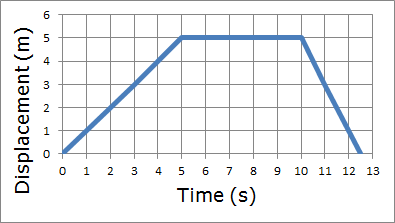
According to the graph how far does the person travel in the first 5 seconds?
a)
2 m
b)
10 m
c)
0 m
d)
5 m
11.
What is the person doing from 5 seconds to 10 seconds?
a)
Walking 
b)
Running
c)
Standing Still 
d)
Walking Fast
12.
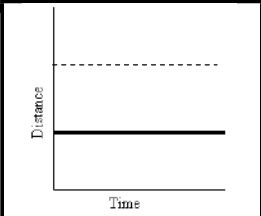
What does this graph represent?
a)
Constant speed
b)
Acceleration
c)
Not moving
13.
What is a force?
a)
the PUSH or PULL on an object 
b)
The MOTION an object creates
c)
The objects HITTING one another
d)
Going REALLY FAST
14.
What is the unit for FORCE? 
a)
N (Newtons)
b)
lbs (pounds)
c)
g (grams)
d)
m/s (meters per second)
15.
Forces that have a force of Zero (0).
a)
Balanced force
b)
Unbalanced force
16.
If there are two forces going in the SAME direction, you would ...?
a)
(-) Subtract the forces
b)
(+) Add the forces
c)
Neither
d)
(x) Multiply
17.
What is the net force?
a)
17 N Right
b)
3 N Right
c)
3 N Left
d)
17 N Left
18.
Students are playing tug-of-war. If group B pulls the rope to the right with a force of 400 N and group A pulls the rope to the left with a force of 250 N, what will happen to the ribbon in the middle of the rope?
a)
The ribbon will move to the left and group A will win the tug-of-war.
b)
The ribbon will move to the left and group B will win the tug-of-war.
c)
The ribbon will move to the right and group B will win the tug-of-war.
d)
The ribbon will move to the right and group A will win the tug-of-war.
19.
A cyclist traveling at 25 km/hr turns sharply to the left while continuing to move 25 km/hr. This means the forces involved are_____________________.
a)
Balanced, because the cyclist's speed did not change.
b)
Balanced, because he was still moving forward.
c)
Unbalanced, because it's the same bicycle.
d)
Unbalanced, because his direction changed.
20.
An airplane is travelling at a constant speed of 540 mph.  Explain the forces at work on the plane.
a)
Unbalanced, because the plane is moving forward not backards
b)
Balanced, because the speed is constant and there is no change in direction
c)
Balanced, because the plane is not falling to a lower altitude
d)
Unbalanced, because the plane is in motion
21.
An airplane is travelling North through the sky at a constant speed when turbulence causes it to take a different route, changing its direction. Explain the forces at work on this plane.
a)
Unbalanced, because the plane is moving forward, not backwards
b)
Unbalanced, because the speed is constant and there is a change in direction
c)
Balanced, because the plane is not falling to a lower altitude
d)
Unbalanced, because the plane is in motion
22.
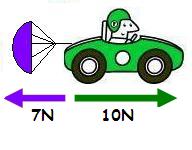
What is the magnitude (size) and direction of the net force?
a)
15 N to the left
b)
15 N to the right
c)
1 N to the left
d)
1 N to the right
23.

An objects resistance to change of speed or direction?

a)

speed

b)

inertia

c)

unbalanced force

d)

gravity

24.
The change in position of an object.
a)
Acceleration
b)
Motion
c)
Equilibrium
d)
Unbalanced Force
25.

What is mass?

a)

when all forces added together equals 0 so there is no movement

b)

energy that is stored

c)

movement of an object

d)

the amount of matter in an object

26.

What is weight?

a)

the amount of matter an object has

b)

the measure of the force of gravity pulling down on an object

c)

the same as mass

d)

a unit used to measure force

27.

force that opposes the motion of objects that move through the air

a)

gravity

b)

air resistance(drag)

c)

speed

28.

What is energy?

a)

moving energy

b)

stored energy

c)

renewable energy

d)

The ability to do work.

29.

An object's location or _______________ is the distance from a reference point.

a)

distance

b)

position

c)

acceleration

d)

displacement

30.

Every action has an opposite, equal reaction.

a)

Newton's 1st law

b)

Newton's 2nd law

c)

Newton's 3rd law

d)

Fig Newton's law

31.

An object at rest will remain at rest unless acted upon by an unbalanced force. Likewise an object in motion will remain in motion unless acted upon by an unbalanced force.

a)

Newton's 2nd law

b)

Newton's 3rd law

c)

Fig Newton's law

d)

Newton's 1st law

32.

Motion of an object depends on the objects mass and the net force applied to it.

a)

Newton's 3rd law

b)

Newton's 1st law

c)

Newton's 2nd law

d)

Fig Newton's law

33.
Rockets are launched into space using jet propulsion where exhaust accelerates out from the rocket and the rocket accelerates in an opposite direction.
a)
Newton's 1st Law
b)
Newton's 2nd Law
c)
Newton's 3rd Law
d)
None of them
34.
A picture is hanging on a wall and does not move.
a)
Newton's 1st Law
b)
Newton's 2nd Law
c)
Newton's 3rd Law
d)
None of them
35.
A magician pulls a tablecloth out from under dishes and glasses on a table without disturbing them.
a)
Newton's 1st Law
b)
Newton's 2nd Law
c)
Newton's 3rd Law
d)
None of them
36.
A person not wearing a seatbelt flies through a car window when someone slams on the breaks because the person’s body wants to remain in continuous motion even when the car stops.
a)
Newton's 1st Law
b)
Newton's 2nd Law
c)
Newton's 3rd Law
d)
None of them
37.
Pushing a child on a swing is easier than pushing an adult on the same swing, because the adult has more inertia.
a)
Newton's 1st Law
b)
Newton's 2nd Law
c)
Newton's 3rd Law
d)
None of them
38.
Acceleration is produced when a force acts on a mass. The greater the mass (of the object being accelerated) the greater the amount of force needed (to accelerate the object).
a)
Newton's 1st Law
b)
Newton's 2nd Law
c)
Newton's 3rd Law
d)
None of them
39.
The swimmer moves her hand down and to the left and her body goes forward to the right.
a)
Newton's 1st Law
b)
Newton's 2nd Law
c)
Newton's 3rd Law
40.
What is the magnitude (size) and direction of the net force?
a)
21 N to the Left
b)
3 N to the Left
c)
21 N to the Right
d)
3 N to the Right
41.
What is the net force needed to accelerate a 66 kg skier at 2 m/sec2?
a)
132 N
b)
33 N
c)
58.8 N
d)
.030 N
42.
A net force of 250 N is applied to an object that accelerates at a rate of 5 m/sec2.  What is the mass of the object?
a)
50 kg
b)
245 kg
c)
.02 kg
d)
25.5 kg
43.
What is the unit for acceleration?
a)
m/s
b)
m/s2
c)
kg*m/s
d)
N
44.
What is the unit for mass?
a)
m/sec
b)
kg/sec
c)
kg
d)
kg m/sec
45.
A ball thrown into the air starts out with an initial upward velocity, but eventually slows and stops before falling back to the ground. Which of the following contributes the most to the change in motion of the ball?
a)
The initial force with which the ball is thrown
b)
The downward force of gravity
c)
The resistance against the atmosphere
d)
The increase of inertia
46.

Which of the following is the best example of work being done.

a)

doing homework

b)

lifting a box

c)

pushing a stationary box

d)

holding a box

47.
If 150 Joules of work is needed to move a box 10 meters, what force was used? 
a)
1500 N
b)
15 N
c)
1.5 N
d)
150 N
48.

What would 54N be an example of?

a)

work

b)

power

c)

distance

d)

force

49.

what would 1m be an example of?

a)

work

b)

power

c)

time

d)

distance

50.

what would 14J be an example of?

a)

work

b)

distance

c)

time

d)

force

51.
The amount of work done in a certain amount of time is known as 
a)
work
b)
effort force
c)
resistance force 
d)
power
52.

If you increase your work and decrease your time, you will have

a)

more power

b)

less power

c)

same amount of power

d)

power rating can not be determined

53.
A _____ is a fixed bar  that us free to move around a fixed point known as a fulcrum.
a)
pulley
b)
inclined plane
c)
lever
54.
If you use a crowbar to get the lid off of a bucket, what simple machine are you using?
a)
Inclined Plane
b)
Pulley
c)
Wheel and Axle
d)
Lever
55.
What type of simple machine is found on the cap of a pickle jar?
a)
lever
b)
inclined plane
c)
pulley
d)
screw
56.
Which of these is an example of a wedge?
a)
skateboard
b)
broom
c)
stairs
d)
butter knife
57.
Consists of two circular objects; a central shaft and a wheel.
a)
wheel and axle
b)
screw
c)
pulley
58.
Calculate the amount of work done if you use a 100N force to push a 50 kg box 5 m across the kitchen floor. 
a)
250 J 
b)
500 J
c)
5000 J
d)
50,000 J
59.
A 16 N force is applied to an object and 96 J of work is done. How far was the object moved?
a)
6 m
b)
16 m 
c)
80 m 
d)
1536 m 
60.
What is work?
a)
A push or pull.
b)
When the object moves in the same direction in which the force is exerted.
c)
A change in energy.
d)
The rate at which energy is transferred.
61.

An axe is an example of a

a)

pulley

b)

inclined plane

c)

screw

d)

wedge

62.

The fixed point on the lever is called

a)

load

b)

resistance

c)

bar

d)

fulcrum

63.
Which of the following does a simple machine do?
a)
allows the users to apply less force over a longer distance
b)
reduce the amount of force needed to do work
c)
change the direction of the applied force
d)
all of the above
64.

How can you reduce the amount of force required to lift an object using an inclined plane (ramp)?

a)

increase the length of the ramp

b)

increase the height of the ramp

c)

decrease the length of the ramp

65.
The table shows the force applied and displacement when different boxes are being pushed. Which box shows the most work being done? 
a)
W
b)
X
c)
Y
d)
Z
66.
An object being lifted or moved is a
a)
load
b)
fulcrum
c)
force
d)
work
67.
A doorknob is an example of a
a)
wheel and axle
b)
inclined plane
c)
pulley
d)
wedge
68.
Stairs
a)
wedge
b)
pulley
c)
inclined plane
d)
wheel and axle
69.

What is mechanical advantage?

a)

The advantage a machine has over a bicycle

b)

A measure of how much a simple machine reduces work

c)

A measure of when is the best time to use a simple machine

d)

the number of times a machine increases input force

70.

What is effort (input) force?

a)

the force one exerts on a machine

b)

the force which an effort force must overcome in order to do work on an object via a simple machine.

c)

the force the machine exerts on a object

d)

the output work times the input distance

71.

What is resistance (output) force?

a)

the force required by a machine in order to accomplish work (the force you put on the machine)

b)

The force that is exerted by a machine

c)

the force the machine exerts on a object

d)

the output work times the input distance

72.
The work of pulling the box will be _________ if the man uses the ramp.
a)
complete
b)
more difficult
c)
easier
d)
painful
73.
The ramp helps the man do work by reducing the input ____________.
a)
distance
b)
force
c)
time
d)
power
74.
A machine's __________________ is the number of times the machine multiplies the input force.
a)
power
b)
force
c)
mechanical advantage
d)
efficiency
75.
No machine in existence has 100% efficiency due to ____________________.
a)
magic
b)
friction
c)
smoke
d)
input
76.
How much work is done in holding a 15 N sack of potatoes while waiting in line at the grocery store for 3 minutes?
a)
15 J
b)
45 J
c)
0 J
d)
5 J
77.
A person weighing 600 N gets on an elevator. The elevator lifts the person 6 m in 10 seconds.  How much power was used?
a)
360 W 
b)
60 W
c)
3600 W
d)
600 W
78.
What is the unit of measurement for Power?
a)
Joules
b)
Newtons
c)
Watts
d)
Meters
79.
What is power?
a)
transfer a force through a distance
b)
the rate of speed 
c)
the rate of work being done
d)
transfer of space over time
80.
The unit used to measure work is the 
a)
Watt
b)
Newton
c)
Joule
d)
meter
81.

What is this graph showing?

a)

At rest

b)

Acceleration

c)

Constant speed of 1 m/s

d)

Gradually speeding up

82.

What is this graph showing?

a)

Constant speed

b)

Gradually speeding up

c)

Gradually slowing down

d)

At rest

83.

What is this graph showing?

a)

Fast constant speed

b)

Slow constant speed

c)

At rest

d)

Accelerating

84.

What is this graph showing?

a)

Fast constant speed

b)

Slow constant speed

c)

Accelerating

d)

At rest

85.

What is the graph showing?

a)

Constant high speed

b)

Stopped

c)

Accelerating

d)

Constant low speed

86.
What is happening at D?
a)
Stationary
b)
Accelerating
c)
Fast steady speed; moving away from the starting position
d)
Slower steady speed; moving away from the starting position
87.
What is happening at A?
a)
Stationary
b)
Accelerating
c)
Slower steady speed; moving away from the starting position
d)
Steady speed; returning to start position
88.
How long did it take this object to travel back to its reference/starting point?
a)
20 s
b)
30 s
c)
60 s
d)
100 s
89.
How long did it take this object to travel 10 m?
a)
0 s
b)
10 s
c)
15 s
d)
20 s
90.
Which is an example of zero acceleration?
a)
A merri-go-round moving at a constant rate
b)
A car coming to a stop
c)
A boat speeding up
d)
A person running on a treadmill at a rate of 6 MPH
91.
Morgan walks 10 miles South. Trevor walks 10 miles North in the same amount of time.  They have:
a)
Different average speeds
b)
Different velocities
c)
Same velocity
d)
Same motion
92.
A car starts from a stoplight and is traveling with a velocity of 10 m/sec east in 20 seconds.  What is the acceleration of the car?
a)
.5 m/s/s
b)
.5 m/s
c)
2 m/s/s
d)
2 m/s
93.
A car is driven for 3 hours. What else do you need to know to describe this car’s speed?
a)
the road the car in driven on
b)
the time of day
c)
the distance the car is driven
d)
the number of passengers in the car
94.

It is much more difficult to move a dresser full of clothes than an empty dresser. Why?

a)

An object in motion stays in motion.

b)

It takes more force to move an object with more mass.

c)

It takes more friction to move the empty dresser.

95.
Why does a rolling ball stop?
a)
Gravity
b)
Friction
c)
Waterfalls
d)
Sand
96.
An object is moving at a constant speed. The object changes direction & continues moving at the same speed. What caused the object to change direction?

a)
Inertia & gravity 
b)
Momentum 
c)
Change in speed 
d)
An outside force acted upon it
97.
A place or object used for comparison to determine if another object is in motion is called a
a)
comparison point
b)
reference point
c)
point of view
d)
motion detector
98.
What is another word used for negative acceleration?
a)
speeding up
b)
accelerating
c)
deceleration
d)
velocity
99.
If an object is not moving the forces acting upon it are _____________
a)
unbalanced
b)
weak
c)
balanced
d)
Hulk Smash!
100.
The sum of all forces acting on an object.
a)
Contact Force
b)
Balanced Force
c)
Unbalanced Force
d)
Net Force