wayground logo

Free Printable Worksheets

Font size

S
M
L
XL
Worksheets

Classification & Bacteria/Viruses

Total questions: 100

Worksheet time: 1hrs 12mins

Name
Class
Date
1.

Based on their names, Felis concolor and Felis leo do NOT belong to the same...

a)

species

b)

genus

c)

order

d)

group

2.

Some scientists propose that the kingdom Protista should be broken up into several kingdoms. Why?

a)

Protists are very diverse organisms

b)

They do not fit into other kingdoms

c)

They have characteristics of both plants and animals

d)

all of the these answer choices

3.

Select all the viral diseases. Select all that apply.

a)

AIDS

b)

Measles

c)

Polio

d)

Common Cold

4.

True or False: Viruses can be treated with antibiotics.

a)

True

b)

False

5.
How does a virus cause a person to develop the common cold?
a)
invades the host cell to reproduce
b)
removes energy from the host cell
c)
produces toxins in the host cell
d)
protects the host cell from bacteria
6.
True or False
The flu is caused by a virus.
a)
true
b)
false
7.
Antibiotics kill viruses
a)
True
b)
False
8.

A group of similar organisms that can mate and produce offspring is called a:

a)

Kingdom

b)

Genus

c)

Class

d)

Species

9.

What is binomial nomenclature?

a)

The two animals in a species that mate.

b)

The classification system was used prior to 1800.

c)

A two-name classification system that uses the genus and species name of an organism

d)

The domain of each living thing on earth.

10.

A _____ is a tiny, nonliving particle that enters and reproduces inside a living cell.

a)

Fungi

b)

Protist

c)

Virus

d)

Bacteria

11.

What does a virus need in order to survive?

a)

Watery environment

b)

A host cell

c)

Energy from the sun

d)

to be able to move from cell to cell

12.

What is the main difference between viruses and bacteria?

a)

Viruses are nonliving and bacteria are living cells

b)

Viruses are less serious than bacteria

c)

Nothing, they are pretty much the same

d)

Bacteria are good and viruses are bad

13.

This medicine is sometimes uses to treat bacterial infections.

a)

Vaccine

b)

Antibiotic

c)

Resistance formula

d)

Allergy medication

14.

Which of the following is NOT a type of fungus?

a)

mushroom

b)

mold

c)

yeast

d)

amoeba

15.
What type of cell are bacteria?
a)
eukaryote
b)
prokaryote
c)
animal
d)
plant
16.
Bacteria reproduce by a process called
a)
sexual reproduction
b)
conjugation
c)
binary fission
d)
meiosis
17.
One way in which bacteria are beneficial:
a)
they make food
b)
they cause disease
c)
they cause food poisoning
d)
they create sugar
18.
Another way in which bacteria are beneficial:
a)
they are decomposers
b)
they are the powerhouse of cells
c)
they contain special DNA
d)
they are used to make Diet Coke
19.
A third way in which bacterial are beneficial:
a)
they are apex predators
b)
they cause the change of seasons
c)
they help with bioremediation
d)
they help with the process of mitosis
20.
In what Kingdom would you find extreme bacteria? 
a)
Kingdom Bacteria
b)
Kingdom Archaea
c)
Kingdom Microbiologica
d)
Kingdom Protista
21.
Besides DNA or RNA, what else is a virus made of?
a)
a cell wall
b)
a cell membrane
c)
a protein coat
d)
a lipid coat
22.
Viruses are difficult to treat because they
a)
are very very sneaky
b)
they are constantly mutating
c)
they are immune to all medicines
d)
they move too fast to catch
23.
What tool do we use to classify things?
a)
Camera
b)
Scientists have to tell us
c)
Measuring tape
d)
Dichotomous key
24.
What field of study names living things?
a)
Taxonomy
b)
Taxidermy
c)
Taxi Driving
d)
Namology
25.
What is the largest group of living things?
a)
Class
b)
Kingdom
c)
Phylum
d)
Order
26.
The grouping of things according to their similarities is called:
a)
Nuclues
b)
Categorizing
c)
Classification
d)
Phylum
27.
Examples are mushrooms and yeast
a)
Fungi
b)
Protista
c)
Plantae
d)
Animalia
28.
Examples are daisies and oak trees
a)
Fungi
b)
Plantae
c)
Protista
d)
Animalia
29.
Examples are amoebas and parameciums
a)
Fungi
b)
Protista
c)
Plantae
d)
Animalia
30.
The classification system is written in what language?
a)
French
b)
English
c)
Latin
d)
Spanish
31.
As you move down the classification pyramid, the variety of organisms:
a)
Increases
b)
Stays the same
c)
Decreases
d)
Doubles
32.
Who developed the system of naming organisms with 2 names?
a)
Mendel
b)
Hooke
c)
Watson and Crick
d)
Linnaeus
33.
Which of the following is NOT a rule to writing scientific names?
a)
The genus is the first word and capitalized.
b)
Both the genus and the species are capitalized.
c)
The second word is the species and is lower case.
d)
The scientific name is either italicized or underlined.
34.
Why do we use scientific names?
a)
Because we like to sound smart.
b)
Because they are recognized world wide.
c)
Because organisms only have one common name and it makes it easier.
d)
What? What are scientific names?
35.

Bacteria is what type of cell?

a)

prokaryote

b)

eukaryote

36.
Name this bacteria shape
a)
coccus
b)
bacillus
c)
spirillum
37.

The bacteria shape seen in the picture is

a)

bacillus

b)

coccus

c)

spirilla

38.

How do some bacteria move?

a)

flagella

b)

cilia

c)

they don't

39.
 Viruses are considered to be nonliving  because _________
a)
they are not made of cells
b)
they cannot reproduce on their own
c)
they cannot make proteins
d)
all of the above
40.
How does antibiotic resistance show evidence of evolution?
a)
Mutations in bacterial cells have resistance to antibiotics, bacteria offspring then gain resistance.
b)
All bacteria go extinct. A new dominant bacteria has resistance to antibiotics.
c)
Mutation in bacterial cells have resistance to antibiotics, bacteria offspring loose resistance.
d)
Viruses and bacteria fought for dominance in precambrian time.  Bacteria won and is more resistant to anibiotics.
41.
Match the term with the correct definition.
Bacteria
a)
A reproductive process that involves only one parent and produces offspring that are genetically identical to the parent.
b)
single-celled organism that lack a nucleus, can be harmful or helpful.
c)
A reproductive process that involves two parents who combine thier genetic material to produce offspring genetically unique.
d)
An organism that can make its own food.
42.
A disease causing organism is known as a 
a)
pathogen
b)
poison
c)
vaccine
43.
Is the following disease caused by a bacteria or virus?
The Flu (Influenza)
a)
Bacteria
b)
Virus
44.
All bacteria are harmful to humans.
a)
True
b)
False
45.
All bacteria are ____________
a)
unicellular
b)
multicellular
c)
eukaryotic
d)
unicellular and multicellular
46.
Process by which bacteria reproduce asexually
a)
binary fission
b)
transduction
c)
transformation
d)
conjugation
47.
Bacteria can be helpful by ___________.
a)
helping us digest food
b)
making cheese
c)
breaking down dead organisms
d)
all of these
48.
Which of the following is a means for bacteria to enter your body?
a)
through the food you eat
b)
through a cut
c)
in the air you breathe
d)
all of these
49.
What does invading the host cell enable the virus to do?
a)
increase its size
b)
synthesize needed oxygen
c)
obtain nutrients
d)
reproduce
50.

A kingdom of mostly one-celled eukaryotic organisms that are different from plants, animals, bacteria, and fungi

a)

Bacteria

b)

Protista

c)

Animalia

d)

Fungi

51.
An organism whose cell contains nuclei
a)
Prokaryote
b)
Eukaryote
52.
Unicellular organism lacking a nucleus
a)
Prokaryote
b)
Eukaryote
53.
Classified in the Kingdom Animalia
a)
human
b)
mushroom 
c)
oak tree
d)
amobea
54.

Classified in the Kingdom Fungi

a)

humans

b)

mushrooms

c)

amoeba

d)

rose bush

55.
A specific term for an organism, made up of the genus and species
a)
taxonomy
b)
scientific name
c)
dichotomous key
d)
classification
56.
a tool used to identify an organism
a)
classification
b)
dichotomous key
c)
taxonomy
57.
the process of grouping items based on their similarities
a)
classification
b)
dichotomous key
c)
scientific name
d)
taxonomy
58.
the science of describing, naming, and classifying organisms
a)
taxonomy
b)
classification
c)
scientific name
d)
dichotomous key
59.

Single celled, lives in extreme environments

a)

Archaea

b)

Bacteria

c)

Protista

d)

Plantae

60.

Multi-celled, most can move on their own

a)

Archaea

b)

Plantae

c)

Protista

d)

Animalia

61.

To what kingdom do viruses belong?

a)

None (not a living thing)

b)

Protista

c)

Archaea

d)

Bacteria

62.

Which of the following would most

likely NOT be considered by scientists when classifying

organisms?

a)

do they have a backbone

b)

how humans use the organism

c)

number of legs

d)

all of the above should be considered

63.

The scientific name for the common house cat is Felis domesticus. What is its species name?

a)

Felis

b)

Animalia

c)

domesticus

d)

house cat

64.

What “Super Scientist” would most likely study organisms in kingdom Fungi?

a)

Botanist

b)

Hydrologist

c)

Ichthyologist

d)

Mycologist

65.

All animals need an outside source of energy. What is an animal that eats other organisms

called?

a)

producer

b)

decomposer

c)

consumer

d)

parasite

66.

What is one way viruses are like humans?

a)

they eat

b)

they are made of cells

c)

they have genetic material (DNA)

d)

they are eukaryotes

67.

The name Streptococcus tells you that the bacteria is ____________________ shaped.

a)

spiral

b)

bacteriophage

c)

spherical

d)

rod

68.

What is one way bacteria are considered helpful?

a)

They are nature’s “little recyclers.”

b)

They are used to make many of the foods we eat.

c)

Some bacteria are able to ‘fix’ atmospheric nitrogen into a form that can be absorbed by the plant as a fertilizer.

d)

All of the given answers are examples of how bacteria is helpful.

69.

Using the Table, which of the species shown are most closely related?

a)

Mammals 1, 2, 5

b)

Mammals 2 and 3

c)

Mammals 4 and 5

d)

Mammals 3 and 4

70.
Bacteria are prokaryotes which means they
a)
have a nucleus on their capsule
b)
do not contain a nucleus
c)
can live in environments with and without oxygen
71.
Name this bacteria shape
a)
bacillus
b)
coccus
c)
spirillum
72.
Name this bacteria shape
a)
coccus
b)
bacillus
c)
spirillum
73.
Bacteria are only found in dirty places
a)
True
b)
False
74.
Live bacteria are found in milk, cheese and yogurt
a)
True
b)
False
75.

Are there more helpful or harmful bacteria in the world?

a)

Harmful

b)

Helpful

76.

Name this bacteria shape

a)

bacillus

b)

coccus

c)

spirillum

77.

A disease causing organism

a)

pathogen

b)

poison

c)

vaccine

78.
Bacteria undergo which type of reproduction? 
a)
asexual
b)
sexual
79.
Is all bacteria bad? 
a)
No, most is good or harmless
b)
Yes, most will get you sick
c)
Most bacteria is actually not very well known. 
80.
Is a virus alive?
a)
Yes
b)
Sure is
c)
Most Def'
d)
Naw, son...
81.

What is a vaccine?

a)

are available to kill every known virus

b)

something that helps the body fight viruses.

c)

a purple fruit from France.

d)

something that will kill all bacteria

82.

Living things in this kingdom possess specialized sense organs that allow them to respond quickly to changes in their environment.

a)

Animalia

b)

Archaea

c)

Bacteria

d)

Fungi

e)

Plantae

83.

This kingdom includes complex, multicellular organisms that are usually green, have cell walls, and make their own food by photosynthesis.

a)

Animalia

b)

Archaea

c)

Bacteria

d)

Fungi

e)

Plantae

84.

Euglena is a member of this kingdom

a)

Animalia

b)

Archaea

c)

Bacteria

d)

Fungi

e)

Protists

85.

Found in/around hot springs (such as in Yellowstone National Park).

a)

Animalia

b)

Archaea

c)

Bacteria

d)

Fungi

e)

Protists

86.

E. coli is a member of this domain

a)

Animalia

b)

Archaea

c)

Bacteria

d)

Fungi

e)

Protists

87.

An entomologist would be interested in living things that belong to this kingdom.

a)

Animalia

b)

Archaea

c)

Bacteria

d)

Fungi

e)

Protists

88.

A thick-walled spore containing genetic material and proteins that allows the bacteria to survive a wide variety of harsh conditions.

a)

bacilli

b)

endospore

c)

host

d)

pathogenic

89.
A table of arachnid and insect characteristics is shown. Which characteristic could be used to distinguish between
arachnids and insects?
a)
Jointed legs
b)
Body segments
c)
Presence of eyes
d)
Presence of antennae
90.
A botanist discovers a new plant in the jungle. Which of the
following observations of the plant’s characteristics would be useful in determining its identity with a dichotomous key?
a)
It was discovered in the summertime
b)
It is wet from a recent rain storm.
c)
Its leaves curl up on the edges.
d)
It is eaten by native jungle ants.
91.
A dichotomous key for trees is provided. Hikers found a tree that has large brown cones and single sharp needles. What species of tree have the hikers found?
a)
Juniper
b)
Pine
c)
Spruce
d)
Fir
92.
What step do we always start with when using dichotomous keys?
a)
1
b)
2
c)
3
d)
4
93.
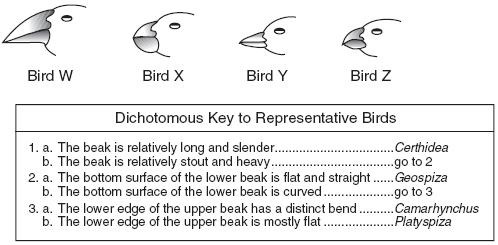
What is the name of bird Z?
a)
Certhidea
b)
Geospiza
c)
Camarhynchus
d)
Platyspiza
94.
Using this dichotomous key, identify the name of the circled Fish, J.
a)
peacock flounder
b)
band-tail puffer
c)
trumpet fish
d)
spotted goat fish
95.
The first part of a scientific name is an organism's _______________ and the second part is its ________________.
a)
species, genus
b)
phylum, order
c)
class, spices
d)
genus, species
96.

A student discovers an arachnid with a segmented abdomen, long legs, and a tail with no stinger.

The student uses the dichotomous key below to identify it.

1. a) Abdomen segmented.............go to 2

b) Abdomen not segmented ......go to 4

2. a) Abdomen with tail....................go to 3

b) Abdomen without tail...............go to 5

3. a) Tail with stinger..........................Scorpion

b) Tail without stinger.....................Whip scorpion

4. a) Legs longer than body.............Daddy Long Legs

b) Legs not longer than body……….Wind scorpion

5. a) Covered with spines .......................Mite

b) Few spines.....................................Tick

a)

Whip Scorpion

b)

Daddy Long Legs

c)

Mite

d)

Tick

97.
What do protists, plants, fungi, and animals ALWAYS have in common? They are all...
a)
Multicellular
b)
Eukaryotic
c)
Prokaryotic
d)
Consumers
98.
Which of the following is the least closely related animal:
Gray Wolf: Canis lupus
Aardwolf: Proteles cristatus
Coyote: Canis latrans
a)
Coyote
b)
Aardwolf
c)
Gray Wolf
d)
Need more information on body characteristics
99.

Identify the eight-word Scientific Name for a human?

a)

Eukarya, Animalia, Chordata, Primata, Mammalia, Homonidae, Homo, sapiens

b)

Eukarya, Mammalia, Animalia, Primata, Homonidae, Chordata, Homo, sapiens

c)

Eukarya, Animalia, Chordata, Mammalia, Primata, Homonidae, Homo, sapiens

d)

Eukarya, Animalia, Arachnida, Mammalia, Primata, Homonidae, Homo, sapiens

100.

What "Super Scientist" would be most interested in studying viruses?

a)

mycologist

b)

mammalogist

c)

herpetologist

d)

virologist