
 Worksheets
Thermal Energy
Total questions: 100
Worksheet time: 1hrs 26mins
Thermal energy being transferred from a hot mug of cocoa to the table it is sitting on is an example of __________.
convection
conduction
radiation
chemistry
Which best explains how this roasting marshmallows happens?
Heat from the fire is conducted to the marshmallow.
Heat from the fire is radiated to the marshmallow.
The coolness of the marshmallow is conducted to the fire.
The coolness of the marshmallow is radiated to the fire.
Which best describes heat transfer by radiation?
A slice of bacon frying in a pan.
A pot on a stove boiling water.
Cooking a hotdog in a microwave.
A hot air balloon.
Which of the following best describes CONVECTION?
When heat is transferred through waves.
When heat is transferred through objects that are touching.
The movement of gas or liquid in which warmer parts move up and the colder parts moves down.

Warm air rises and the cool air sinks demonstrates this type of heat transfer.
Conduction
Convection
Radiation

Walking on hot sand with your bare feet shows this type of heat transfer.
conduction
convection
radiation

Ironing a shirt is an example of:
condensation
evaporation
conduction
convection

You and your friends are gathered around a campfire to keep warm. How is heat being transferred to you?
conduction
convection
radiation

This is the transfer of thermal energy through "space".
conduction
radiation
convection
spaceship

What kind of heat transfer is occurring when the sun warms the sand?
Conduction
Convection
Radiation
All of them


a convective flow of energy is set up inside the iron bar.
energy is conducted from atom to atom along the length of the iron bar.


Which type of heat transfer is happening inside the hot air balloon?
convection
conduction
radiation
hot air balloon
The total energy of all the particles in a substance is called
Temperature
Thermal energy
Degrees
Mass

A teacher puts one test tube of 50 degree C liquid and one test tube of 10 degree C liquid into a 20 degree C water bath, as shown in the diagram below. Which of the following diagrams best represents the directions that heat will move when the test tubes are placed into the water bath?


The more particles a substance has at a given temperature,
The higher its temperature
The more thermal energy it has
The more degrees it has
The more kelvin it has
The movement of thermal energy from a warmer object to a cooler object is called
Heat
Temperature
Motion
Momentum
Heat is transferred from one particle of matter to another without the movement of matter itself in a process called
Conduction
Convection
Radiation
Insulation
Heat transfer occurs
In many directions
Both from warm objects to colder ones and from cold objects to warmer ones
Only from warm objects to colder ones
Only from cold objects to warmer ones
The transfer of energy by electromagnetic waves is called
Conduction
Convection
Radiation
Insulation
Which of these is a good conductor?
Wood
Paper
Silver
Air
A measure of the average kinetic energy of the individual particles in an object is called
Thermal energy
Conduction
Convection
Temperature
Because a bath has more molecules, it has more __________ than a teacup at the same temperature.
Heat
Thermal energy
Potential energy
Degrees
The handle of a spoon in a bowl of soup becomes warm due to heat transfer by the process of
Conduction
Convection
Radiation
Insulation
Stars transfer thermal energy by the process of
Conduction
Convection
Radiation
Insulation

The diagram above shows the amount of light reflected from each block. Which block will increase in temperature most rapidly?
Block 1
Block 2
Block 3
Block 4
Which of the following is the best example of heat being transferred by conduction?
ocean currents moving warm water to cold water
mountain boulders warming up in bright sunlight
rocks buried in sand absorbing heat from surrounding sand
air masses moving from high-pressure to low-pressure regions
When ice cubes melt in a glass of water, a current forms in which heat energy moves from particles ....
with a lower temperature to particles with a higher temperatures
with a higher temperature to particles with a lower temperatures
that are cold to particles that are warm
that are a solid to particles that are a liquid
Thermal energy (heat) always moves from a (1)_______ substance to a (2)_______ substance.
(1) hot
(2) cold
(1) cold
(2) hot
(1) red
(2) blue
(1) blue
(2) red
What is the energy in motion?
Potential
Thermal
Kinetic
Heat
Objects with MORE MASS have______________
lower potential energy
higher thermal energy
higher temperature
As temperature increases, molecules _____________
move slower
move the same
move faster
Cold things often have a _________ kinetic energy because_______
lower; particles are moving around less
lower; particles are moving around more
higher; particles are moving around the same
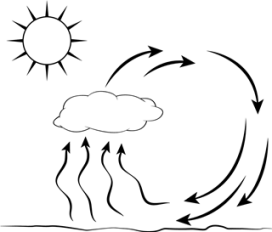
The moving of air in the image is an example of _?_.
radiation
convection
conduction


If a door was left open between the bedroom (74 degrees) and the living room (68 degrees), what would likely happen to the temperatures after several hours?
nothing, they would not change
both rooms would become hotter
both room would become colder
the bedroom temp. would lower and the living room temp. would rise

If an insulator is doing it's job well, the temperature of an object over time should...
rise slowly
lower quickly
show very little change
rise quickly
Cold things often have a _________ kinetic energy because_______
lower; particles are moving around less
lower; particles are moving around more
higher; particles are moving around the same
higher; particles do not move
We used aluminum foil to ___________ radiation into our solar ovens.
absorb
reflect
greenhouse
heat
______________ is the transfer of energy by touching
Kinetic energy
Radiation
Conduction
Convection
Black paper helps us ____________ more energy.
absorb
reflect
bounce
conduct
If you are at the beach, and you get sunburned, it is because of solar ________________
absorption
conduction
convection
radiation
What color absorbs more heat?
Black
White
Pink
Orange
What did we use to reflect energy?
Cardboard
Something shiny
A chromebook
Dark paper

In the situation illustrated, how will heat energy move? Heat energy will be transferred from –
the hot plate to the water by conduction
the water to the hot plate by conduction.

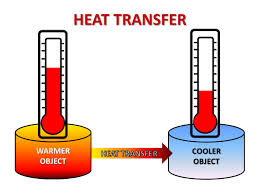


Which type of heat transfer is shown?
convection
conduction
radiation
ironing
What happens to the molecules in the ground when the temperature of the ground increases?
The cold energy of the molecules in the ground decreases.
The energy of the molecules in the ground decreases.
More heat molecules combine with the molecules in the ground.
The energy of the molecules in the ground increases.
What happens to the molecules in a printer when the temperature of the printer decreases?
The energy of the molecules increases.
The cold energy of the molecules in the printer increases.
The printer loses heat molecules.
The energy of the molecules in the printer decreases.
What is the difference between molecules of stew in a hot pot and the molecules of stew in the freezer?
The molecules of the stew in the pot are moving faster than the molecules of the stew in the freezer.
The molecules of the stew in the pot are moving and the molecules of the stew in the freezer are not moving.
There is no difference because all of the stew. It is made of the same type of molecules.
The molecules of the stew in the freezer are smaller than the molecules of the stew in the pot.
A pop tart is hot from the toaster. The pop tart is then placed on the plate. The energy of the plate increases. What happens to the energy of the pop tart?
It is impossible to know without data on the number of molecules in each object.
Its energy decreases while the energy of the plate increases.
Its energy stays the same while the energy of the plate increases.
Its energy increases while the energy of the plate increases.
A candle is blown out, the wax of the candle decreases in temperature. What happens to the molecules of the wax when the temperature of the wax decreases?
The cold energy of the molecules of the wax increases.
The energy of the molecules of the wax increases.
The wax loses heat molecules.
The energy of the molecules of the wax decreases.
Energy is not created or destroyed, so when energy increases in one part of a system, it decreases by the same amount in another part of the system.
True
False
All matter is made up of atoms that are constantly moving
True
False
If a cup of hot chocolate is put in the microwave, would that add or remove thermal energy to the hot chocolate.
Thermal Energy is Added
Thermal Energy was Removed
If thermal energy is increasing, what is happening to the kinetic energy.
Kinetic energy would be decreasing
Kinetic energy would stay the same
Kinetic energy would be increasing
The total kinetic energy of the tiny particles that make up matter.
Thermal Energy
Energy Transfer
Temperature
Heat
Energy transferred between two objects with varying temperatures, always transferring from warmest to coldest until the two objects have equal temperatures.
Heat
Thermal Energy
Energy Transfer
Temperature
Imagine Nora, Anika, and Avery are in a science experiment. They are trying to understand the transfer of thermal energy between materials. This happens because of the collisions between the particles. What is this process called?
convection
conduction
radiation

What type of heat transfer is happening at "A"
conduction
convection
radiation
What type of heat transfer is happening at "B"?
conduction
convection
radiation
What type of heat transfer is happening at "C"?
conduction
convection
radiation

I took some cupcakes out of the oven and place them on the counter. After some time, the cupcakes, the pan, and the air in the room will be at the same temperature. Why?
Thermal energy will be transferred from the cupcakes and the pan to both the counter and the air.
Coldness will be transferred from the counter to the cupcakes and the pan.
The pan will stay hot because thermal energy does not transfer from pans to air.
Thermal energy will be transferred from the air to the cupcakes only.

Croc 1 and Croc 2:
-Both Crocs are made up of the same types of molecules.
-Both Crocs are made up of the same number of molecules.
- Croc 1 has more thermal energy than Croc 2.
How does the speed of the molecules in Croc 1 compare to the speed of the molecules in Croc 2?
Croc 1's molecules move faster
Croc 2's molecules move faster
both Croc's molecules move at the same speed because they are made up of the same molecules

The thermal energy transfer being shown in this image is...
conduction
convection
radiation

The thermal energy transfer being shown in this image is...
conduction
convection
radiation

Which of the boxes in the image are at thermal equilibrium? Choose all that apply.
A
B
C
D

Which of the boxes shows the correct direction of heat transfer? Choose all that apply.
A
B
C
D


Everything has thermal energy
False
True
On a hot summer day, a piece of ice is removed from a cooler and placed in a cup that is sitting on a picnic table. Which of the following statements are true about what happens to the ice and the cup over time? Choose the TWO that apply.
Heat moves from the ice to the cup.
The particles in the ice start to move faster.
Both the ice and the cup change state.
The cup changes temperature.
Material that does not transfer heat easily.
Conductor
Convection
Radiation
Insulator

_____________ is the form of energy that is transferred between systems or objects with different temperatures.
Temerature
Heat
Specific Heat
Mechanical Energy

All three types of heat transfer can be present at one time.
True
False

What would happen to the atoms in a system if the temperature decreased?
The atoms would have less kinetic energy and move slower.
The atoms would have the same amount of kinetic energy and move at the same rate.
The atoms would have more kinetic energy and move faster.

The reason the temperature in the cups in the experiment above changes is because aluminum is
thermally expanding
a conductor
an insulator
a nonmetal
A material that allows heat to pass through it well, unlike wool, is called a
insulator
conductor
metal
thermal expander
Water currents that flow from the equator to the poles move heat from warmer climates to colder ones are an example of which transfer of heat?
Conduction
Convection
Radiation

