
 Worksheets
Final Review
Total questions: 100
Worksheet time: 3hrs 51mins
Defintion of Energy Transfer
Energy Moving Between 3 objects
Energy Moving Between Two Objects Or systems
Energy Moving Between One object or systems
Energy Moving between systems
Newtons 3rd law
F=Ma
An object in motion stays in mtion until acted by an unbalanced force
For every action there is an equal and opposite reaction
An objects force is equal to its mass times its acceration
Defintion of energy
To be able to do something
The ability to change speed
The abilty to change dircetion
The ability to do work


What happens when two forces act in the same direction?
They cancel each other out.
The stronger one prevails.
Their strengths are added.
Their sum divided by two is the total force.
The greater the mass of an object,
the easier the object starts moving.
the greater its inertia.
the more balanced it is.
the more space it takes up.
Define the term inertia.
the amount of matter in an object
the amount of space an object takes up
the tendency of an object to resist a change in motion, determined by mass
The force that one surface exerts on another when the two rub against each other
Kinetic energy increases with what two factors.
Speed
Mass
Direction
Heat energy
Thermal energy
Potential energy
Nuclear energy
Kinetic Energy
Resistance of a surface to movement
Insulator
Friction
Temperature
Heat
Conductor
The Law of Conservation of Energy states...
energy cannot be created or destroyed, but it can change forms
energy can be created, destroyed, and can change forms
energy cannot be created, destroyed, or change forms
energy cannot be created, but it can be destroyed and change forms
____________ energy is energy that is stored in the bonds of compounds like food and fuel.
Radiant
Electrical
Thermal
Chemical
______ energy is the energy of electromagnetic waves, also referred to as solar or light energy.
Chemical
Nuclear
Thermal
Radiant
_________ energy is the energy an object possesses because of its motion.
Mechanical (KE)
Mechanical (PE)
Sound
Electrical
Chemical --> Electrical --> Radiant
Battery Powered Flashlight
Battery Powered Alarm Clock
Nuclear Bomb
Playing the violin
Electrical --> Radiant --> Sound
Television
Solar Powered Calculator
Lamp
Playing the Drums
How does temperature change as altitude increases in the troposphere?
It decreases because particles are closer together
It increases because particles are closer together
It decreases because particles are farther apart
It increases because particles are farther apart
Why is it helpful to have ozone in the stratosphere but NOT the troposphere?
Stratospheric ozone neither helps nor hurts us.
Tropospheric ozone occurs naturally so it's not harmful, Dummie.
Stratospheric ozone is closer to us, so it helps us out
Stratospheric ozone blocks harmful UV rays, but tropospheric ozone is harmful to breathe

What causes wind?
differences in air pressure
differences in gravity
difference in oxygen
differences in the thermosphere

Which front is in this picture?
Warm front
Cold front
stationary front
occluded front
Protects the body, regulates body temperature
Integumentary
Nervous
Skeletal
Muscular
Carries oxygen and nutrients to all parts of the body.
Integumentary
Nervous
Circulatory
Respiratory
Allows movement in the body
Integumentary
Nervous
Skeletal
Muscular
Receives stimuli and transports impulses, coordinates actions and reactions in the body
Integumentary
Nervous
Circulatory
Respiratory
Supports and provides structure for the body
Skeletal
Muscular
Circulatory
Respiratory
Supplies blood with oxygen and rids the body of carbon dioxide
Integumentary
Nervous
Circulatory
Respiratory
Main Organs: Brains, spinal cord, nerves
Integumentary
Nervous
Circulatory
Respiratory
Main Organs: Lungs
Integumentary
Nervous
Circulatory
Respiratory

Breaks down food into nutrients that can be used by the body.
excretory system
cardiovascular system
digestive system
nervous sytem

Removes wastes from blood.
excretory system
lymphatic system
endocrine system
digestive system

Makes chemical messages that regulate conditions inside the body.
circulatory system
respiratory system
endocrine system
muscular system

What type of protist is this?
euglena
volvox
paramecium
amoeba
Which two protists can make their own food?
amoeba, paramecium
volvox, euglena
euglena, amoeba
paramecium, volvox
Which two protists ingest their food to get energy?
amoeba, paramecium
volvox, euglena
euglena, amoeba
paramecium, volvox
Euglena and Volvox move using _____.
pseudopods
cilia
flagella
Paramecium move using _____.
pseudopods
cilia
flagella
Amoebas move using _____.
pseudopods
cilia
flagella
Which organelle produces proteins?
Ribosomes
Lysosomes
Nucleus
Vacuoles
Which cell parts are not present in animal cells?
cell membrane & cytoplasm
nucleus & chloroplasts
cell wall & chloroplasts
ribosomes & mitochondria
Which organelle is the location of DNA (genetic material)?
mitochondria
ribosomes
nucleus
Endoplasmic Reticulum
Which part of the cell provides structural support?
Cell Membrane
Cell Wall
Cytoplasm
Nucleus
The "garbage can" of the cell; digestion and waste removal.
cell wall
cell membrane
lysosome
nucleus
Controls what goes in and out of the cell.
cell membrane
cell wall
organelle
cell
Houses gel-like fluids that support cell organelles and holds them in place.
cytoplasm
endoplasmic reticulum (e.r.)
golgi bodies
nucleus
Place where materials are processed and moved around inside the cell.
endoplasmic reticulum (e.r.)
mitochondria
cytoplasm
chloroplast
Storage space for water, wastes, food, and other cellular material
mitochondria
cell membrane
cell wall
vacuoles
The "powerhouse" of the cell; breaks down food to make energy for the cell.
organelles
cell
mitochondria
cytoplasm
Packages and transmits cellular materials throughout the cell.
golgi bodies
plant cell
endoplasmic reticulum
organelles
The basic unit of structure and function in living things.
cell
cell wall
plant cell
cell membrane

A trait that is expressed if one copy of the allele is present is a(n)
characteristic
dominant trait
gene
recessive trait

An organism’s genetic makeup; the pair of alleles for a trait is called a(n)
dominant trait
genotype
phenotype
recessive trait

Which pair of alleles is an example of homozygous recessive?
bb
BB
Bb

Which pair of alleles is an example of homozygous dominant?
tt
TT
Tt

Which pair of alleles is an example of heterozygous alleles?
ll
LL
Ll
What are physical characteristics of an organism?
Alleles
Genotypes
Genes
Traits

In animals, shaggy fur is dominant to short fur. According to the genotypes shown, what percent of offspring will have short fur?
0
25
50
75
100

T = tall and t = short
In the punnett square shown, what belongs in the missing square
tt
Tt
Bb
TT

How many Chromosomes do we inherit from our parents?
23 from dad and 23 from mom, or 46 total
13 from dad and 13 from mom, or 26 total
13 from dad and 33 from mom, or 46 total

What are chromosomes?
They are thread like structures containing DNA found inside the nucleus of our cells
They are X shaped blobs made of ribosomes
They are the inherited traits we recieve from our parents
They are types of alleles found in the mitochondria of a cell

What is a gene?
An entire chromosome.
A small part of DNA found in a chromosome that gives our body instructions to build for a specific trait that we have
Things that are sometimes refered to as XX and XY inside of our cell membranes
Kind of like a "flavor" because there are 23 kinds from each parent.
What is a mutation?
A mistake that happens when our cells code for a type of base.
A genetic defect caused by our genes that always leads to cancer
Another way to name the proteins that make up a strand of DNA
What happens to the chromosomes when our cells are ready to reproduce.
What is asexual reproduction?
1 parent
2 parents
What is sexual reproduction?
1 parent
2 parents
Cell division in eukaryotic cells that creates sex cells
Mitosis
Meiosis
Binary Fission
Fertilization
One form of a gene
Chromosome
Allele
Phenotype
Genotype

The fixed point around which a lever rotates is know as the
wheel.
fulcrum.
input force.
output force.
How can simple machines make work easier?
by decreasing the force needed to complete the task
by increasing the friction between the machine and the object
by adding more work on the object than originally applied
by removing the force of gravity on the object


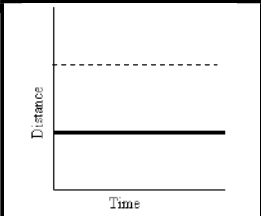
What does the solid line on this graph represent?
Constant speed
Acceleration
At rest
deceleration

The Dark Lord is walking towards you for a duel. He moved 18m in 5.2 seconds. What is his speed?
3.46 m/s
3.46 m/m
.28 m/s
.28 m/m

Which is true about their motions?

