
NEW
Font size
 Worksheets
Unit 8/9 Review (Thermo & Gases)
Total questions: 38
Worksheet time: 51mins
Temperature is a measurement of
average potential energy
average kinetic energy
thermal energy
number of molecules
Study the reaction below. Is it exothermic or endothermic?
H2 + Cl2 --> 2 HCl + 1845 kJ
Exothermic Reaction
Endothermic Reaction
ΔH value in an endothermic reaction is negative.
True
False
Change in enthalpy is also called as _______.
Systematic Reaction
Balanced Reaction
Energy of Reaction
Heat of Reaction
Based on Table I, which compound dissolves in water by an exothermic process?
NaCl
NaOH
NH4Cl
NH4NO3

How much energy is produced in the reaction between aluminum and oxygen as written on Table I
-3351 kj
-890.4 kj
-6072 kj
-2219.2 kj
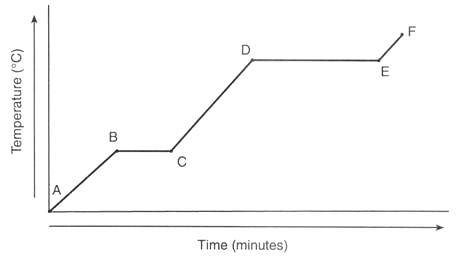


The melting point of the sample is
-60 ºC
-100 ºC
60 ºC
100 ºC

Given the heating curve of water, what is happening to potential and kinetic energy during segment CD?
the potential energy and kinetic energy both increase
the potential energy increases while the kinetic energy decreases
the potential energy is constant while the kinetic energy increases
the potential energy increases while the kinetic energy is constant
If the specific heat of water is 4.18 J/g∙°C, how much heat is required to increase the temperature of 1,200 g of water from 23 °C to 39 °C?
-80,256 J
80.256 J
80,256 J
-80.256 J
The specific heat of water is 4.18 J/g°C.
If 980. J of energy is added to 6.20 g of water at 18.0 °C, what is the final temperature of the water?
37.8 °C
-19.8 °C
19.8 °C
55.8 °C
How much heat is needed to change 12 grams of ice at 0 ºC to 12 grams of water at 0ºC?
Q = 12 x 4.18 x 0
Q = 12 x 334
Q = 12000 x 334
Calculate the energy needed to completely boil away 30 g of water at 100 ⁰C .
67,800 J
2260 J
226,000 J
100 J
Entropy is a measure of
accuracy
precision
the disorder of a system
the attraction of a nucleus for an electron
Systems in nature tend to undergo changes toward
lower energy and less disorder
lower energy and more disorder
higher energy and less disorder
higher energy and more disorder
Which sample has the lowest entropy?
HINT - Look at the phase of each chemical....
1 mole of KNO3(l)
1 mole of KNO3(s)
1 mole of H2O(l)
1 mole of H2O(g)
Which phase change represents a decrease in entropy?
solid to liquid
gas to liquid
liquid to gas
solid to gas
Given the change of phase:
CO2(g) —> CO2(s)
As CO2(g) changes to CO2(s), the entropy of the system
decreases
increases
remains the same

Which of the following statements is true?
Gases do not move in straight line
Gas particles are spaced so far apart that most of the volume of gas is empty space
Gas particles are not in constant motion
Gas particles attract each other
Which among the following is NOT true regarding the Kinetic Molecular Theory of gases?
Gases particles move in straight lines.
Gas particles are closely packed and their motion is orderly.
Gas particles are in constant motion.
Gas particles do not attract or repel each other.
The kinetic model of matter states that
atoms and molecules move in continuous and non-random motion.
atoms and molecules move in continuous and random motion.
the kinetic energies of atoms and molecules increase with increasing temperature.
the pressure of atoms and molecules is due to the collision of these particles with the walls of the container they are in.
Which sample behaves most like an ideal gas?
He(g) at 300K
He(g) at 273K
He(g) at 32 degrees Celsius
He(g) at 10 degrees Celsius
What are the conditions for an ideal gas?
high temperature, high pressure
low temperature, high pressure
low temperature, low pressure
high temperature, low pressure
What is the value of STP?
0 K and 1 atmosphere
0 C and 1 atmosphere
32 F and 1 atmosphere
100 C and 1 atmosphere
At STP, which gas sample has the same number of
molecules as 4.0 liters of CH4(g) at STP?
1.0 liters of C2H8(g)
2.0 liters of O2(g)
4.0 liters of H2(g)
5.o liters of CO2(g)
If I initially have 4.0 L of a gas at a pressure of 1.1 atm, what will the volume be if I increase the pressure to 3.4 atm?
1.29 L
12.36 L
1.29 atm
12.36 atm
A sample of nitrogen occupies a volume of 250 mL at 25oC. What volume will it occupy at 95oC?
308.70 mL
456.1 mL
308.70oC
456.1oC

A quantity of gas has a volume of 250 L, at 290 K and 303.98 kPa of pressure. What volume must the gas be for the gas to be at 273 K and 101.33 kPa?
78.4 L
88.5 L
706 L
771 L

A sample of sulfur dioxide occupies a volume of 652 mL at 313 K and 150 kPa. What volume will the sulfur dioxide occupy at STP?
1682.6 mL
20.7 mL
492.3 mL
842.1 mL
The weaker the intermolecular forces of a substance the _____________ the boiling point
higher
lower

According to the reference table, what is the boiling point of ethanoic acid at 80 kPa?
28 oC
100oC
111oC
125oC

Which liquid has the highest vapor pressure at 75oC?
ethanoic acid
ethanol
propanone
water

At which temperature is the vapor pressure of ethanol equal to the vapor pressure of propanone at 35oC?
35oC
60oC
82oC
95oC

