Wayground logo

Free Printable Worksheets

Font size

S
M
L
XL
Worksheets

Benchmark Test Ch13-15 Review

Total questions: 81

Worksheet time: 1hrs 16mins

Name
Class
Date
1.
The survival of the fittest 
a)
Natural selction
b)
Evolution 
c)
Mimic 
d)
Camouflage 
2.
The changes of species over time
a)
Embryonic 
b)
Natural selection 
c)
Mimicry 
d)
Evolution 
3.
Two organisms that are closely related would have
a)
very similar DNA sequence
b)
exactly the same DNA sequences
c)
no proteins in common
d)
completely different DNA sequence
4.
The diagram shows fossils in different rock layers. Which of these statements about the age of these fossils is most likely correct?
a)
Fossil A and C are the same age
b)
Fossil B is older than fossil C
c)
Fossils A is older than fossil B
d)
Fossil D is older than fossil C
5.
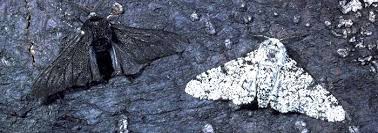
Predict which moth would increase in population
a)
light 
b)
dark
6.

The picture shown is an example of

a)

Vestigial structures

b)

Homologous structures

c)

Analogous structures

d)

Fossils

7.

Which process of evolution is demonstrated below?

a)

Comparative anatomy

b)

Homologous structures

c)

Comparative embryology

d)

Vestigial structures

8.

Which statement provides the best evidence that Ambulocetus natans is an ancestor of Basilosaurus isis?

a)

Homologous structures occur in each fossil

b)

Similar nitrogenous bases are found in the DNA of each fossil

c)

The fossils were found in different locations

d)

The youngest fossils is larger than the older fossils

9.

Which evidence for evolution is shown below?

a)

Comparative embryology

b)

Homologous structures

c)

Biochemical evidence

d)

Vestigial structures

10.

See picture for question

a)

Live in the same type of ecosystem

b)

Have slowly evolved to become herbivores

c)

Have a common ancestor

d)

Exchanged DNA at some point in the past
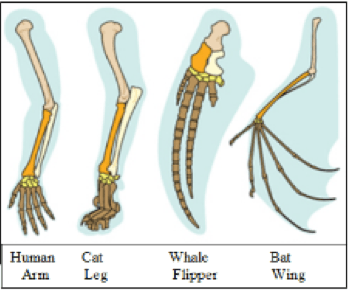
11.

The bones in the figure above are-

a)

Evidence of a common ancestor

b)

Evidence that animals can walk

c)

Evidence that fossils are old

d)

Evidence of nothing

12.

Genome maps provide the DNA sequences of chromosomes. Some scientists have compared the genome maps of a hedgehog and a sloth. What do these genome maps allow the scientists to determine?

a)

The color patterns of the offspring of each species

b)

How much the size ranges of the two species differ

c)

The methods of protein synthesis that each species uses

d)

How closely related the two species are to each other.

13.

What conclusion can you draw from the fact that many modern whale species have vestigial pelvic and leg bones?

a)

The ancestors of whales may have been land mammals

b)

Whales could walk if they wanted to

c)

Whales are preparing to evolve into land animals

d)

Someday whales will be able to walk and will have legs

14.

The fact that both these mammals incubate their immature offspring in a pouch provides evidence that they-

a)

Belong to the same species

b)

Must range great distances to eat

c)

Have very similar skeletal structures

d)

Are descended from a common ancestor

15.

Structures that are similar in structure, but not in function. 

a)
Homologous 
b)
Analogous 
c)
Vestigial 
d)
DNA
16.

Structures are similar in function but not in structure

a)
Vestigial 
b)
Homologous 
c)
Analogous Structures 
d)
Embryonic 
17.
What is the advantage of having different shaped beaks?
a)
To look different from other species.
b)
To be able to eat the food readily available in the environment.
c)
To protect itself against predators.
d)
To protect itself against prey.
18.
Why did the population of peppered moths in England change from light to dark after the Industrial Revolution?
a)
Light moths were easy to see against sooty trees and were eaten
b)
Light moths were killed by soot
c)
The birds that ate the dark moths were killed by soot
d)
Dark moths were produced by industrial processes
19.
Why are advantageous traits more likely to be passed onto offspring?
a)
Because they are more likely to survive and reproduce.
b)
Because they come from dominant alleles.
c)
Because they come from recessive alleles.
d)
Because the trait is an acquired phenotype.
20.
In recent years "SuperBugs" (bacteria that aren't effected by antibiotics) are becoming more and more common. How could natural selection explain this?
a)
Superbugs survive antibiotics and reproduce
b)
Antibiotics cause bacteria to become superbugs
c)
We have always had the same amount of superbugs; modern media just discusses them more.
d)
There is no reliable data on the origin of super bugs.
21.
Which of these is an example of natural selection?
a)
The largest animal in a population will have more opportunities for reproduction.
b)
Several species of organisms work together so that they all succeed.
c)
One species takes all the resources in an environment leaving none for others.
d)
Organism that are best suited to an environment tend to survive and reproduce more often.
22.
Which of the following explains adaptation.
a)
An individual organism changes to meet its needs in the environment. These changes pass down to their offspring.
b)
The species as a whole changes their characteristics.
c)
Beneficial traits allow organism to survive and pass on those traits
d)
New characteristics arise in a species as needed.  If these traits are helpful, they are passed down.
23.
A large herd of goats lives in a field full of poison ivy.  Some goats are able to eat the poison ivy while others have become sick when they eat it. Over time the herd as a whole will tend to
a)
Become more likely to eat poison ivy.
b)
Become less likely to eat poison ivy.
c)
Not change in the proportion of goats that can and can not eat poison ivy.
d)
Eat all the poison ivy and leave only plants all the goats can eat.
24.
Some people use similarities in embryos to support the the theory that 
a)
The organisms have the same ancestors 
b)
The organisms have similar numbers of offspring
c)
Cells naturally develop along similar line 
d)
There are no connections 
25.

Genetic diversity in a species makes long term survival of some members

a)

impossible

b)

improvable

c)

more likely

d)

less likely

26.

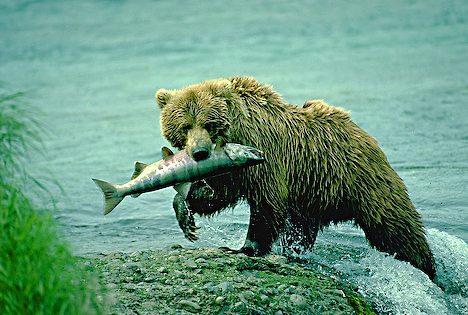
A grizzly bear survives because he is well-adapted to his environment. When he reproduces he passes on those traits to his offspring. this process is called

a)

Natural Selection

b)

Selective Breeding

c)

Random mutations

d)

Variations in a species

27.

A population of rabbits grows rapidly from one year to the next. Then one year, a disease strikes approximately one fourth of the adult rabbits. The disease remains with the population in the years that follow.

As explained by Darwin’s theory, which of these conditions allows the rabbit population to evolve by natural selection?

a)

The disease affects adult and juvenile rabbits equally.

b)

The disease reduces the ability of the rabbits to reproduce.

c)

Some rabbits are resistant to the disease, and they pass the resistance to their offspring.

d)

No rabbits are resistant to the disease, and all die when the disease strikes them.

28.

The figure shows how natural selection of a single-trait gene affects lizard survival.

Which of the following most likely causes the changes in allele distribution?

a)

The allele for light gray coloration disappears from the population. This may be because light gray lizards are more visible to predators and therefore they might be less likely to survive and reproduce.

b)

The allele for black coloration decreases fitness and becomes less common. This may be because black coloration keeps the lizards cool during hot summer temperatures.

c)

Medium gray coloration in lizards appears to be a neutral mutant allele that allows the lizards to hide better from predators. This leads to increases in phenotype and allele frequency of gray coloration.

d)

Because black and medium gray lizards are less visible to predators, these alleles are neutral to natural selection and therefore will not disappear from the population of lizards.

29.

Which of the following best illustrates natural selection?

a)

An organism with favorable genetic variations will tend to survive and breed successfully.

b)

A population monopolizes all of the resources in its habitat, forcing other species to migrate.

c)

A community whose members work together utilizing all existing resources and migratory routes.

d)

The largest organisms in a species receive the only breeding opportunities.

30.

What is the most likely explanation of the data shown below?

a)

There has been a drought in the area that is affecting all life forms.

b)

The population of natural predators of the moths has gotten smaller.

c)

The moths are living in an environment with light trees.

d)

The moths are living in an environment with dark trees.

31.

Suppose a certain species of insect lives in the lush green canopy of the rain forest. Some of the insects are bright green in color, and some are bright yellow. Assume there is a natural predator of the insect in the area. What do you expect to happen to the populations of the green and the yellow insects over time?

a)

The green insect population will increase and the yellow insect population will decrease.

b)

The green insect population will decrease and the yellow insect population will increase.

c)

Both insect populations will remain constant over time.

d)

Both insect populations will increase over time.

32.
An application of using DNA technology to help environmental scientists would be ___.
a)
use PCR to analyze DNA at a crime scene
b)
create a tobacco plant that glows in the dark
c)
clone the gene for human growth hormone to treat pituitary dwarfism
d)
make transgenic bacteria that can be used to clean up oil spills more quickly than do the natural bacteria
33.
Recombinant DNA are currently used to produce____.
a)
clothing dye, cheese, and laundry products
b)
human antibiotics and vaccines
c)
crops that taste better and stay fresh longer
d)
all of these
34.
The Human Genome Project has made diagnosing genetic disorders easier.Once a genetic disorder is diagnosed, ____ can be used as a possible treatment.
a)
cell cultures
b)
gene therapy
c)
DNA fingerprinting
d)
PCR
35.
A gene gun and a virus may both be classified as ____ because they are mechanisms by which foreign DNA may be transferred into a host cell.
a)
bacteria
b)
plasmids
c)
vectors
d)
splicers
36.
____ are produced when DNA from another species is inserted into the genome of an organism, which then begins to produce the protein encoded on the recombinant DNA.
a)
vectors
b)
plasmids
c)
transgenic organisms
d)
gene guns
37.
A ____ is a small ring of DNA found in a bacterial cell.
a)
virus
b)
plasmid
c)
gene bullet
d)
PCR
38.
The entire collection of genes within human cells is referred to as the ______.
a)
human genome
b)
karyotype
c)
pedigree
d)
gene map
39.
____ is an application of the human genome project that involves the insertion of normal genes into cells with defective genes in order to correct genetic disorders.
a)
gene gun
b)
gene mapping
c)
gene linkage
d)
gene therapy
40.
Genetic engineering has produced goats whose milk contains proteins that can be used as medicines. This effect was produced by
a)
mixing genes into the milk
b)
injecting genes into the goats udders
c)
inserting foreign genes into fertilized goat eggs
d)
genetically modifying the nutritional needs of the goats offspring 
41.
Researchers have been working on cloning animals such as sheep. Which result is most likely to be a negative result such as cloning?
a)
development of extra organs
b)
premature death
c)
a low rate of genetic diseases
d)
delayed aging
42.
You have benefited from selective breeding by having more agricultural produce than would have been possible otherwise.
a)
True
b)
False
43.
A scientist cloned a goat. Which of these is a true statement about the cloned goat?
a)
It has new genes and traits
b)
It lacks the genes for reproduction
c)
It has the genes that are identical to the original goat
d)
It looks the same but has different genes.
44.
Which best describes stem cells? 
a)
 stem cells can only come from embryos 
b)
stem cells can only come from adult bone marrow 
c)
stem cells do not ever change
d)
stem cells can develop into different specialized cells 
45.
This diagram represents which of the following? 
a)
Gel electrophoresis
b)
Gene therapy
c)
Cloning 
d)
Genetic engineering
46.
 This diagram shows the DNA fingerprints of a common ancestor of Deer Species. Which deer species is most related to the common ancestor
a)
2
b)
3
c)
4
47.
Which is a step in the process of producing transgenic bacteria?  
a)
A plasmid is used to replace a faulty gene in a human cell.
b)
A human gene is inserted into a bacterial plasmid. 
c)
A chain of bacterial amino acids is inserted into human DNA.
48.
A new variety of rice called golden rice has been genetically modified to have vitamin A. People in starving countries can eat this rice and receive the vitamin A. Without this rice people go blind from vitamin A deficiency. What word(s) below best describes this rice?
a)
electrophoresis
b)
DNA fingerprinting
c)
G.M.O
d)
clone
49.
The blood stain most likely belongs to 
a)
Bob
b)
Sue
c)
John
d)
Lisa
50.
Why is DNA fingerprinting used?
a)
To determine who is the child's father
b)
Link suspects to a crime scene
c)
determine if a family relationship exist between two people
d)
all of the above
51.
Which is an example of a transgenic animal ?
a)
Dog
b)
Lion
c)
Mouse that carries a florescent green protein
d)
Cat
52.
Which is the primary purpose of using restriction enzymes in gel elctrophoresis?
a)
It allows the strands of DNA to be cut into various lengths for testing
b)
It restricts the number of base pairs that can be tested in a sample
c)
It makes the testing simpler by moving the strands into the gel faster
d)
It charges the DNA strands
53.
Pattern of DNA fragments obtained by examining a person’s unique sequence of DNA base pairs
a)
Chromosome
b)
DNA Probe
c)
DNA Fingerprint
d)
Electrophoresis
54.
Which agricultural benefit can biotechnology  provide?
a)
developing plants that are less dependent on the sun for energy
b)
developing plants that are less sensitive to variations in environmental temperatures
c)
developing plants with inheritable traits unrelated to the genetic material they contain
d)
developing plants that will not die
55.
Which of these is not a way in which biotechnology can benefit agriculture?
a)
increase crop population
b)
reducing the loss of crops to insects
c)
producing better-tasting fruits
d)
improving farm machinery
56.
Which of these has to do with genetic modification?
a)
Crossbreeding 
b)
Kidney surgery 
c)
Gene splicing 
d)
use of herbicides 
57.
A genome is
a)
part of a chromosome
b)
a gene inserted into a chromosome of bacteria
c)
a sequence of units in a short segment of DNA
d)
the complete sequence of an organism’s DNA  
58.
What is an antibiotic?
a)
a substance that changes the body's DNA
b)
A substance that helps the body fight an infection
c)
a drug that kills bacteria and slows their growth
d)
a drug that kills viruses and slows their growth
59.
Which suspect is linked to the crime scene by this DNA analysis
a)
Suspect A
b)
Suspect C
c)
Suspect D
d)
Suspect B
60.
DNA fingerprinting works because
a)
Most genes are dominant
b)
All organisms contain RNA
c)
The most important genes are different among most people
d)
No two people, except identical twins, have exactly the same DNA 
61.
Who is the father?
a)
Dad 1
b)
Dad 2
c)
Dad 3 
d)
can not be determined
62.
How do you create recombinant DNA?
a)
First, cut the gene and plasmid with the same restriction enzyme. Second, insert the gene into the plasmid. 
b)
First, insert the gene into the plasmid.  Second, cut the gene and plasmid with the same restriction enzyme. 
c)
First, cut the gene and plasmid with different restriction enzymes. Second, insert the gene into the plasmid. 
d)
First, insert the gene into the plasmid.  Second, cut the gene and plasmid with different restriction enzymes. 
63.
Which biotechnology is used to make exact DNA copies of an organism?
a)
Gel electrophoresis
b)
Genetic Engineering
c)
Inbreeding
d)
Cloning
64.
Gene therapy is successful if the...
a)
DNA can be placed in a virus
b)
Virus carrying the gene can insert it into DNA
c)
New gene is expressed as a protein
d)
New gene is replicated in DNA
65.
What biotechnology allows a researcher to make thousands of copies of a DNA strand?
a)
Cloning
b)
PCR
c)
gene therapy
d)
gel electrophoresis
66.
What information must be known before a gene can be inserted into a bacteria?
a)
DNA sequence of the gene
b)
mRNA sequence of the gene
c)
tRNA sequence of the gene
d)
protein sequence of the gene
67.
Another name for GMO (Genetically Modified Organsim) is ____________.
a)
Transgenic
b)
Transplanted
c)
Transducted
d)
Plasmid
68.
All of the following are advantages of GMO's except
a)
pest resistant crops
b)
more nutritional foods
c)
unknown long term health effects
d)
creating more human insulin
69.
An argument in favor of food biotechnology is that it
a)
provides foods that cure disease.
b)
provides more food to feed a growing population.
c)
provides a cash crop for low income nations.
d)
biotech foods are not controversial
70.

Two DNA fragments created by cutting both with the same restriction enzyme can be recombined

a)

if both DNA fragments come from the same species

b)

if both DNA fragments come from animals

c)

if both DNA fragments come from eukaryotes

d)

regardless of the sources of the DNA

71.

What is the purpose of PCR?

a)

To determine paternity

b)

To determine if a crime scene sample matches a suspect

c)

Create a DNA profile

d)

Create multiple copies of DNA

72.

Which male is the father of this child?

a)

Male 1

b)

Male 2

c)

Neither could be the father

d)

Either could be the father

73.

DNA fingerprinting is used in

a)

Forensic science

b)

Paternal disputes

c)

Research work

d)

All of the above

74.

Gel electrophoresis is used to separate DNA fragments by what?

a)

size

b)

color

c)

functions

d)

chromosomes

75.

When cloning an organism, DNA is removed from a somatic cell and placed into an empty

a)

virus

b)

sperm cell

c)

bacteria cell

d)

egg cell

76.

After finding the location of a gene, how can a scientist remove it from a cell?

a)

Using a microscope

b)

Using PCR

c)

Using scissors

d)

Using enzymes

77.

Why do farmers choose to use GM crops rather than regular crops?

a)

They are safer

b)

They are more productive

c)

They decrease biodiversity

d)

They are less controversial

78.

True or False: Gel electrophoresis allows scientists to compare DNA of different individuals.

a)

True

b)

False

79.

Which information was most important to the development of genetic engineering techniques?

a)

the observation of nondominant alleles

b)

the discovery of lethal genes

c)

the formulation of Punnett squares

d)

the sequencing of the human genome

80.

Medical research involving stem cells is important for ...

a)

to test the effectiveness of new drugs

b)

the generation of cells and tissues that can be used in cell based therapies

c)

to understand the consequences of turning genes off and on

d)

All of the above

81.

Which is what scientists think may be a disadvantage of genetically modifying plants?

a)

Plants will pass on diseases to animals

b)

There will be a decrease in biodiversity

c)

Pesticide manufacturers might lose money

d)

Plants will have a longer growing season