wayground logo

Free Printable Worksheets

NEW

Font size

S
M
L
XL
Worksheets

S2 H. Biology Practice TEST 2: DNA to Protein

Total questions: 72

Worksheet time: 1hrs 3mins

Name
Class
Date
1.
Which of the following units are repeatedly joined together to form a strand of DNA?
a)
amino acids
b)
nucleotides
c)
fatty acids
d)
polysaccharides
2.
The enzyme that unwinds the DNA to prepare for replication
a)
helicase
b)
replicase
c)
polymerase
d)
synthase
3.
DNA replication results in two DNA molecules,
a)
each one with two original strands
b)
each one with two new strands
c)
each one with one new strand and one original strand
d)
one with two new strands and the other with two original strands
4.
order of replication
a)
3, 4, 2, 1
b)
3, 1, 4, 2
c)
2, 1, 4, 3
d)
3, 4, 1, 2
5.
A process in which DNA has the unique ability to make an exact copy of itself.
a)
Replication
b)
Translation
c)
Transcription
6.
In what phase of the cell cycle does DNA replication take place?
a)
G1
b)
S
c)
G2
d)
M
7.
Which enzyme is responsible for adding nucleotides?
a)
Topoisomerase
b)
DNA Polymerase
c)
Ligase
d)
Primase
8.
The process of DNA replication is called semi conservative because it results in
a)
none of these
b)
Two DNA molecules.  One original molecule and one with two new strands
c)
two exact copies with new strands
d)
two identical molecules, each with 1 original strand and one new.
9.
Based on the diagram, the enzyme (represented in gray) is most likely...
a)
DNA polymerase
b)
DNA Ligase
c)
Nuclease
d)
Helicase
10.
What will the first four bases of the new DNA strand look like if copying the template strand?
a)
TGGT
b)
ACCA
c)
GTTG
d)
CAAC
11.
Which of the following does DNA polymerase NOT do?
a)
connects nucleotides (in the new strand) through covalent bonds
b)
Matches the template nucleotides with free nucleotides
c)
proofreads
d)
It does all of these functions
12.
Which enzyme fixes the Okazaki fragments in the lagging strand?
a)
Helicase
b)
Polymerase
c)
Ligase
d)
Primerase
13.
If a strand reads:
3' A A A T T T C 5'
The matching strand would read...
a)
5' T T T A A A G 3'
b)
3' T T T A A A G 5'
c)
5' A A A T T T C 3'
d)
3' U U U A A A G 5'
14.
What are the gaps between the newly synthesized DNA on the lagging strand called?
a)
Okazaki fragments
b)
Polymer gaps
c)
Helicase fragments
d)
Acidic gaps
15.

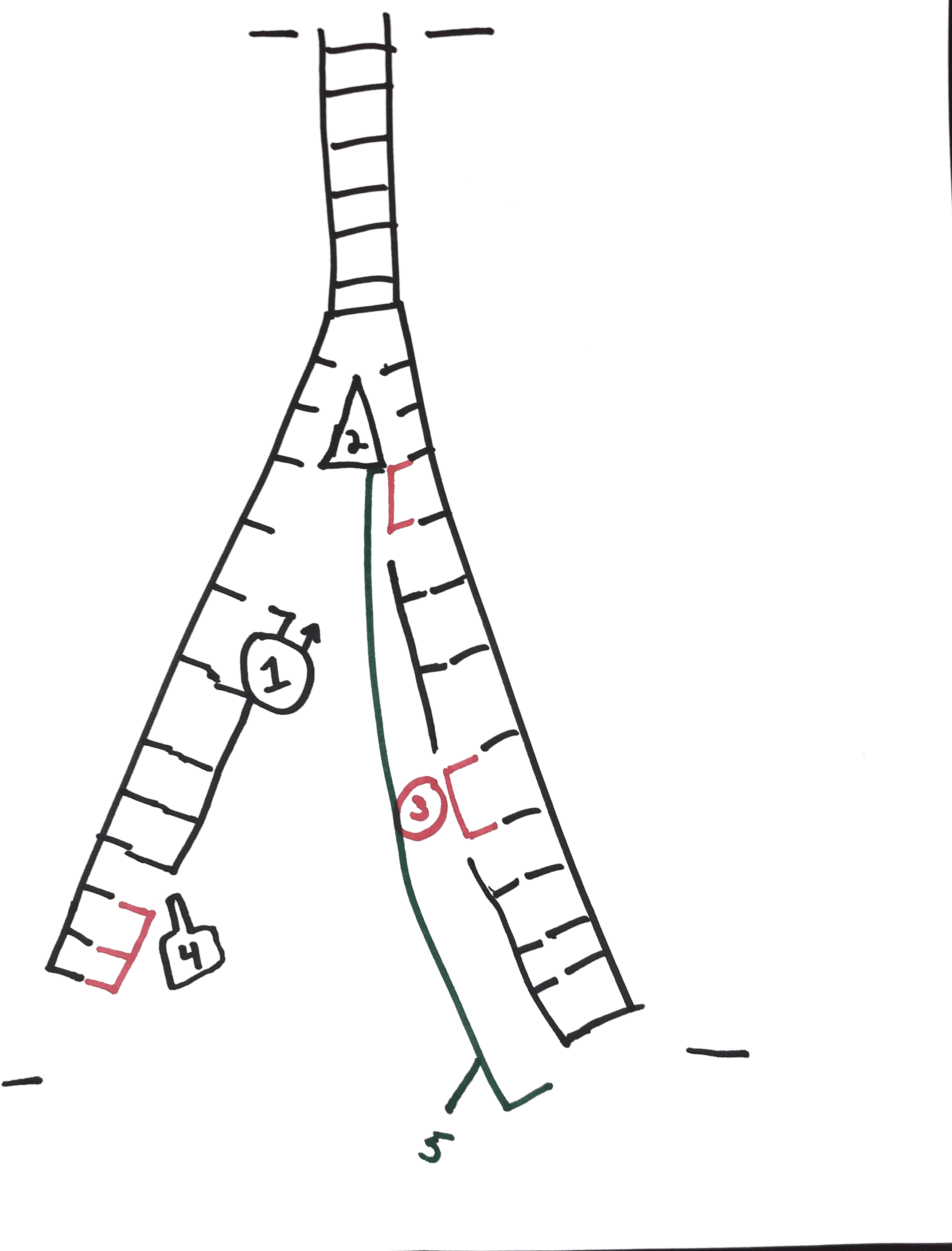
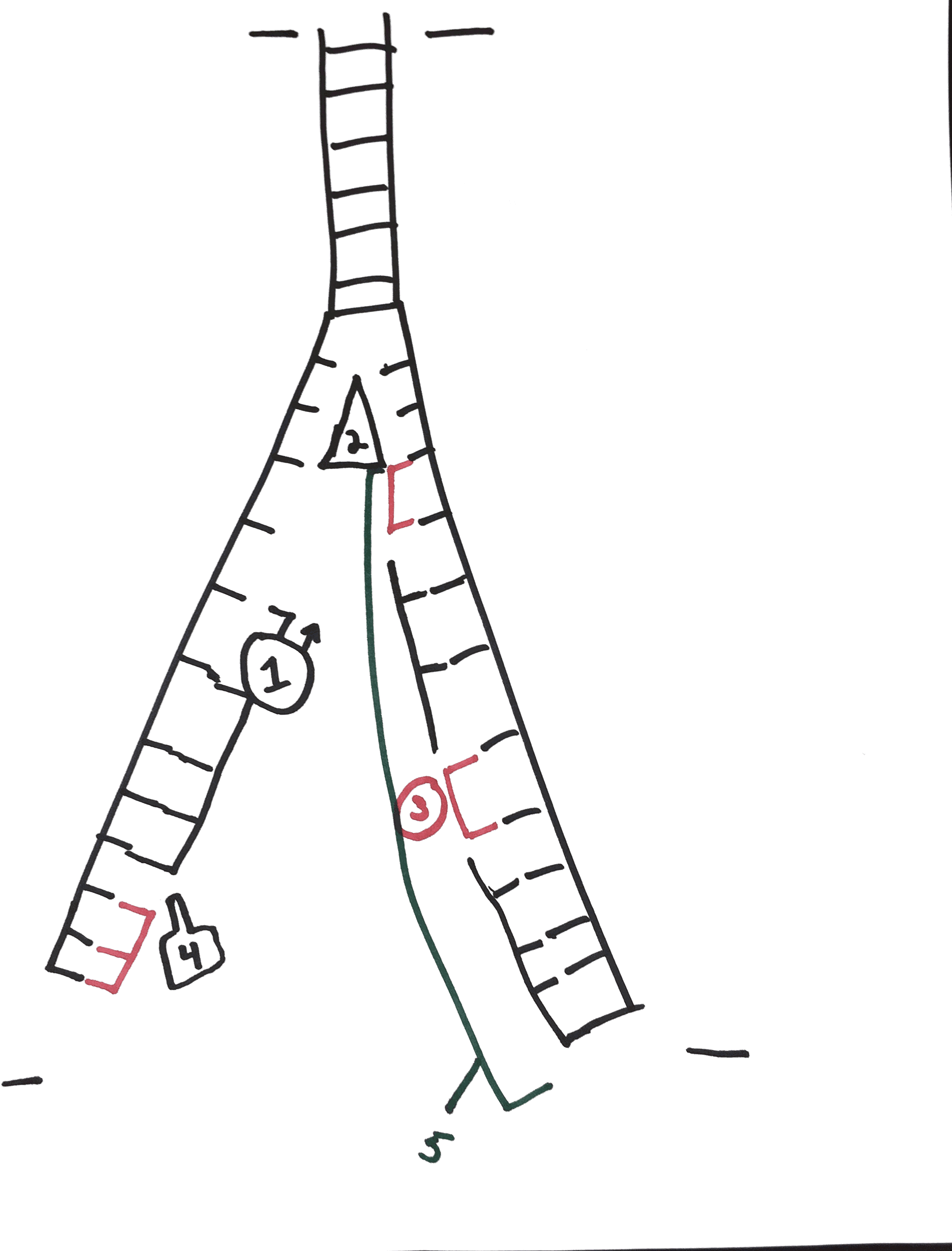
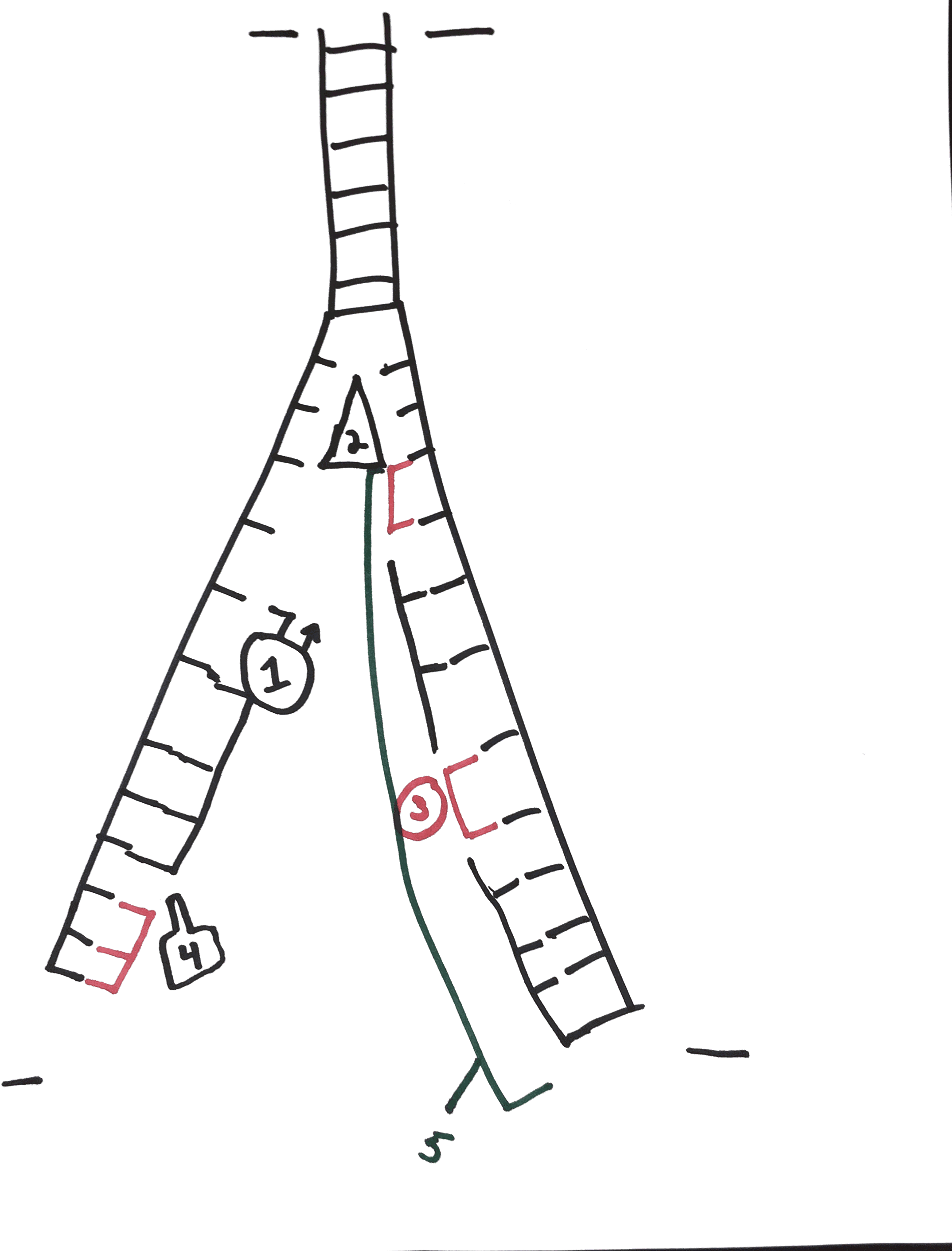
#4 in the picture

a)

Polymerase

b)

Primase

c)

Helicase

d)

Ligase

16.

Number 1 in the picture above

a)

Replication

b)

DNA Polymerase

c)

Primase

d)

Ligase

17.

#3 setting Primers

a)

Ligase

b)

Helicase

c)

Polymerase

d)

Primase

18.
A DNA nucleotide contains all of the following, except...
a)
Deoxyribose
b)
Phosphate group
c)
Nitrogenous base
d)
Cholesterol
19.

Which is the first step?

a)

DNA Helicase unwinds original DNA strand

b)

RNA Primase lays down RNA primer for new nucleotide bases.

c)

DNA polymerase builds new strands by bring in new nucleotide bases.

d)

Ligase knits together fragments on lagging strand

20.

Which is the second step?

a)

DNA Helicase unwinds original DNA strand

b)

RNA Primase lays down RNA primer for new nucleotide bases.

c)

DNA polymerase builds new strands by bring in new nucleotide bases.

d)

Ligase knits together fragments on lagging strand

21.

Which is the third step?

a)

DNA Helicase unwinds original DNA strand

b)

RNA Primase lays down RNA primer for new nucleotide bases.

c)

DNA polymerase builds new strands by bring in new nucleotide bases.

d)

Ligase knits together fragments on lagging strand

22.

Which is the fourth step?

a)

DNA Helicase unwinds original DNA strand

b)

RNA Primase lays down RNA primer for new nucleotide bases.

c)

DNA polymerase builds new strands by bring in new nucleotide bases.

d)

Ligase knits together fragments on lagging strand

23.

DNA replication runs from ______' to _____' and is said to be ______________________

a)

5, 3, antiparallel

b)

3, 5, antiparallel

c)

5, 3, parallel

d)

3, 5, parallel

24.

Okazaki fragments appear on which strand of DNA during DNA replication?

a)

lagging

b)

leading

25.

Direction that DNA is READ?

a)

3' to 5'

b)

5' to 3'

26.

Structure C is

a)

helicase

b)

primase

c)

DNA polymerase III

d)

gyrase

27.

H is the

a)

leading strand

b)

lagging strand

c)

parent strand

d)

none of these

28.

Structure G is

a)

primase

b)

gyrase

c)

DNA polymerase III

d)

DNA polymerase I

29.

This structure is an Okazaki fragment.

a)

A

b)

D

c)

F

d)

G

30.
Which 2 molecules forms the sides (backbone) of the DNA ladder?
a)
deoxyribose and adenine
b)
deoxyribose and a hydrogen bond
c)
sugar and the nucleus
d)
deoxyribose (sugar) and phosphate
31.
Adenine bonds with ______________.
a)
Guanine
b)
Thymine
c)
Cytosine
d)
Adenine
32.
Guanine bonds with ______________.
a)
Adenine
b)
Guanine
c)
Cytosine
d)
Thymine
33.
Name this structure
a)
double helix
b)
nucelotide
c)
twisted ladder
d)
hydrogen bond
34.
A(n) _____ is a virus that enters a bacterial cell.
a)
endospore
b)
decomposer
c)
plasmid
d)
bacteriophage
35.
A capsid is
a)
a structure that directly causes cell lysis
b)
the type of virus that attacks bacteria
c)
the genetic material of a virus
d)
the protein coat of a virus
36.
The copying of DNA into a strand of mRNA is called
a)
transformation
b)
transcription
c)
translation
d)
replication
37.
The synthesis of a protein from the information carried by  mRNA molecules.
a)
Transformation
b)
Transcription
c)
Translation
d)
Replication
38.
In RNA, adenine bonds with 
a)
cytosine
b)
guanine
c)
thymine
d)
uracil
39.
Which of the following isn't a type of RNA discussed in your notes?
a)
mRNA
b)
pRNA
c)
tRNA
d)
rRNA
40.
RNA can be found in the ___
a)
nucleus
b)
cytoplasm
c)
both the nucleus and the cytoplasm
41.
Sets of nucleotides that do not code for amino acids
a)
introns
b)
exons
c)
exron
d)
deletions
42.
A group of 3 mRNA that codes for an amino acid is called a __
a)
anticodon
b)
triad
c)
triplet
d)
codon
43.

What type of RNA carries the amino acids to the ribosome?

a)

mRNA

b)

tRNA

c)

pRNA

d)

rRNA

44.
What carries the genetic message out of the nucleus?
a)
DNA
b)
mRNA
c)
tRNA
d)
rRNA
45.
How many possible codons are there?
a)
36
b)
24
c)
48
d)
64
46.
How many amino acids are there?
a)
10
b)
20
c)
36
d)
48
47.
What do amino acids form?
a)
RNA
b)
DNA
c)
Proteins
48.

Which of the following is a pyrimidine?

a)

adenine

b)

thymine

c)

guanine and thymine

d)

cytosine and thymine

49.

What causes a mutation?

a)

a repeat in base pairs

b)

a base pair being deleted

c)

base pairs being flipped in order

d)

Any change of sequence of base pairs

50.

Which of the following is the correct order?

a)

RNA -> DNA-> protein

b)

protein -> DNA -> RNA

c)

DNA -> protein -> RNA

d)

DNA->RNA-> Protein

51.
Which of the following is the sugar found in RNA?
a)
Ribose
b)
Maltose
c)
Deoxyribose
d)
Amylose
52.
Codons contain ______ bases
a)
1
b)
3
c)
6
d)
9
53.
Which is the organelle that makes proteins?
a)
Nucleus
b)
Ribosomes
c)
Rough ER
d)
Golgi Apparatus
54.

If a strand of DNA had bases in the following order - ATCCGTC, what would be the transcribed mRNA sequence?

a)

TAGGCAG

b)

UAGGCAG

c)

TUGGCUG

d)

None of the above are correct

55.

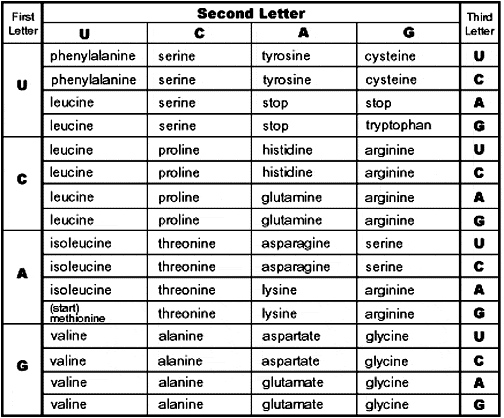
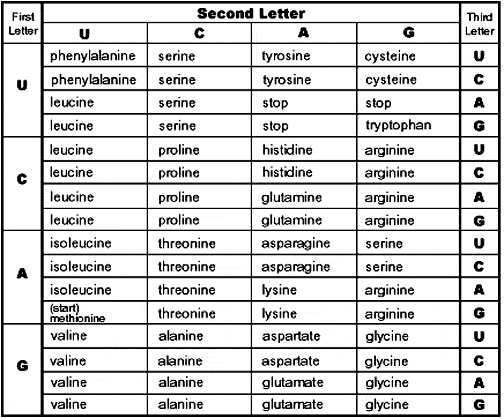
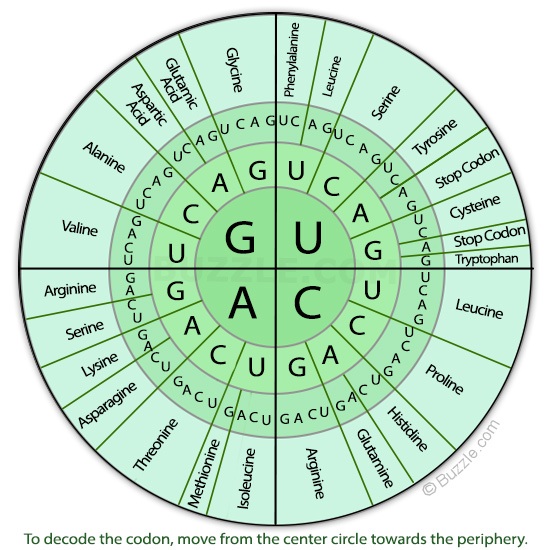
Use the codon chart to determine the amino acid sequence: (Hint: mRNA must be used to determine the AA sequence!)


ATT CGC ATC

TAA GCG TAG

AUU CGC AUC

UAA GCG UAG

a)

tyrosine, alanine, stop

b)

stop, alanine, tyrosine

c)

start, arginine, methionine

d)

Isoleucine, arginine, isoleucine

56.

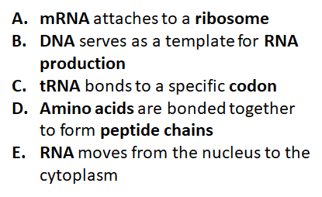
What is the correct order for the following events that occur during protein synthesis?

a)

B,E,A,C,D

b)

B,A,E,C,D

c)

D,A,E,C,B

d)

C,B,A,E,D

57.

Which of the following polypeptides are coded for by the mRNA sequence


5' AUG GUU AAA 3'

a)

Val, Lys, Phe

b)

Met, Asp, Phe

c)

Met, Val, Lys

d)

Ile, Gln, Lys

58.

A sequence of a DNA template strand is shown.


3' TCC AAT GGC TTA TTT 5'


Which of these is the correct amino acid chain produced from the DNA template strand?

a)

Arginine, Leucine, Proline, Asparagine

b)

Tryptophan, Phenylalanine, Leucine

c)

Serince, Leucine, Proline, Asparagine

d)

Tryptophan, Phenylalanine, Leucine, Glycine

59.
Which process is happening in this picture?
a)
Transcription
b)
Translation
c)
Replication
60.
What amino acid is represented by the codon CAG?
a)
Aspartic Acid
b)
Histidine
c)
Glutamine
d)
Methionine
61.
What is the correct amino acid for the following codon:
 UGA
a)
Stop
b)
Met
c)
Asp
d)
Ala
62.
What mutation has occurred here? 
T-G-A-C-C-A
T-G-A-G-C-A
a)
Substitution
b)
Deletion
c)
Insertion
d)
Frameshift 
63.
Which of the following would result in a frameshift mutation?
a)
Insertions only
b)
Substitution only
c)
Deletion only
d)
Insertions and Deletions
64.

Which Karyotype displays a female with Down syndrome?

a)
b)
c)
d)
65.
DNA molecule segment is : TTACGCAAG
The mutated DNA segment is TTCGCAAG. This is an example of ___ mutation.
a)
Substitution
b)
Deletion
c)
Insertion
d)
Inversion
66.

A mutation is defined as:

a)

A change in the cell's structure

b)

Anything that changes in an embryo

c)

Any change in the physical features of a human

d)

A change in the DNA sequence

67.
ATTTGAGCC- Original
ATTGAGCC - Mutated
The example above is an example of a 
a)
Insertion- Frameshift
b)
Deletion- Substitution
c)
Deletion -Frameshift
d)
All of the above
68.
Why are insertion and deletion (frameshift) mutations so harmful?
a)
They change all of the codons from the mutation on down the line, which changes the amino acid sequence
b)
They insert things that an organism doesn't need.
c)
They often delete things that organisms need.
d)
Insertion and deletions are not any more harmful than substitution mutations.
69.

What is it called when a mutation has no effect on the amino acid sequence in the final polypeptide?

a)

Substitution mutation

b)

No mutation

c)

Silent mutation

d)

Replication mutation

70.

What type of chromosomal mutation removes genes and then re-attaches the genes backwards?

a)

Duplication

b)

Inversion

c)

Deletion

d)

Translocation

71.

What type of chromosomal mutation gains extra genes that it did not have before?

a)

Duplication

b)

Inversion

c)

Deletion

d)

Translocation

72.

What does a missense mutation do?

a)

Changes one amino acid to a stop codon.

b)

Changes one amino acid to a different amino acid.

c)

Changes one amino acid to a start codon.

d)

It does not change the amino acids.