Worksheets
Making Sense of Anatomy
Total questions: 67
Worksheet time: 2hrs 58mins
This quizizz will help you review for the up coming exam by asking questions to review the material covered in the senses lab and pig dissection 1 an2 labs. Are you ready?


Numbers 1 and 8 represent the ______
lens
cornea
sclera
retina
Which light pathway is correct?
cornea, lens, retina, pupil, aqueous humor, fovea
lens, cornea, posterior chamber, pupil, anterior chamber, retina
cornea, anterior chamber, pupil, lens, posterior chamber, retina
lens, anterior chamber, cornea, pupil, posterior chamber, retina
The human senses are as follows:
Touch, olfaction, gustation, hearing, sight, gut
Touch, olfaction, gustation, hearing
Touch, olfaction, gustation, sight
Touch, olfaction, gustation, hearing, sight

7 is indicating the _____
lens
cornea
vitreous humor
retina
Humans have a nictitating membrane.
True
False
It is only found in Aliens
yes, but it is removed at birth

Label M indicates _____
pons
spinal cord
medulla oblongata
Optic nerve

A highlights the ______
occipital lobe
pons
parietal lobe
frontal lobe

the midbrain is indicated by
j
o
p
i
k

The item labeled with 14 in the image is______
the liver
the stomach
the spleen
the colon

pins 1 and 2 make up the
renal medulla
renal cortex
renal pelvis
nephron
Deoxygenated blood moves through the heart as follows:
From the body to enter the vena cava -> right atrium -> tricuspid valve -> right ventricle -> _________ -> lungs -> _______ -> left atrium-> ______ -> left ventricle-> aorta
pulmonary vein, pulmonary artery, bicuspid valve
pulmonary artery, pulmonary vein, mitral valve
Pulmonary vein, pulmonary artery, bicuspid valve
pulmonary artery, pulmonary vein, bicuspid valve

The probe is pointing to what organ?
stomach
lung
liver
spleen
Please draw the flow of deoxygenated blood as it enters the heart, becomes oxygenated, and enters the body

Which is the correct order that food will move through the small intestine?
Jejunum, duodenum, ilium
ilium, duodenum, jejunum
duodenum, ilium, jejunum
duodenum, jejunum, ilium

What organ is indicated by number 9?
(a)

15 indicates what organ?
(a)

Plays large role in the immune system and produces and destroys red blood cells.
kidney
liver
gallbladder
spleen
Small muscular pouch responsible for storing bile from the liver.
pancreas
mechanical
amylase
gallbladder

Identify this pig structure? It helps hold your digestive system in place.
pancreas
mesentery
pericardium
diaphragm

What is structure A? This structure produces bile and detoxifies the blood. It is the largest internal organ in your body.
liver
spleen
large intestine
small intestine

What is G? This structure secretes digestive enzymes into the digestive tract.
Duodenum
Spleen
Pancreas
Small Intestines


Name the structure indicated by the number "42" in the picture. It secretes hormones such as insulin that regulates blood sugar and pancreatic juices that contain enzymes for helping with digesting foods (carbohydrates, lipids and proteins).
spleen
stomach
small intestine
pancreas
A flexible cord like structure in mammals that connects the placenta to the fetus during gestation. It carries nutrients to the fetus and wastes to the mother.
Ureters
Duodenum
Larynx
Umbilical Chord

Identify structure 2 and 3. They are chamber of the heart (right and left) that receives blood as it returns to the heart.
on the heart.
Aorta
Ventricles
Pericardium membrane
Atrium
Identify structure 7 and 8. They are chambers of the heart (right and left) that pumps blood to the arteries.
Aorta
Ventricles
Pericardium membrane
Atrium
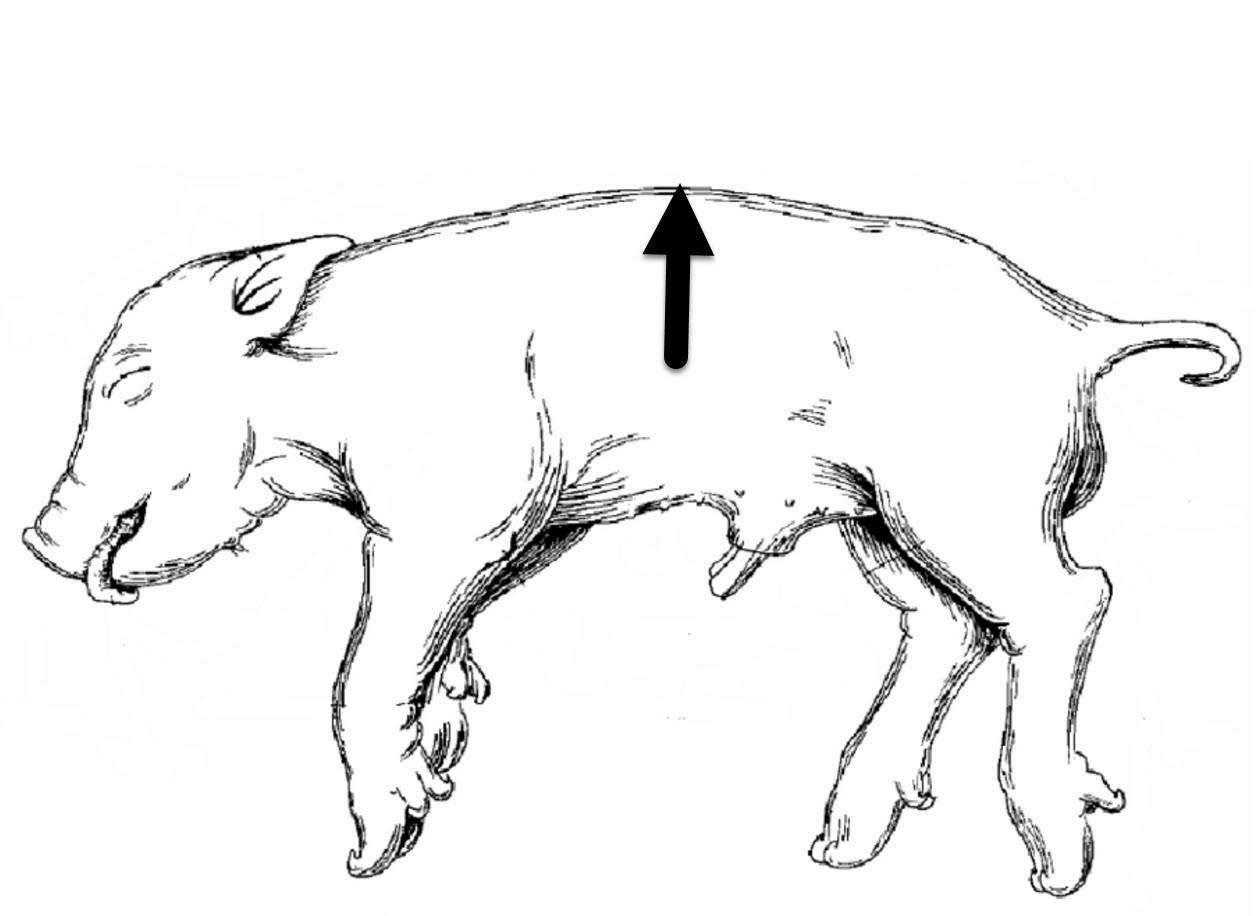

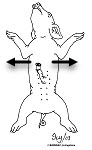


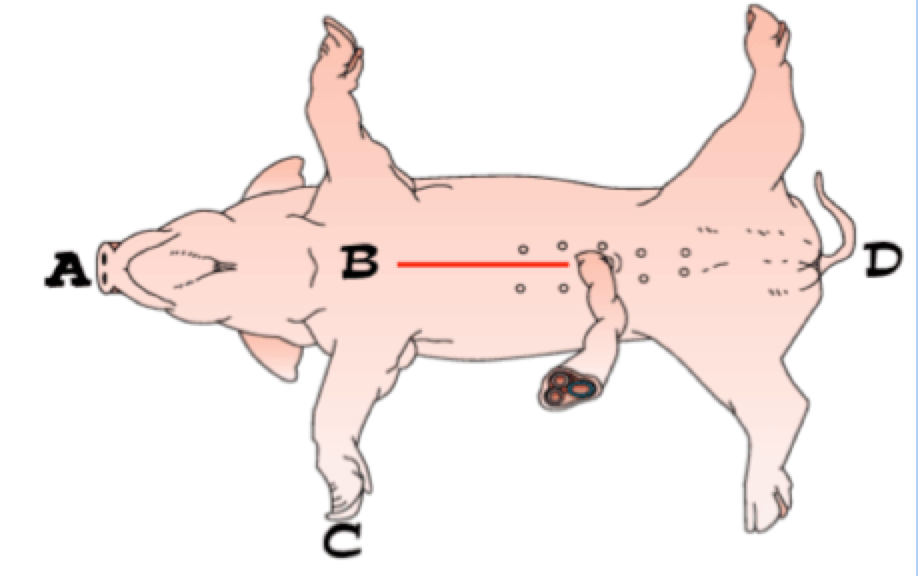
The tail (D) of the pig is located __________ to B.
Anterior
Posterior
Ventral
Dorsal
When you are looking for the nares of the pig, where should you be looking?
Snout
Feet
Eyes
Tail
Rods are light sensitive cells in the retina that
give you color vision in dim light
respond in dim light
give you color vision in bright light
respond in bright light
The optic nerve transmits signals to the
temporal lobe
parietal lobe
occipital lobe
frontal lobe
True/False: The vitreous humor helps give the cornea its rounded shape.
True
False
True/False: The tapetum helps with night vision.
True
False
The pupil is located at the center of the
sclera
iris
retina
nothing
The vitreous humor is
gel like and gives the eyeball its shape
watery and gives the eyeball its shape
Area of the retina which contains no photoreceptors and is located over the optic nerve
fovea centralis
blind spot
pupil
iris


Defect in the shape of the eye
depth perception
refraction
astigmatism
visual acuity
Which part of the eye is made up of rods and cones?
Lens
Retina
Iris
Sclera