wayground logo

Free Printable Worksheets

Font size

S
M
L
XL
Worksheets

Bio 111 review: DNA, Transcription/ Translation (Ch's 16,17)

Total questions: 70

Worksheet time: 1hrs 4mins

Name
Class
Date
1.
What did Erwin Chargaff conclude from his experiments?
a)
Nitrogen bases are held together by peptide bonds
b)
A and T, C and G always occur in equal amounts
c)
Proteins are the carriers of genetic information
d)
C and G rarely occur in eukaryotic organisms
2.
What was Watson and Crick's main scientific accomplishment?
a)
Building the first accurate model of DNA
b)
Isolating strains of pneumonia causing bacteria
c)
Determining base pairing rules
d)
Discovering the process of genetic transformation
3.
Cystosine is an example of a single ringed nitrogen base called...
a)
Purine
b)
Peptide
c)
Ribose
d)
Pyrimidine
4.
If a sample of DNA has 20% ADENINE, how much GUANINE will it have?
a)
30%
b)
20%
c)
80%
d)
60%
5.
The image illustrates which of the following structures?
a)
Amino acid
b)
Nucleotide
c)
Protein
d)
Peptide Bond
6.
From his work with mice and pneumonia-causing bacteria, Frederick Griffin discovered ________.
a)
Replication
b)
Transcription
c)
Transformation
d)
Translation
7.
By using radioactive isotopes, Hershey and Chase were able to conclude that __ is/are the carrier(s) of genetic information.
a)
DNA
b)
Proteins
c)
Carbohydrates
d)
Lipids
8.
A pyrimidine (single ring nitrogen base) always pairs with a purine (double ring nitrogen base).
a)
True
b)
False
9.
Which of the following pairs identifies the PURINE nitrogen bases?
a)
Cytosine and Thymine
b)
Adenine and Thymine
c)
Adenine and Guanine
d)
Cytosine and Guanine
10.
Rosalind Franklin's "Photo 51" allowed Watson and Crick to determine the ___ of DNA.
a)
Shape
b)
Backbone
c)
Nitrogen bases
d)
Hydrogen bonds
11.
Nitrogen bases attach to the deoxyribose sugar of a DNA molecule backbone.
a)
True
b)
False
12.
What makes up the rails, or backbone, of a DNA molecule?
a)
Alternating sugars and nitrogen bases
b)
Nitrogen base pairs
c)
A sugar, a phosphate, and a nitrogen base
d)
Alternating sugars and phosphates
13.
If a DNA sample has 40% CYTOSINE, how much THYMINE will it have?
a)
10%
b)
20%
c)
40%
d)
60%
14.
Identify the 5-carbon sugar found in a molecule of DNA.
a)
Ribose
b)
Deoxyribose
c)
Glucose
d)
Lactose
15.
The enzyme that constructs the new strand of DNA during replication is known as...
a)
DNA Helicase
b)
DNA Polymerase
c)
DNA Ligase
d)
RNA Polymerase
16.
Which enzyme is responsible for unwinding and unzipping the DNA during replication AND transcription?
a)
DNA Helicase
b)
DNA Polymerase
c)
DNA Ligase
d)
RNA Polymerase
17.
During replication, what would be the complementary DNA sequence to: TTA GCC TAG
a)
AAT CGG ATC
b)
CCG ATT CGA
c)
GGC TAA GCT
d)
AAT CGG TAC
18.
According to the semi-conservative model of DNA replication, two DNA molecules result, ___.
a)
Each strand with one new strand and one original strand
b)
Each with two new strands
c)
One with two new strands and one with both original strands
d)
Each with two original strands
19.
Replication use___ to make more ___.
a)
DNA, RNA
b)
RNA, RNA
c)
DNA, DNA
d)
DNA, Protein
20.
When does DNA replication take place in the cell cycle?
a)
Cytokinesis
b)
Anaphase
c)
Prophase
d)
S stage of Interphase
21.
DNA replication produces ___ molecules of DNA.
a)
2 Identifcal
b)
2 Different
c)
4 Identical
d)
4 Different
22.
If the original sequence is CGA TTA AGC, what would be the complementary nucleotides added during DNA replication?
a)
GCU AAU UCG
b)
GCT AAT TCG
c)
ATC GGC CTA
d)
CGA ATT AGC
23.
What is the site where DNA separates and replication occurs?
a)
Replication sites
b)
Replication spoons
c)
Replication split
d)
Replication forks
24.
Replication takes place in many locations of the lagging strand of DNA.  This creates ___ which are pieced together by DNA ligase.
a)
RNA Sections
b)
DNA Polymerase
c)
Okazaki Fragments
d)
Replication Forks
25.
Who is responsible for producing this image?
a)
Francis Crick
b)
James Watson
c)
Rosalind Franklin
d)
Watson and Crick
26.
The two strands of DNA are held together by what type of bond?
a)
Ionic
b)
Covelant
c)
Polar
d)
Hydrogen
27.
By using radioactive isotopes, Hershey and Chase were able to conclude that _____ is the carrier of genetic information.
a)
DNA
b)
Protein
c)
Carbohydrate
d)
Lipid
28.
Which of the following best describes a DNA molecule?
a)
double helix
b)
contains ribose
c)
made of amino acids
d)
contains Uracil
29.
Why is DNA important?
a)
it is very small and very complicated
b)
it's in everything
c)
it serves as the blueprint for traits of all living things
d)
because we eat it every day for energy
30.
Which type of RNA is made in the nucleus?
a)
mRNA
b)
rRNA
c)
tRNA
31.
What is the significance of the sequence (order) of the Nitrogen Bases in DNA?
a)
The order of the Nitrogen Bases determines the number of chromosomes present in an organism.
b)
The order of the Nitrogen Bases determines the traits that an organism will possess (have).
c)
The order of the Nitrogen Bases determines the gender of an organism.
d)
The order of the Nitrogen Bases determines whether an organism is abiotic biotic.
32.
Which of the following would be determined by the order of the Nitrogen Bases in your DNA?
a)
Your Gender.
b)
The Number of Chromosomes you have.
c)
Your hair color.
d)
The number of siblings you will have.
33.
What is meant by the phrase "DNA is universal"?
a)
All organisms possess DNA made up of the same 3 components.
b)
All organisms share the exact same DNA
c)
DNA can be found throughout the universe
d)
DNA is found in Prokaryotes, Eukaryotes, and Viruses
34.
The enzyme that unzips the DNA to prepare for replication
a)
helicase
b)
replicase
c)
polymerase
d)
synthase
35.
Seals the Okazaki fragments together
a)
DNA Polymerase
b)
ligase
c)
helicase
d)
primase
36.
Adds nucleotides to the newly synthesized strand of DNA
a)
DNA polymerase I
b)
DNA polymerase III
c)
Primase
d)
Ligase
37.
synthesizes a short fragment of RNA that allows DNA polymerase III to bind
a)
ligase
b)
DNA polymerase I
c)
primase
d)
helicase
38.
removes the RNA primer and adds DNA nucleotides to fill in the gap
a)
DNA polymerase III
b)
ligase
c)
primase
d)
DNA polymerase I
39.
repetitive sequences of DNA on the ends of chromosomes (TTAGGG)
a)
telomeres
b)
telomerase
c)
Okazaki fragments
d)
primer
40.
What is meant by the description "antiparallel" regarding the strands that make up DNA?
a)
The twisting nature of DNA creates nonparallel strands.
b)
One strand is positively charged and the other is negatively charged.
c)
The 5' to 3' direction of one strand runs counter to the 5' to 3' direction of the other strand.
d)
Base pairings create unequal spacing between the two DNA strands
41.
What is meant that DNA replication follows a “semi-conservative” model?
a)
After DNA replication, each strand contains one side that is a parental strand and the other side is a daughter strand.
b)
After DNA replication, one completed strand contains only parental DNA while the other contains only daughter DNA.
c)
None of these identify the “semi-conservative” model.
d)
After DNA replication, one completed strand contains a mixture of both parental DNA and daughter DNA dispersed throughout the strand.
42.
What is the function of telomeres on a DNA strand?
a)
They are used as a recognition site for DNA helicase to bond & begin "unzipping" the strand for replication.
b)
They bond the Okazaki fragments together forming a continuous replication of DNA on the lagging strand.
c)
When cell continually replicate, the DNA gets shorter so by adding telomeres to the ends of DNA, they extend the life of a cell.
d)
They help untangle the DNA strand prior to DNA helicase's arrival to unzip the DNA strand, readying it for replication.
43.
Mistakes in the replication process are called _____
a)
helicase
b)
excision repair
c)
mutations 
d)
RNA 
44.
The process to go from DNA to mRNA is _______
a)
translation
b)
transcription
c)
replication
45.
The process to go from mRNA to a protein is called ____
a)
transcription
b)
rRNA
c)
replication
d)
translation
46.
DNA holds the code for
a)
lipids
b)
carbohydrates
c)
protein
d)
sugar
47.
The main function of tRNA is to...
a)
carry a message that, when translated, forms proteins
b)
form a portion of ribosomes
c)
string together complementary RNA and DNA strands
d)
bring amino acids from the cytoplasm to the ribosomes
48.
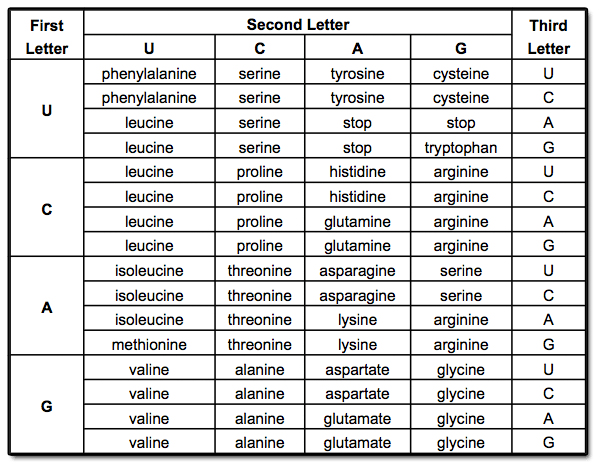
What amino acid is represented by the codon UUA?
a)
Phenylalanine
b)
Tyrosine
c)
Leucine
d)
Stop codon
49.
What is the location in the cell for translation?
a)
nucleus
b)
mitochondria
c)
ribosome
d)
chloroplast
50.
What is the three base sequence of mRNA that codes for a single amino acid?
a)
Anticodon
b)
Codon
c)
Protein
51.

Which is the mRNA molecule that would be transcribed from this DNA template:

TGG CAA GTA CGT

a)

ACCGTTCATGCA

b)

UGGCAAGUACGU

c)

UCCGUUCUUGCU

d)

ACCGUUCAUGCA

52.
How many amino acids are coded for by this sequence of nucleotides:
ATG GGA ACT CCA
a)
4
b)
2
c)
6
d)
12
53.

What is the RNA synthesized from a section of DNA with the code: GATTACA ?

a)

CUAAUGU

b)

GATTACA

c)

GAUUCA

d)

CTAATGA

54.
This image is most likely showing...
a)
Transcription
b)
Translation
c)
mRNA processing
d)
Post Translational Modification
55.
This image is most likely showing...
a)
Transcription
b)
Translation
c)
mRNA processing
d)
Post Translational Modification
56.
tRNA molecules match the mRNA codons with a(n):
a)
Codon
b)
Anti-Codon
c)
Intron
d)
Methylated Cap
57.

Okazaki fragments are used to elongate

a)

)the leading strand toward the replication fork

b)

the lagging strand toward the replication fork

c)

both strands in both directions

d)

)the leading strand away from the replication fork

e)

the lagging strand away from the replication fork

58.

The mRNA actively being translated in the cytoplasm would have all of the following EXCEPT

a)

a poly-A-tail

b)

a 5' cap

c)

exons

d)

introns

e)

RNA nucleotides

59.

What is the building block of proteins?

a)

Monosacchrides

b)

Polysaccharides

c)

amino acids

d)

Triglycerides

60.
what does mRNA do?
a)
carry info from genes to ribosomes
b)
carry amino acids to ribosomes
c)
help with RNA splicing
d)
make up ribosomes
61.
Nucleotides are made up of a sugar, phosphate, and..?
a)
nitrogenous base
b)
nucleic acid
c)
cholesterol
d)
fatty acid
62.
The function of tRNA is to
a)
synthesize DNA.
b)
synthesize mRNA.
c)
form ribosomes.
d)
transfer amino acids to ribosomes
63.
What is the correct sequence?
a)
RNA --> DNA --> Protein
b)
Protein --> RNA --> DNA
c)
DNA --> RNA --> Protein
d)
DNA --> Protein --> RNA
64.

To which end of an mRNA molecule is a poly-A tail added after transcription?

a)

5' end

b)

3' end

65.

Which of the following correctly describes exons? Choose ALL that apply.

a)

They code for proteins.

b)

They do not code for proteins.

c)

They may remain in mRNA after editing.

d)

They are usually removed from mRNA during editing.

66.

Which of the following correctly describes introns? Choose ALL that apply.

a)

They code for proteins.

b)

They do not code for proteins.

c)

They may remain in mRNA after editing.

d)

They are usually removed from mRNA during editing.

67.

During DNA replication, which strand is built in the same direction that the replication fork is forming?

a)

Lagging strand

b)

Leading strand

68.

Nucleic acids are always built in which direction?

a)

3' to 5'

b)

5' to 3'

69.

Amino acids are held together by _____ bonds.

a)

hydrogen

b)

peptide

c)

glycosidic

d)

ionic

70.

Which of the following most accurately illustrates DNA replication?

a)
b)
c)
d)