
 Worksheets
Economics Review - Week 3
Total questions: 35
Worksheet time: 1hrs 10mins
What determines the prices of goods and services?
Supply
Demand
Supply and demand
Goods
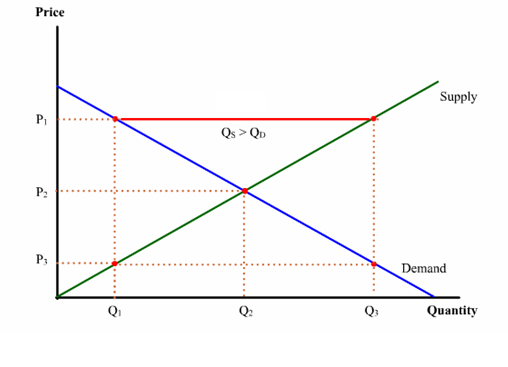
What exists when quantity supplied is greater than quantity demanded?
Surplus
Shortage
Overflow
Mass outrage
A market is said to be in equilibrium when
when demand is higher than the supply
when demand is lower than the supply
when the demand and supply quantities are equal
when the supply is doubled the demand
the price at which a good is bought and sold in a market equilibrium is called
retail price
equilibrium price
discount price
base price
Kanye West's new shoe the Yeezy Boost sold out in stores. This is an example of...
shortage
surplus
equilibrium
supply
What happens to price when the market has a surplus
price drops
price stays the same
price increases
price triples

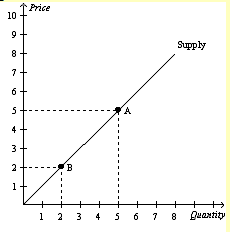
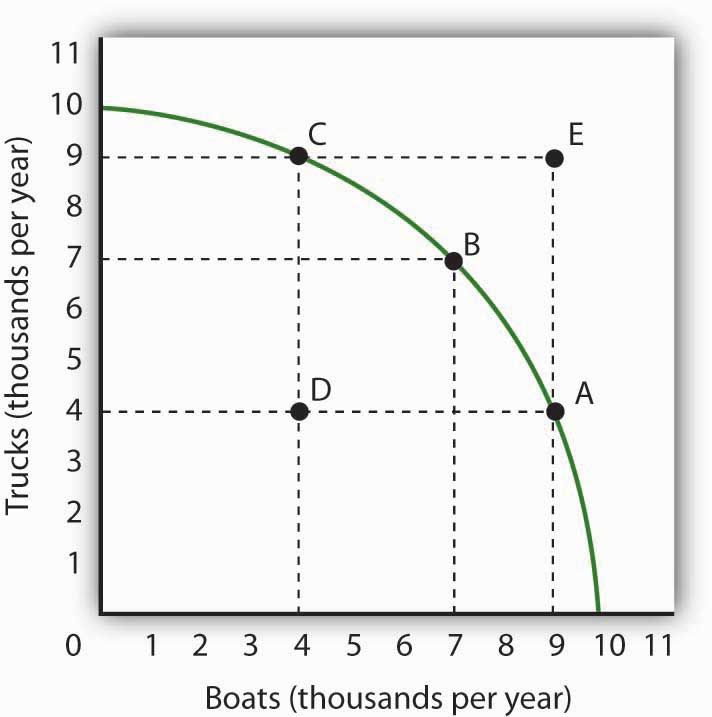

What does point B represent?
Production at greater than the country's minimum potential
Production is less than the country's minimum potential
Production is greater than the country's maximum potential
Production at the country's maximum potential
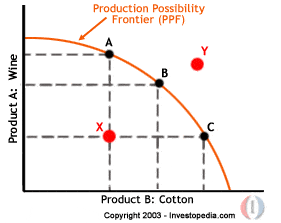

Which of the following are the choices in case the technology is fixed and all resources are efficiently employed. Choose the correct option/s.
G
C
A
E
B

Which coordinate(s) is/are inefficient to produce both products? Choose the correct option/s.
B
F
G
E
What is macroeconomic policy objective?
to increase employment
to increase the output of the car industry
to reduce the price level
to reduce economic growth
It is the study of the economy of the nation as a whole.
Microeconomics
National economy
National output
Macroeconomics
It is the measure of a country's total production of final goods and services in a given period of time.
Gross National Product
Gross Domestic Product
Exports
Imports
It is the continuing increase of the general price level in the market.
Inflation
Deflation
Stagflation
Recession
It is the decrease in the general level of prices of basic commodities.
Inflation
Deflation
Stagflation
Stagnation
Which of the following situation describes unemployment?
Robert is a full-time student.
Sharon just graduated from college.
George earns 70 pesos an hour.
Gene works after school as a bagger at a local grocery store.
Macroeconomics approaches the study of economics from the viewpoints of
individual firms
individual consumers
government units
the entire economy
The three major macroeconomic goals do not include
full employment
price level stability
sustained economic growth
high levels of environmental quality
A country is said to be experiencing inflation when…
Prices of most goods and services are rising over time
Total output is falling over time
Total output is rising over time
Prices of most goods and services are falling over time

Define the unemployment
State of having a paid job being to employ someone to pay them to work
Labour force participants being available and willing to work , but are unable to find jobs
Measure of the extent to which available labour resources
Legislation that provides for financial compensation for employees injured at work
What measure shows how well the economy is doing over time?
Gross Domestic Product
Unemployment Rate
Inflation Rate
Select the three macroeconomic policy goals from the following list.
Keep the economy growing over time
Limit unemployment
Keep prices stable
Raise unemployment
Keep the economy shrinking over time
Which of the following is not concerned with Macroeconomics?
National Income Accounting
Inflation
International Trade
Individual Firm
One measure of the economy macroeconomists pay attention to to study the pace of growth in the economy is
supply
inflation
demand
equilibrium price
Which of the following best defines “unemployment”?
When a person is not earning a wage.
When a person is actively looking for a job, but is unable to find one.
When a person is actively working, but not earning a wage or salary.
When a person is earning a wage while working at a regular job.

