
 Worksheets
Earth's Materials Review
Total questions: 50
Worksheet time: 8hrs 45mins
What is the definition of half life?
An abbreviation of the name of an element.
An abbreviation that always contains letters from the element name.
The amount of time it takes for half of a radioactive substance to decay.
A combination of numbers and letters
What is matter?
Any substance that has volume
Any substance that has compounds
Any substance that has mass
Any substance that has density
Radioactive decay is also known as ...
A full life
A half life
staying alive
A power that the terminator has
What are minerals?
They are small rocks
The building blocks of rocks
Crystals
Decayed biological organisms
What is the definition of luster?
The way that a mineral absorbs heat
The price of a mineral
The way that a mineral floats in water
The way that a mineral reflects light
What are the two types of luster?
Black and white
Glassy and Metallic
Metallic and Non-metallic
Mirrors and Metals
What is mineral cleavage?
The ability of a mineral to break along specific planes
The ability of mineral to shatter
The ability of a mineral to break into random pieces
The inability of a mineral to break at all
What is mineral fracture?
The ability of a mineral to break along specific planes
The ability of mineral to shatter
The ability of a mineral to break into random pieces (no cleavage)
The inability of a mineral to break at all
What do igneous rocks form from?
Heat and pressure
magma and/or lava
the lithification of weathered sediments
What do sedimentary rocks form from?
Heat and pressure
magma and/or lava
the lithification of weathered sediments
What do metamorphic rocks form from?
Heat and pressure
magma and/or lava
the lithification of weathered sediments
What are the two main types of metamorphic rocks?
Clastic and chemical
intrusive and extrusive
Foliated and non-foliated
What are the two main types of igneous rocks?
Clastic and chemical
intrusive and extrusive
Foliated and non-foliated
What are the two main types of sedimentary rocks?
Clastic and chemical
intrusive and extrusive
Foliated and non-foliated
This type of igneous rock cools slowly, allowing crystals to grow large in size.
Clastic
Chemical
Intrusive
Extrusive
This type of igneous rock cools quickly, allowing for little to no crystal growth.
Clastic
Chemical
Intrusive
Extrusive
This type of sedimentary rock forms when layers of sediment get stuck together over time - a process known as cementation.
Clastic
Chemical
Intrusive
Extrusive
This type of sedimentary rock forms when water evaporates and leaves minerals behind.
Clastic
Chemical
Intrusive
Extrusive
What household material is made from gypsum?
Drywall
Pencils
Glass
Cups
What item is made from graphite?
Drywall
Pencils
Glass
Cups
What household material is made from quartz?
Drywall
Pencils
Glass
Paper Cups
Which of the following is NOT one of the criteria used to classify an object as a mineral?
It must be a solid under normal conditions
It must be organic
It must be naturally occurring
It must have a fixed chemical formula and atomic structure
Why is liquid mercury not a mineral?
It is not naturally occuring
It does not have a fixed chemical formula
It does not have a fixed atomic structure
It is not a solid
What causes a mineral to display physical properties, such as odor or color?
There is no way to determine this
the fixed arrangement of the atoms
The color of the mineral
The luster of the mineral
Even though diamond and graphite are both composed of Carbon, why do they have such different physical properties?
The chemical formula is exactly the same
the arrangement of the atoms in each mineral is different
The color of the mineral is different
The luster of the mineral is different
Which of the following is NOT one of the properties of mineral identification?
size of the mineral
color of the mineral
luster of the mineral
hardness of the mineral
The hardness of a mineral is measured using this scale.
The Newton Scale
Moh's Hardness Scale
Know's Hardness Scale
The Isaac Scale
The streak of a mineral shows...
The hardness of a mineral
the arrangement of the atoms in a mineral
the chemical formula of the mineral
The color of the pulverized powder of a mineral
What is the innermost layer of the Earth?
The outer core
The inner core
The mantle
The lithosphere
True or False? Minerals and rocks are exactly the same.
True
False
All minerals must be in this state of matter.
Solid
Liquid
Gas
Plasma
For a mineral to cleave instead of fracture, it must...
be inorganic
break along flat, crystal surfaces
occur as a pure element
be a rock
The two most common elements in the Earth's crust are oxygen and...
silicon
carbon
nitrogen
potassium
Mineral crystals can grow large if they have enough time and....
space
competition
initiative
oxygen
Which is an example of mechanical weathering?
Dissolution
Oxidation
Thermal Expansion
Cave formation
Which is an example of chemical weathering?
Dissolution
Frost wedging
Exfoliation
Thermal expansion
Which is not an example of erosion by gravity?
Slump
Rock Slides
Mud Slides
Runoff
Which is an example of erosion by wind?
Slump
Dust storms
Flooding
Rivers
Which is not an example of erosion by water?
Runoff
Flooding
Rivers or streams
Dust storms
Which is an example of erosion by ice?
Barrier Islands
Glaciers
Sandbars
Runoff
Sediment is deposited in a stream when...
It gains energy
It decreases in temperature
It loses energy
It increases in temperature
An example of deposition by wind.
Sandbars
Barrier Islands
Sand dunes
Mountains

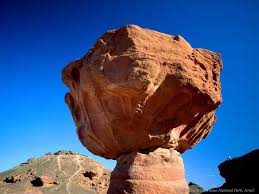
The dropping off of sediments in a new place is called __________.
weathering
deposition
sedimentary rock
drop off zone
What is density?
The amount of space an object occupies
The amount of matter in an object
The ratio of mass and volume
The amount of weight in an object
What is volume?
The amount of space an object occupies
The amount of matter in an object
The ratio of mass and volume
The amount of weight in an object
What is mass?
The amount of space an object occupies
The amount of matter in an object
The ratio of mass and volume
The amount of weight in an object
Do dense objects sink of float?
Sink
Float
What is the equation for density?
D = M/V
D = M x V
D = M - V
D = M + V

