

wayground logo

Free Printable Worksheets

Font size

S
M
L
XL
Worksheets

Year 5 Q2 Science

Total questions: 67

Worksheet time: 1hrs 5mins

Name
Class
Date
1.

Which rock is formed form the cooling of volcanic ash on Earth's surface?

a)

intrusive igneous

b)

foliated metamorphic

c)

extrusive igneous

d)

organic sedimentary

2.
A rock formed from fragments of other rocks is a(n)
a)
Metamorphic Rock
b)
Sedimentary Rock
c)
Extrusive Rock
d)
Igneous Rock
3.
This rock was another type of rock that was heated and compressed over time. What type of rock is this?
a)
Sedimentary
b)
Igneous
c)
Metamorphic
4.
This rock started as molten magma. What type of rock is this?
a)
Sedimentary
b)
Igneous
c)
Metamorphic
5.
This rock was formed by smaller pieces of rock that settled at the bottom of a lake millions of years ago. What type of rock is this?
a)
Sedimentary
b)
Igneous
c)
Metamorphic
6.
The process when rocks break into smaller pieces due to exposure to natural elements is called
a)
erosion
b)
weathering
c)
sediments
7.
What are the 3 major types of rocks?
a)
Igneous, Metamorphic, Sedimentary
b)
Metamorphic, Igneous, Cementation
c)
magma, lava, crystals
8.
The name rock is given when it is broken down into smaller pieces.
a)
texture
b)
weathering
c)
sediment
d)
erosion
9.
True/False: Igneous rocks can only turn into metamorphic rocks.
a)
True
b)
False
10.

Any rock that forms from another rock as a result of changes in heat or pressure (or both) is a:

a)

chemical rock

b)

igneous rock

c)

sedimentary rock

d)

metamorphic rock

11.

This is a natural solid that is made of one or more minerals.

a)

Mineral

b)

Fossil

c)

Rock

d)

Sediment

12.

This is the continuous process of rock changing from one type to another.

a)

Igneous rocks

b)

Sedimentary rocks

c)

Metamorphic rocks

d)

Rock Cycle

13.

What type of rock might contain evidence of past life?

a)

Sedimentary Rock

b)

Igneous Rock

c)

Metamorphic Rock

14.

Which of the following lists the steps an igneous rock undergoes in order to become a sedimentary rock, in the correct order?

a)

Deposition, erosion, melting, cooling

b)

Erosion, weathering, eruption, cooling

c)

Dissolving, deposition, cooling, fracture

d)

Weathering, erosion, deposition, cementation

15.

Limestone is a sedimentary rock. During the rock cycle, limestone is changed into marble, a metamorphic rock. The processes that act on limestone and change it into marble are

a)

weather and erosion

b)

heat and pressure

c)

compacting and cementing

d)

melting, cooling, and hardening

16.

According to the diagram, what process is shown by letter B?

a)

compaction & cementation

b)

weather & erosion

c)

heat & pressure

d)

melting

17.

If a lot of heat is applied to a rock, it will turn into

a)

magma

b)

rocks

c)

sediment

d)

metamorphic rocks

18.
What are the 3 major types of rocks?
a)
Igneous, Metamorphic, Sedimentary
b)
Metamorphic, Igneous, Cementation
c)
Brown, Red, Gray
d)
Streak, Hardness, Breakage
19.
This rock formed when bits of other rocks became pressed into a solid. What type of rock is it?
a)
Sedimentary Rock
b)
Metamorphic Rock
c)
Igneous Rock
20.
This rock was formed when molten rock cooled into a solid. What type of rock is it?
a)
Igneous Rock
b)
Metamorphic Rock
c)
Sedimentary Rock
21.

The name of a person that studies rocks and the earth.

a)

veterinarian

b)

geologist

c)

podiatrist

d)

teacher

22.
When you watch a volcano erupt molten rock, you are seeing _____
a)
Lava
b)
Magma
c)
Mineral Crystals
d)
Igneous Rocks
23.
When sediments are pressed together tightly, this is called ____________.
a)
Compaction
b)
Cementation
c)
Weathering
d)
Erosion
24.
The process when rocks break into smaller pieces due to exposure to natural elements is called
a)
erosion
b)
weathering
c)
sediments
25.
True or False: Once a rock is sedimentary, it cannot become an igneous rock.
a)
True
b)
False
26.

Geologists have classified rocks into three major groups of rocks which are:

a)

inorganic, organic and chemical rocks

b)

igneous, sedimentary and metamorphic rocks

c)

metamorphic, chemical and non chemical rocks

d)

sedimentary, inorganic and igneous rocks

27.

The process by which metamorphic rock changes to igneous rock begins with

a)

melting

b)

erosion

c)

deposition

d)

crystallization

28.
The process by which igneous rocks are formed...
a)
heat and pressure
b)
melting and cooling
c)
weathering and erosion
29.
The process by which metamorphic rocks are formed...
a)
heat and pressure
b)
erosion and deposition
c)
melting and cooling
30.
The name rock is given when it is broken down into smaller pieces.
a)
texture
b)
weathering
c)
sediment
d)
erosion
31.
_______ rock forms from magma/lava
a)
Metamorphic
b)
Sedimentary
c)
Igneous
32.
What is process in which water, wind, and heat break down rock?
a)
weathering
b)
exfoliation
c)
cementation
d)
composition
33.
During the rock cycle, what forms when the magma cools?
a)
igneous rocks
b)
sedimentary rock
c)
metamorphic rock
d)
foliated rock
34.
Sedimentary rocks may contain fossils.
a)
True
b)
False
35.

Name of the impression of a plant or animal, in the soil, that existed in the past

a)

diamond

b)

hardness

c)

fossil

36.
The changes to water when it cycles the earth is called
a)
the moon cycle
b)
the sun cycle
c)
the water cycle
d)
the wind cycle
37.
When water vapor s cooled and forms droplets-
a)
Condensation
b)
Evaportation
c)
Transpiration
d)
Run-off
38.
Forms of precipitation are-
a)
only sleet and snow
b)
rain, sleet, hail, and snow
c)
only dew and rain 
d)
only snow and rain
39.
Water in lakes and rivers that does not contain salt-
a)
recycled water
b)
new water
c)
salt water
d)
fresh water
40.
When water is heated in the ocean by the sun and turns into water vapor
a)
condensation
b)
evaporation
c)
transpiration
d)
runoff
41.
What is it called when plants give off water vapor as a waste product?
a)
condensation
b)
evaporation
c)
sublimation
d)
transpiration
42.
What is precipitation?
a)
The part of the water cycle when the sun heats up water, turning it from a liquid into water vapor or steam. It rises from the ground into the air.
b)
The part of the water cycle when the water vapor in the air gets cold. The water turns back into a liquid and forms clouds.
c)
The part of the water cycle when clouds get heavy and can no longer hold the liquid water. This causes the water to fall from the sky to the earth as rain, snow, sleet, or hail.
43.
On which kind of day would you expect the most evaporation from the surface of a pond?
a)
cold, rainy
b)
cold, sunny
c)
warm, rainy
d)
warm, sunny
44.
What is water vapor?
a)
Water on the land (geosphere)
b)
Water in the air (atmosphere)
c)
Water in plants
d)
Water in the water (hydrosphere)
45.
What cloud is found at ground level? 
a)
Cirrus
b)
Stratus
c)
Culumlus 
d)
Fog
46.
Which of these is not an example of precipitation?
a)
rain
b)
clouds
c)
sleet
d)
snow
47.

What is the role of the sun in the water cycle?

a)

provide heat energy for evaporation

b)

provide heat energy for condensation

c)

dry out the soil for runoff to occur

d)

provide thermal energy for accumulation

48.

What do we call water in its gas state?

a)

rain

b)

snow

c)

ice

d)

water vapor

49.
What part of the water cycle does this picture show?
a)
condensation
b)
precipitation
c)
evaporation
50.
Which is the opposite of condensation?
a)
runoff
b)
evaporation
c)
precipitation
d)
transpiration
51.
When water _________, dew forms.
a)
Melts
b)
Evaporates
c)
Condenses
d)
Precipitates
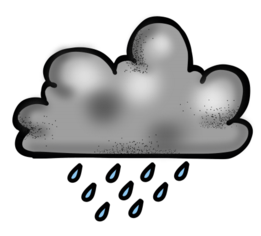
52.
True or False -
The greatest amount of water found on earth is fresh water.
a)
True
b)
False
53.
What part of the water cycle does this picture show?
a)
condensation
b)
precipitation
c)
evaporation
54.
What is A?
a)
Evaporation
b)
Condensation
c)
Precipitation
d)
Runoff
55.
What is B?
a)
Evaporation
b)
Condensation
c)
Precipitation
d)
Runoff
56.
What is      D?
a)
Evaporation
b)
Condensation
c)
Precipitation
d)
Runoff
57.

Precipitation means...

a)

water vapor cooling to form clouds

b)

water running downhill

c)

water falling from the sky

d)

water heating up and rising as gas

58.

Runoff means...

a)

water vapor cooling to form clouds

b)

water running downhill

c)

water falling from the sky

d)

water heating up and rising as gas

59.

Condensation means...

a)

water vapor cooling to form clouds

b)

water running downhill

c)

water falling from the sky

d)

water heating up and rising as gas

60.
What is water that flows in rivers and streams into the oceans and lakes?
a)
evaporating
b)
condensing
c)
precipitating
d)
runoff
61.

Evaporation means...

a)

water vapor cooling to form clouds

b)

water running downhill

c)

water falling from the sky

d)

water heating up and rising as gas

62.

During evaporation water changes from ...

a)

water vapor (gas) to liquid

b)

liquid to water vapor (gas)

c)

water vapor (gas) to solid ice

63.

During condensation water changes from ....

a)

solid ice to liquid water

b)

liquid water to water vapor (gas)

c)

water vapor (gas) to liquid water drops

64.

Liquid water turns into gas and rises into the sky in....

a)

precipitation

b)

condensation

c)

evaporation

65.

Water falls from the sky in...

a)

evaporation

b)

condensation

c)

precipitation

66.

_____________________ is the step of the water cycle where the Sun heats up liquid water in a puddle and turns it into water vapor gas.

a)

precipitation

b)

evaporation

c)

runoff

67.
Snow, sleet, hail, and rain are all examples of  ________________. 
a)
evaporation
b)
condensation
c)
accumulation
d)
precipitation
