Wayground logo

Free Printable Worksheets

Font size

S
M
L
XL
Worksheets

7G - The Particle Model

Total questions: 42

Worksheet time: 26mins

Name
Class
Date
1.
What state of matter consists of tightly packed atoms?
a)
Solid
b)
liquid
c)
gas
d)
plasma
2.
When pressure increases, which of the following also increases?
a)
mass
b)
volume
c)
temperature
d)
length
3.
Liquid has a definite ___________, but a variable _____________.
a)
shape, volume
b)
mass, area
c)
smell, taste
d)
volume, shape
4.
Which of the following states of matter has the most kinetic energy?
a)
solid
b)
liquid
c)
gas
5.
Which of the following states of matter has the lowest kinetic energy? 
a)
solid
b)
liquid 
c)
gas
6.
To make a solid become a liquid, you must increase its________________.
a)
mass
b)
density
c)
kinetic energy
d)
potential energy
7.
Gas particles move around at __________ speeds. 
a)
low
b)
slow
c)
high
d)
unknown
8.
Adding thermal energy to matter casues its particles to _________________.
a)
move slower
b)
move faster
c)
melt
d)
feeze
9.
Which state of matter has particles that are loosely connected, and move freely past each other? 
a)
solid
b)
liquid
c)
gas
d)
plasm
10.

_______ have lots of space between particles and no regular arrangement.

a)

Solids

b)

Liquids

c)

Gasses

11.

_______ can be compressed.

a)

Solids

b)

Liquids

c)

Gasses

12.

_______ have molecules that are usually arranged in a pattern.

a)

Solids

b)

Liquids

c)

Gasses

13.

________ can not change volume, but can change shape.

a)

Solids

b)

Liquids

c)

Gasses

14.
The smallest piece of anything that still has the properties of that thing is called
a)
an element.
b)
a particle.
c)
a substance.
d)
a gas.
15.
Air particles inside a closed object are
a)
compressed so that the particles bond to each other.
b)
vibrating rapidly until they break the bonds holding them to other particles.
c)
constantly moving and bumping into other particles and the object.
d)
perfectly still because they have enough room.
16.

When something goes from gas to liquid, it is called...

a)

Evaporation

b)

Condensation

c)

Deposition

d)

Freezing

17.

Something that goes from liquid to gas is...

a)

Evaporation

b)

Melting

c)

Freezing

d)

Sublimation

18.

Which of the following sentences are true about solids?

a)

Solids are rigid, have a fixed shape but not a fixed volume

b)

Solids are not rigid, have a fixed shape and no fixed volume

c)

Solids are rigid, have a fixed shape and a fixed volume

19.
Number 2 represents a ________
a)
solid
b)
liquid
c)
gas
d)
plasma
20.
As particles are exposed to warmer temperatures they __________
a)
speed up
b)
slow down
c)
stay the same
d)
vibrate
21.
As particles are exposed to colder temperatures they _____
a)
speed up
b)
slow down
c)
stay the same
d)
become ions
22.
What term describes a solid changing to a gas?
a)
Deposition
b)
Sublimation
c)
Evaporation
d)
Freezing
23.
Particles have energy and _________ stop moving
a)
rarely
b)
always
c)
never
d)
sometimes
24.
As molecules bump into each other, they push each other ________ until they are equally spread out. 
a)
together
b)
apart
25.
3. Identify the states of matter where Brownian Motion can occur.
a)
a) Solid, liquid, gas
b)
b) Liquid, gas
c)
c) Solid, gas
d)
d) Solid, liquid
26.

Pollen grains suspended in water exhibit Brownian motion. How does a particle undergoing Brownian motion move?

a)

In smooth curves

b)

Randomly

c)

Orderly with a pattern

d)

In straight lines with no change of direction

27.

A pollen grain in a beaker of still water is viewed through a microscope. Which diagram shows the most likely movement of the pollen grain?

a)

A

b)

B

c)

C

d)

D

28.

Diffusion is...

a)

It is the random movement of particles.

b)

It is when particles move from a place of higher concentration to a place with lower concentration.

c)

It is when particles move when being mixed together.

d)

It is when the particles hit the sides of their container.

29.

Select the 4 correct answers. A particle _____.

a)

can be a solid.

b)

can be a liquid.

c)

can be a gas.

d)

has random motion.

e)

remains stationary.

30.

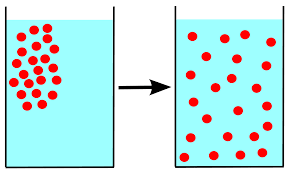
The picture below is an example of _________________.

a)

osmosis

b)

isotonic

c)

diffusion

d)

active transport

31.

Diffusion occurs only in solids

a)

True

b)

False

32.

How long does diffusion last?

a)

Until the concentration of particles in the system is equal

b)

Until a region in the system has a smaller concentration of particles than the other

c)

Until a region in the system has a greater concentration of particles than the other

d)

Until the particles disappear from the system

33.

How does an increase in temperature affect diffusion?

a)

Diffusion speeds it up

b)

Diffusion slows it down

c)

Diffusion has no effect

34.
All matter is made of _____ that are constanly moving.
a)
insulators
b)
particles
c)
convection
d)
pieces of plastic
35.
Pressure is the effect of
a)
the weight of all the air above pressing down
b)
water vapor in the atmosphere
c)
greenhouse gases
d)
solar radiation
36.

The higher the altitude, the lower the air pressure.

a)

True

b)

False

37.

As air pressure decreases, so does density.

a)

True

b)

False

c)

I don't know

38.
What does the air consist of?
a)
molecules
b)
helium
c)
density
d)
weather
39.
How can we increase the gas pressure inside a sealed container?
a)
Increase the number of particles inside the container
b)
Increase the temperature
c)
Decrease the volume of the container
d)
All of these
40.

If a hairspray can is heated, what can be expected of the pressure of the gas inside the can?

a)

The pressure will increase

b)

The pressure will decrease

c)

The pressure will remain constant

d)

The pressure will equalize

41.
In what direction(s) does air exert pressure?
a)
everywhere
b)
no where
c)
there is no pressure
d)
downward
42.

This is an example of the everyday application of pressure in:

a)

Solids

b)

Liquids

c)

Gases

d)

Plasma