
 Worksheets
Taxonomy, Classification, Evidence of Evol
Total questions: 55
Worksheet time: 3615secs
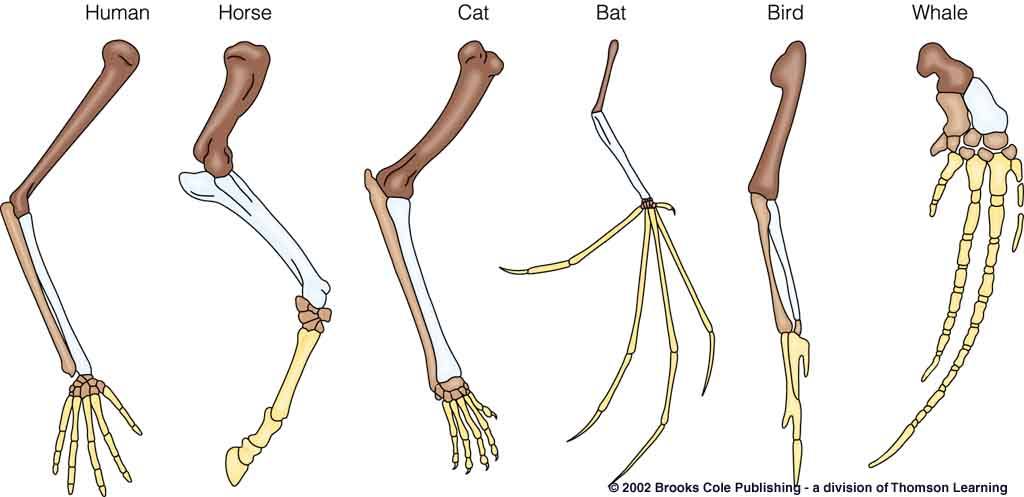


The five species illustrated most likely have
similar limb structures because they all -
share a common ancestor
use their limbs for the same functions
occupy the same level on the food pyramid
adapted to the same environmental conditions

Which information would best help scientists verify the relationships among the organisms shown above?
The organisms’ nutritional requirements
The organisms’ DNA sequences
The organisms’ migratory patterns
The organisms’ population sizes

The diagram illustrates an embryonic stage of two organisms. Which of the following can be determined by observing the embryos shown in the diagrams?
The organisms share a common ancestry
The organisms belong to the same genus
The organisms are native to the same geographic areas
The organisms will grow into anatomically similar adults


This cladogram shows the evolutionary relationships among some mammals based on homologous structures. Which statement is supported by this cladogram?
Hippopotamuses are more closely related to cows than javelinas
Toothed whales are more closely related to mouse deer than to hippopotamuses
Javelinas and pigs are more closely related than baleen whales and toothed whales
Cows and mouse deer are more closely related than javelinas and pigs

Scientists can determine relatedness among organisms by comparing partial amino acid sequences. The table shows four partial amino acid sequences from four organisms. Which organism is the least related to the other three organisms?
organism 1
organism 2
organism 3
organism 4

The image shows part of the humerus bone in different genera of primates. Which statement is best supported by the observable structures of the different humerus bones?
the primates lived in similar environments
the primates shared a common ancestor
the primates interbreed with similar organisms in a population
the primates had diets that consisted of similar types of foods

Researchers studying populations of lizards from the genus Gallotia on the Canary Islands compared the protein cytochrome b in different populations. The table shows the number of differences in the cytochrome b protein between different populations. Which conclusion about the relatedness of the lizards do these data support?
G. atlantica and G. stehlini are the least closely related
G. simonyi and G. bravoana are the most closely related
G. galloti eisentrauti and G. galloti palmae are the most closely related
G. galloti eisentrauti and G. galloti galoti are the least closely related

Cetaceans are whales and their relatives. The diagram shows some fossils of cetaceans. Which statement provides the best evidence that Ambulocetus natans is an ancestor of Basilosaurus isis?
Homologous structures occur in each fossil
Similar nitrogenous bases are found in the DNA of each fossil
The fossils were found in different locations
The youngest fossil is larger than the older fossils

An analysis of DNA and RNA sequences can be used to classify organisms. A dendrogram, such as the one shown below, is based on molecular data. It can be used to represent evolutionary relationships within a group of organisms that are hypothesized to have descended from a common ancestor. Which statement is best supported by the information in this dendrogram?
Lesser pandas are more genetically similar to giant pandas than they are to raccoons
Brown bears are more genetically similar to giant pandas than they are to sun bears
Lesser pandas are more genetically similar to racoons than they are to giant pandas
The bear species are all more genetically similar to dogs than they are to giant pandas

Three species of lizards of the genus Gallotia are found on the Canary Islands, a chain of seven volcanic islands off the wet coast of Africa. The easternmost island, Lanzarote, is the oldest, while the westernmost island, El Hierro, is the youngest. The distribution of lizard species is shown on the map. Which statement about the ancestry of the lizards from the genus Gallotia is best supported by this information?
The common ancestor of the lizards first colonized the island of El Hierro
The ancestors of each species came from different continents at different times
the common ancestor of the lizards probably came from Africa
The ancestors of each species evolved in Spain and were brought to the islands at the same time

The opossum, which is native to North America, and the kangaroo, which is native to Australia, are marsupials. The fact that both these mammals incubate their immature offspring in a pouch provides evidence that they -
belong to the same species
must range great distances to eat
have very similar skeletal structures
are descended from a common ancestor
Genome maps provide the DNA sequences of chromosomes. Some scientists have compared the genome maps of a hedgehog and a sloth. What do these genome maps allow the scientists to determine?
The color patterns of the offspring of each species
How much the size ranges of the two species differ
The methods of proteins synthesis that each species uses
How closely related the two species are to each other

Zoogeographic regions are characterized by the presence of specific groups of animals. These regions are determined by the taxonomic or phylogenetic relationships of animals. The map shows the zoogeographic regions proposed by the naturalist Alfred Russel Wallace in 1876. The similarities of organisms in which two areas numbered above provide the best evidence for common ancestry between the organisms in both locations?
1 and 2
3 and 4
5 and 6
7 and 8

The limbs of several organisms are shown in the illustrations below. Scientists sometimes compare the limbs of these organisms to look for evidence of common ancestry. These limbs provide evidence of common ancestry because they -
have the same basic structure
perform the same function
are the same size
are parts of mammals

This diagram of the fossil record represents changes in mollusks over millions of years. How can the pattern of change in the fossil record best be explained?
The mollusks were well adapted to their stable environment. A large, sudden change occurred in their environment. After the change the mollusks with the bigger shells were better adapted to the new environment
The mollusks were well adapted to their stable environment. The mollusks hybridized with a smaller species of mollusk. A new species of mollusk with a bigger shell resulted
The mollusks were not well adapted to their environment. The length of the mollusks' shells changed gradually over time. The mollusks in the original population that had small shells died over a period of many years
The mollusks were well adapted to their environment. Humans introduced a new species of mollusk that was not adapted to this environment. The introduced mollusk outcompeted the native mollusk species

Which of the following accurately lists the levels of classification in our current taxonomic system?
Phylum, kingdom, domain, class, order, family, genus, species
Class, domain, kingdom, phylum, order, family, genus, species
Domain, phylum, kingdom, class, order, family, genus, species
Domain, kingdom, phylum, class, order, family, genus, species

If two organisms are in the same class, then they must also be in the same
Phylum
Order
Family
Genus

Based on the key, which of these best describes the leaves and cones of the longleaf pine?


8B. A student used a microscope to study four members of the phylum Ciliophora. Members of this phylum move when propelled by hundreds of tiny cilia. Although these organisms belong to the same phylum, they are classified as different-
families
species
kingdoms
orders
Scientists around the world use a standardized taxonomic system. Why would scientists want to use a taxonomic system that is standardized?
In order to avoid confusion with the identification of organisms
Because Linnaeus established the system
So that Latin names can be applied for a practical purpose
In order to place organisms in different groups

Choose the correct way to write the scientific name for humans:
homo sapiens
Homosapiens
Homo sapiens
Homo Sapiens

The scientific name for a raccoon is written below in several different ways. Which one is written in the correct form?
Procyon lotor
Procyon lotor
Procyon Lotor
PROCYON LOTOR


Heterotrophs- obtain food from other animals.
Observing the table above, Fungi and Animals are________?

What kingdom do unicellular, prokaryotic organisms that live in extreme environments?
Animal
Archaebacteria
Eubacteria
Plant

This organism is multicellular, heterotroph, that has a cell wall made of chitin. What kingdom does it belong in?
fungi
plantae
animalia
eubacteria

This organism is found in pond water. It has a nucleus, is microscopic, unicellular and can perform photosynthesis. What kingdom does it belong in?
protista
eubacteria
archaebacteria
plantae

What is the correct order of taxonomy?
Kingdom, pylum, class, species, genus, family, class
Species, genus, family, order, class, phylum, kingdom
Kingdom, phylum, class, order, family, genus, species
species, phylum, order, class, kingdom, family, genus



