Wayground logo

Free Printable Worksheets

Font size

S
M
L
XL
Worksheets

Waves Review

Total questions: 40

Worksheet time: 46mins
Name
Class
Date
1.
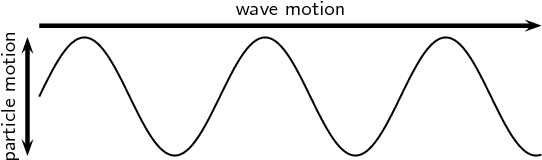
What kind of wave is pictured below?
a)
compressional wave
b)
transverse wave
c)
sound wave
d)
mechanical wave
2.
Waves are a transfer of what?
a)
Heat
b)
Light
c)
Energy
d)
Food
3.
The units for frequency are measured in _____________.
a)
hertz
b)
seconds
c)
m/s
d)
m
4.
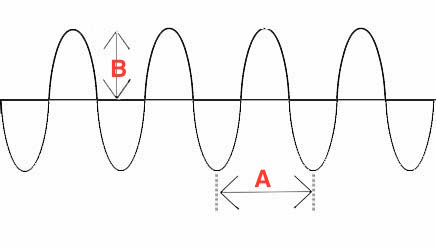
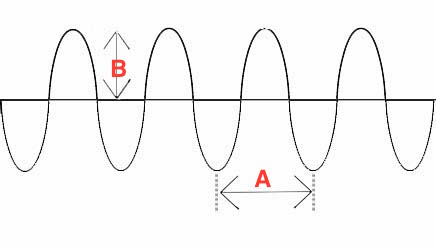
What property of this wave is represented by the letter "A"
a)
amplitude
b)
crest
c)
trough
d)
wavelength
5.
The highest point on a wave is:
a)
the crest
b)
the trough
c)
the top
d)
the coast 
6.
The number of wavelengths that pass a point each per second is:
a)
frequency
b)
period
c)
longitudinal 
d)
transverse wave 
7.
When the frequency of a wave increases, what happens to the wavelength?
a)
The wavelength is not directly affected by the frequency of a wave.
b)
The wavelength increases.
c)
The wavelength decreases.
d)
More specific information is needed to form a conclusion about the wavelength.
8.
What is the speed of a sound wave that has a frequency of 250 hertz and a wavelength of 8 meters? 
a)
31 m/s
b)
250 m/s
c)
2000 m/s
d)
5280 m/s
9.
A wave in which the particles of the medium move perpendicularly to the direction the wave is traveling
a)
A. surface wave
b)
B. transverse wave
c)
C. electromagnetic  wave
d)
D. longitudinal wave
10.
A wave in which the particles of the medium vibrate parallel to the direction of the wave motion
a)
A. mechanical wave
b)
B. surface wave
c)
C. longitudinal wave
d)
D. wave
11.

What makes electromagnetic waves different from mechanical waves?

a)

no medium required

b)

medium needed

c)

light -catalyzed

d)

space exclusive

12.

Which type of EM waves has the shortest wavelength?

a)

radio wave

b)

visible light

c)

gamma ray

d)

ultraviolet

13.

Utilized in treating cancer, the radiotherapy

a)

gamma ray

b)

x-ray

c)

visible light

d)

microwave

14.

Plays important role in wireless communication

a)

ultraviolet

b)

visible light

c)

infrared

d)

microwave

15.

Used in medical technology specifically in generating images of lungs and bone fractures

a)

infrared

b)

visible light

c)

ultraviolet

d)

x-ray

16.

Helpful in military night vision goggles

a)

radio wave

b)

microwave

c)

infrared

d)

light

17.

Used in medical technology specifically in generating images of lungs and bone fractures

a)

infrared

b)

visible light

c)

ultraviolet

d)

x-ray

18.
Which of these waves cannot travel in a vacuum?
a)
light wave
b)
sound wave
c)
electromagnetic wave
d)
microwave
19.
What is the wavelength of a wave?
a)
the size of the disturbance
b)
the amount of time that occurs in one full cycle
c)
the distance between two crests of a wave
d)
the amount of cycles that occur in a given time
20.
Unlike a longitudinal wave, the disturbance in a transverse wave is
a)
perpendicular to the wave motion.
b)
in a circular motion.
c)
parallel to the wave motion.
d)
in the opposite direction of the wave motion.
21.
Unlike a transverse wave, the disturbance in a longitudinal wave is
a)
in a circular motion.
b)
parallel to the wave motion.
c)
perpendicular to the wave motion.
d)
in the opposite direction of the wave motion
22.
the bending of a light wave as it moves from one medium to another
a)
reflection
b)
refraction
c)
reflaction
d)
retraction
23.
What is frequency?
a)
the number of vibrations per second
b)
how high or low a sound is
c)
the loudness or softness of a sound
d)
the back and forth movement of matter
24.
What property of the wave is represented by the letter "B"?
a)
amplitude
b)
crest
c)
trough
d)
wavelength
25.
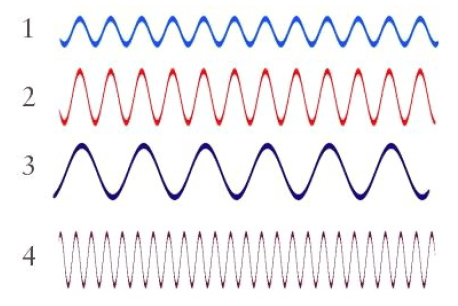
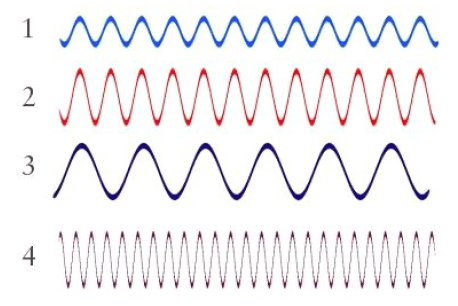
Which wave in the diagram has the greatest frequency?
a)
1
b)
2
c)
3
d)
4
26.
When a wave strikes and object and bounces off. (example echo)
a)
medium
b)
refraction
c)
reflection
d)
interference
27.

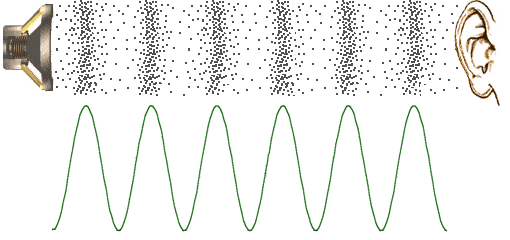
A section of a longitudinal (sound) wave where the particles are crowded together is called a

a)

A. rarefaction.

b)

B. vibration

c)

C.compression

d)

D. surface wave.

28.

Electromagnetic waves do NOT need a medium through which to travel.

a)

true

b)

false

29.

This is a _____ wave.

a)

surface

b)

longitudinal

c)

transverse

30.

This is a _____ wave.

a)

surface

b)

longitudinal

c)

transverse

31.
Which wave in the diagram has the greatest wavelength?
a)
1
b)
2
c)
3
d)
4
32.
Which electromagnetic waves have the highest frequencies and the shortest wavelengths?
a)
microwaves
b)
visible light
c)
gamma rays
33.
Which of the following has wavelengths longer than microwaves?
a)
Infrared waves
b)
Radio waves
c)
Visible light
34.

The full range of frequencies of electromagnetic radiation is called

a)

visible light.

b)

radio waves.

c)

the electromagnetic spectrum.

d)

invisible radiation.

35.

Wave

a)

Any disturbance that transfers energy from place to place.

b)

Movement of a wave that travels through some type of matter.

c)

Movement of a wave that travels without needing to pass through matter.

d)

The matter a wave travels through.

36.

Medium

a)

Any disturbance that transfers energy from place to place.

b)

Movement of a wave that travels through some type of matter.

c)

Movement of a wave that travels without needing to pass through matter.

d)

The matter a wave travels through.

37.

What are the 3 mechanical waves?

a)

Transverse Waves

b)

Longitudinal Waves

c)

Surface Waves

d)

Electromagnetic Waves

38.

Speed

a)

The distance between the highest crest and the resting position

b)

The distance the wave travels before it repeats

c)

The number of time a wave repeats

d)

The distance the wave travels in a certain amount of time

39.

Which of the following are applications of UV light? Select three

a)

sunblock

b)

sterilizing medical equipment

c)

helps in the production of vitamin D

d)

detecting nectar

e)

organ detection

40.

Radio waves and _______ are used in communication

a)

Microwaves

b)

Gamma rays

c)

Visible light

d)

Ultraviolet