
 Worksheets
Plate Tectonics
Total questions: 84
Worksheet time: 1hrs 4mins

Wegner used the following as pieces of evidence...
fit/shape of continents
geologic and fossil
climate
all of the above
What is the thinnest layer?
Crust
Mantle
Outer Core
Inner Core
What is the thickest layer?
Crust
Mantle
Outer Core
Inner Core
Which layer is the only liquid layer?
Crust
Mantle
Outer Core
Inner Core
Which layer is made of solid Iron and nickel?
Crust
Mantle
Outer Core
Inner Core
Which layer is made of liquid iron and nickel?
Crust
Mantle
Outer Core
Inner Core
The Lithosphere is made up of the ___________.
Crust and Upper Mantle
Inner and Outer Cores
Outer Core and Lower Mantle
Lower and Middle Mantle
What is the Asthenosphere?
an elastic substance on which the tectonic plates float.
the air that we breathe.
another name for a globe.
the hard inner core
Which layer is the hottest?
crust
mantle
outer core
inner core
What is the middle part of the mantle that is partially molten rock, or putty like, or semisolid.
Asthenosphere
Mesosphere
Lithosphere
Crust
Which of the following is true regarding the composition of the lithosphere?
The lithosphere is mostly liquid, with some medium-density materials, such as silicon.
The lithosphere is more plastic and flows slowly compared to the solid crust of Earth.
The lithosphere includes the core and the lower portion of the mantle.
The lithosphere includes the crust and the uppermost portion of the mantle, which is sold and rigid.

As you travel from the crust to the core, how would temperature, pressure and density of the material change?
They would all increase
They would all decrease.
Nothing, the layers are made of the same material throughout
Temperature would decrease, but pressure and density would increase
The continental crust is
thinner than the oceanic crust
thicker than the oceanic crust
the same thickness as the oceanic crust

The layer is divided into two: the continental and oceanic.
Crust
Mantle
Core
What distinguishes physical layers of Earth?
the elements and compounds in each layer
how rigid each layer is
the thickness of each layer
the temperature of each layer
What distinguishes chemical layers of Earth?
the elements and compounds in each layer
how rigid each layer is
the thickness of each layer
the temperature of each layer
Which of the following represents physical layers of Earth?
core, mantle, crust
core, mantle, oceanic crust, continental crust
inner core, outer core, mesosphere, asthenosphere, lithosphere
inner core, outer core, mantle, oceanic crust, continental crust

All known life exist on this layer.
inner core
mantle
core
crust
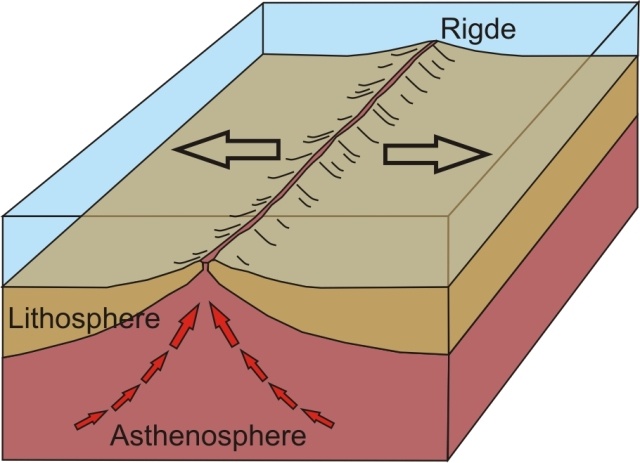
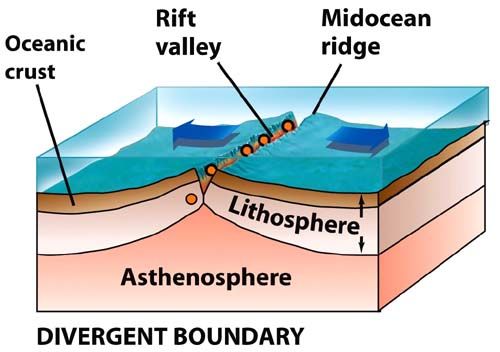
According to plate tectonic theory, new crust is created at _________ boundaries
convergent
divergent
transform
normal
Divergent plate boundaries can be defined as areas where plates
move in opposite directions
move in opposite directions past each other
move in opposite towards each other
move in opposite away from each other

Which letter is closest to the divergent boundary in the cross section here?
a
b
c
d

Why is the ocean shallower where there are divergent plate boundaries?
there is less water in that part of the ocean
new sea floor “floats” because is hot and has a low density.
the sea floor there is not as heavy as the surrounding sea floor.
the oceanic crust there is thicker.

What geological feature would an oceanic-continental convergent boundary create?
volcanic mountains
mountains
volcanic islands

What geological feature would an oceanic-oceanic convergent boundary create?
volcanic mountains
mountains
volcanic islands

What geological feature would an continental-continental convergent boundary create?
volcanic mountains
mountains
volcanic islands

When one plate forces it's way under another plate.
convection
boundary
subduction


What would you be most likely to find at a convergent boundary between an oceanic and oceanic plate?
Mountains
Volcanoes
Mid-Ocean Ridge
Rift
A subduction zone is formed...
when the oceanic crust sinks below the continental crust
at every type of convergent plate boundary
at every type of divergent plate boundary
at transform boundaries


The Aleutian Islands and Aleutian Trench are an example of what type of plate boundary?
divergent
ocean-to-continent convergent
continent-to-continent convergent
ocean-to-ocean convergent
The Himalayas in Asia are an example of what type of plate boundary?
divergent
ocean-to-continent convergent
continent-to-continent convergent
transform
The Peru Trench and Andes Mountains are an example of what type of plate boundary?
divergent
ocean-to-continent convergent
continent-to-continent convergent
ocean-to-ocean convergent
A transform boundary, where one tectonic plate slides past another, is likely to result in which of the following?
Frequent earthquakes
Rift valley formation
Intense weathering
Mountain building

What is the only event associated with ALL plate boundaries?
Volcanoes
Earthquakes
Subduction
Deep Trenches
Select all that apply: What type of landform is created by a convergent boundary that has an Oceanic and Oceanic plate?
Trench
Mountain
Volcano
Earthquake
What is the name of the theory that tectonic plates are moving because of the movement of magma in the mantle. The movement is caused by the magma heating and cooling and drags the plates along with it.
Slab pull
Ridge push
Convection currents

Scientists think that convection currents that move the plates flow in Earth's
Continental crust
Oceanic crust
mantle
outer core
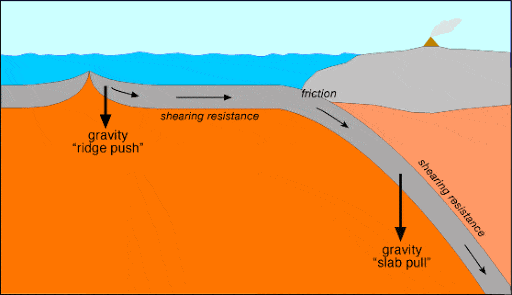
When the force of gravity pulls a lithospheric plate downward and away from a ridge pushing it toward a trench.
Sea Floor Spreading
Subduction
Ridge Push
Slab Pull
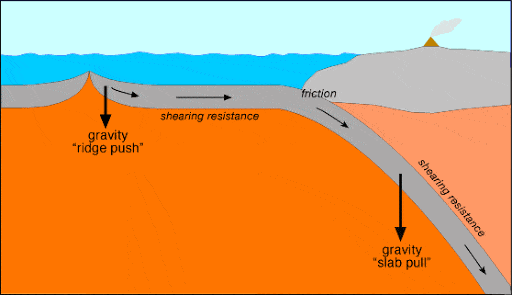
When the force of subduction and gravity moves a lithospheric plate downward into a trench and pulls it away from a ridge.
Sea Floor Spreading
Subduction
Ridge Push
Slab Pull
Which Theory of plate movement occurs as oceanic crust moves away from the mid-ocean ridge and becomes cooler and more dense, sinking into a trench?
convection
ridge push
slab pull
What is slab pull?
cooler, denser crust sinks (is pulled) into the mantle along a trench
when edges become denser and gravity pulls them downward and away from one another
currents just beneath Earth's crust flow very slowly, causing movement in the plates above them
folding and crumpling and sliding upward creating mountains
Identify the three possible driving forces of plate tectonics
conduction
convection
Ridge push
slab pull
A hot spot is located at the boundary of a plate
true
false
What geologic feature will occur at a hot spot ?
volcano
folded mountain
deep sea trench
crevasse
A prime example of an area over a hot spot is :
Japan
the Andes Mountains
the East African Rift
the Hawaiian Islands
Which of the following will move with time ?
a hot spot
the plate the hot spot is over
neither move
both move

