
 Worksheets
Reviewer EOC 1.1 to 2.3
Total questions: 80
Worksheet time: 57mins
What is the purpose of using crystal violet in microscopy?
To increase the magnification of the microscope
To stain the outer layer of certain bacterial cells for differentiation
To enhance the resolution of the microscope
To repair damaged cells during observation
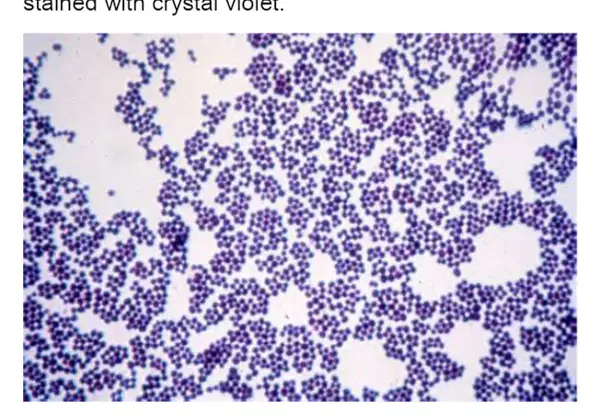
What type of microscope would be used to obtain this type of image?
dissecting microscope
compound microscope
scanning electron microscope
transmission electron microscope
In the context of observing Covid-19 virus protein spikes, which microscope is necessary to produce a 3D image to determine their shape?
dissecting microscope
compound microscope
scanning electron microscope
transmission electron microscope
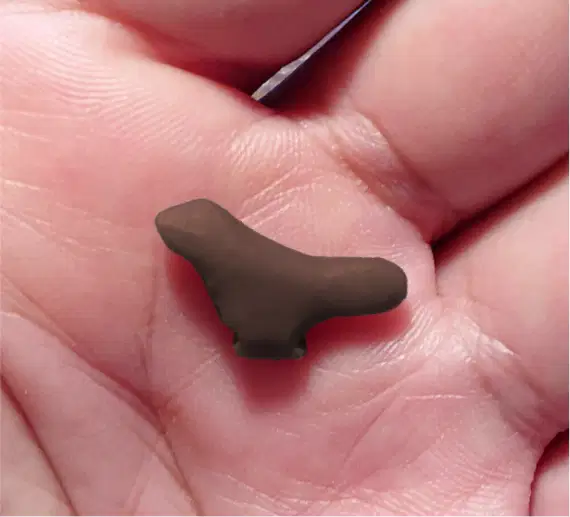
Which of the following microscopes would be the best choice for getting a better view of this 3D piece of art while preserving the artifact for later study?
dissecting microscope
compound microscope
scanning electron microscope
transmission electron microscope
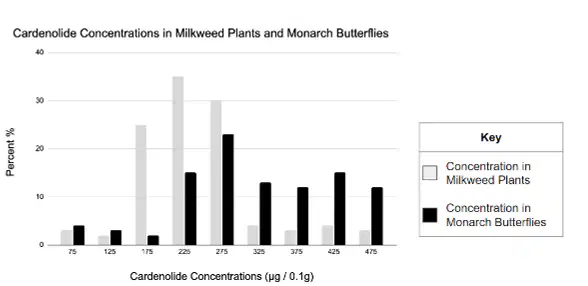
Based on the graph shown, what can be concluded about the cardenolide concentration in monarch butterflies as they mature from caterpillars that fed on milkweed plants?
The cardenolide concentration in the milkweed decreased and the plants grew larger.
The cardenolide concentration decreased in the monarchs as it decreased in the milkweed.
The cardenolide concentration in the adult monarchs is dependent on the concentration found in the milkweed plant.
The cardenolide concentration was found in the adult monarchs regardless of the concentration in the milkweed plant.
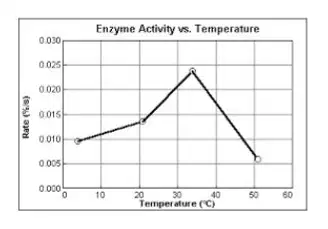
What does the graph suggest about the relationship between enzyme activity and temperature?
This enzyme will only work at a temperature of 35°C.
This enzyme only functions at temperatures above 50°C.
The higher the temperature the better the enzyme will function.
The activity level of the enzyme is directly influenced by the temperature.
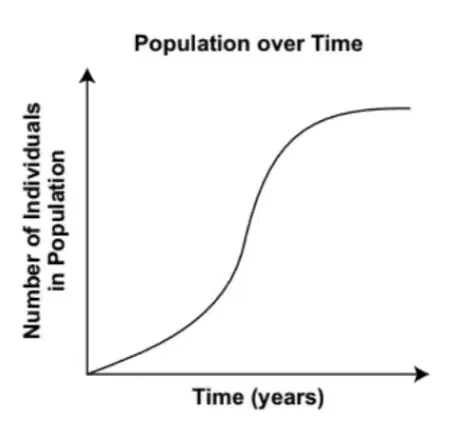
Which population description is most likely represented by the graph?
A population of birds increases but then becomes stable.
A population of wolves slowly increases but then increases rapidly.
A population of mice slowly increases but then fluctuates seasonally.
A population of fish quickly increases in the spring but then decreases quickly in the fall.
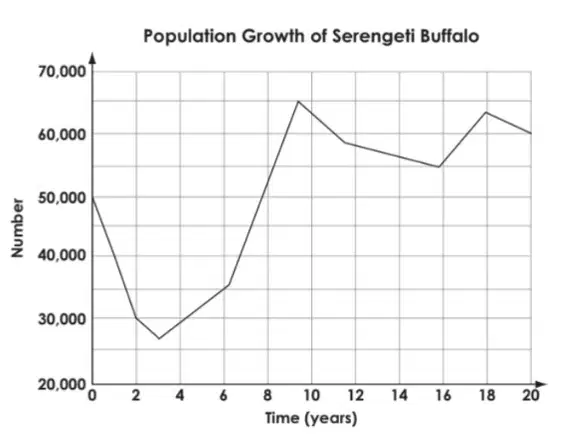
Which of the following inferences is supported by the graph?
The predator population increased in year 16.
The ecosystem can sustain, at most, 50,000 buffalo.
The virus was eliminated from the population during year 3.
The ecosystem is healthiest with a population of 30,000 buffalo.
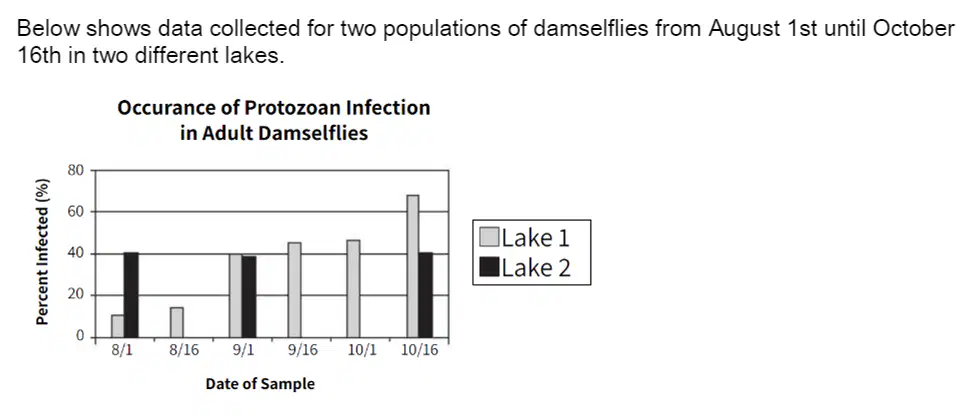
What conclusion can be drawn based on the data?
Lake 2 produces healthier damselflies.
Only Lake 1 resulted in protozoa infection.
Rate of infection in Lake 1 has increased over time.
The later in the year the higher the infection rate in Lake 2.
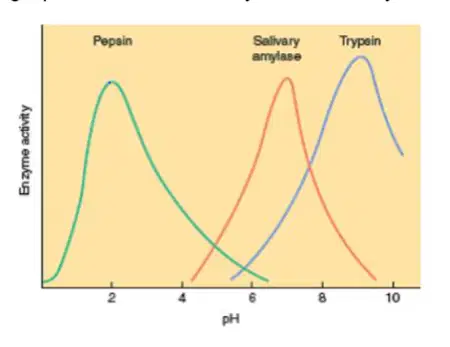
Which of the following would be a valid conclusion about how pH affects enzyme activity?
Each enzyme operates best at a specific pH.
Enzymes do not work at a pH greater than 9.
The pH does not affect how an enzyme functions.
The pH changes the role of the enzyme within the digestive system.
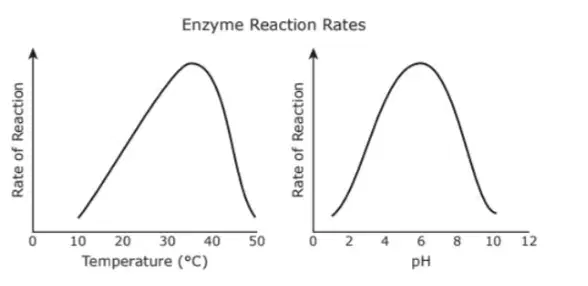
Based on these data, this enzyme reaction functions best at what temperature and pH?
temperature of 10°C and a pH of 1
temperature of 37°C and a pH of 6
temperature of 40°C and a pH of 8
temperature of 50°C and a pH of 10
Summer solstice is the one day of the year with the most sunlight. Predict how extended hours of sunlight on this day will impact the water cycle?
There will be a decrease in percolation.
There will be an increase in evaporation.
There will be a decrease in precipitation.
There will be an increase in condensation.
2. A local forest is infected with a disease that prevents tree roots from absorbing water and
transporting it throughout the plant. Which graph demonstrates the effect of this disease on the
water cycle?


Fossil fuels are involved in the carbon cycle and are currently our world's primary sources of energy. Fossil fuels are formed from organic matter over the course of millions of years. There has been a growing concern about people's increased usage and dependence on fossil fuels. How has fossil fuel usage over time affected the carbon cycle?
Increased combustion of fossil fuels will encourage higher rates of respiration.
Decreased combustion of fossil fuels will deplete our carbon reserves found underground.
Increased combustion of fossil fuels will lead to higher levels of carbon dioxide in the atmosphere.
Decreased combustion of fossil fuels will lead to more available carbon for photosynthetic organisms.
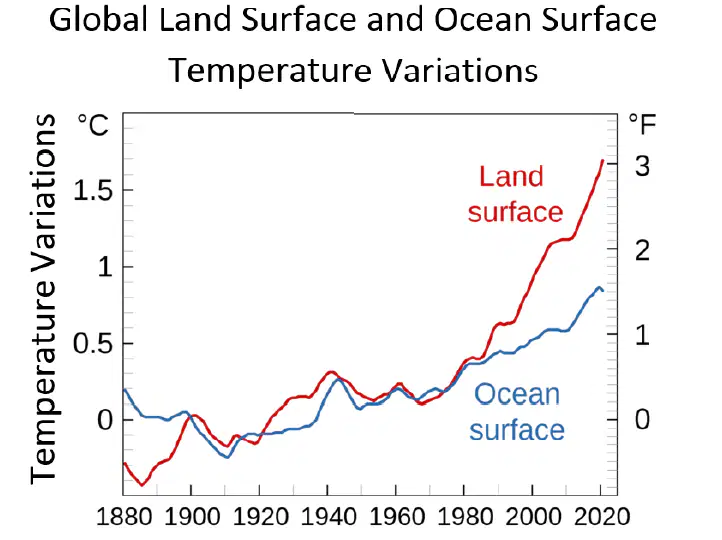
The graph below shows global land and ocean temperature variations since 1880.
Based on this graph, which of the following best describes the impact these variations would have on the water cycle?
A decrease in global land and ocean temperatures will result in lower rates of evaporation.
A decrease in global land and ocean temperatures will result in higher rates of
precipitation.
An increase in global land and ocean temperatures will result in higher rates of
evaporation.
An increase in global land and ocean temperatures will result in lower rates of
condensation.
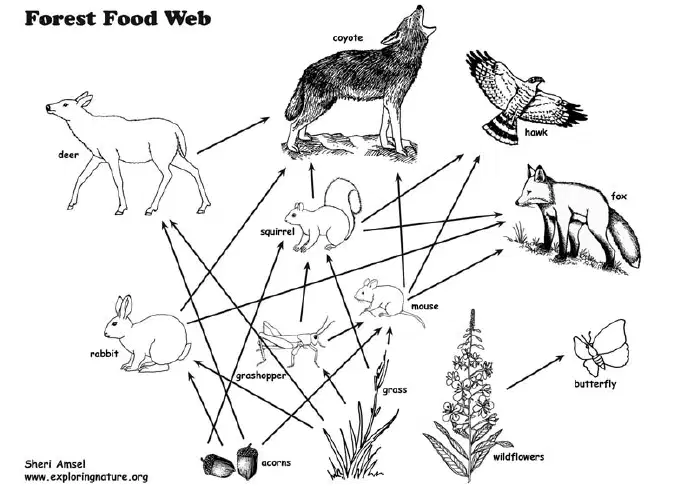
Which of the following displays the correct order of energy transfer based on the food web?
The rabbit receives energy from the deer.
The grass receives energy from the acorns.
The mouse receives energy from the coyote.
The squirrel receives energy from the grasshopper.

The diagram below shows a simple food web.
Which of the following statements best describes the transfer of energy between a red squirrel
and a fox, if the red squirrel contains 4000 kJ of energy?
The red squirrel received the 4000 kJ of its energy from the fox.
The fox will receive exactly 4000 kJ of available energy from the red squirrel.
The red squirrel will receive less than 4000 kJ of available energy from the fox.
The fox will receive less than 4000 kJ of available energy from the red squirrel.
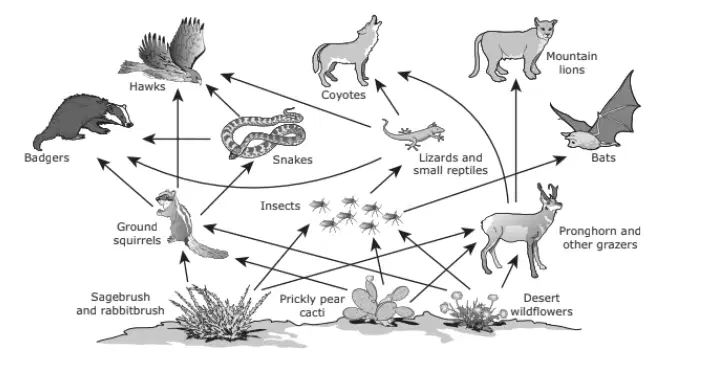
The food web provided represents organism interactions in a sagebrush-steppe ecosystem.
Which of these organisms directly receives energy captured by the producers?
hawks
snakes
mountain lions
ground squirrels
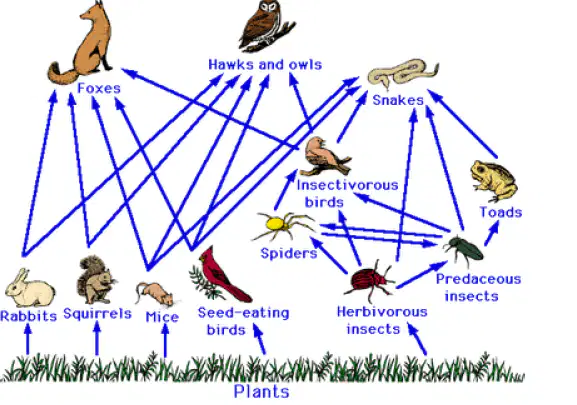
A food web is shown in the diagram below.
If the herbivorous insect population was removed, what would be the long term effects of available energy in the ecosystem above?
The energy available for the producers would increase.
The energy available for the tertiary consumers would decrease.
The energy available for the primary consumers would decrease.
The energy available for the secondary consumers would increase.
Which of the following best describes a benefit of non-renewable energy use?
A. Scientific advances now allow us to synthesize fossil fuels making them renewable.
B. Ecosystems will be healthier as dangerous chemicals in fossil fuels are extracted for use
as energy.
C. Removing these energy sources will stabilize the abiotic factors in the ecosystem making
them more resilient to change.
D. The infrastructure to distribute and use this energy is already in place, therefore less
surrounding environments need to be disturbed.
Renewable energy sources, such as solar energy, are often presented as a perfect solution to
the complex problem of needing more energy for an expanding population. Which image below
best highlights a potential cost associated with an increased use of solar energy?


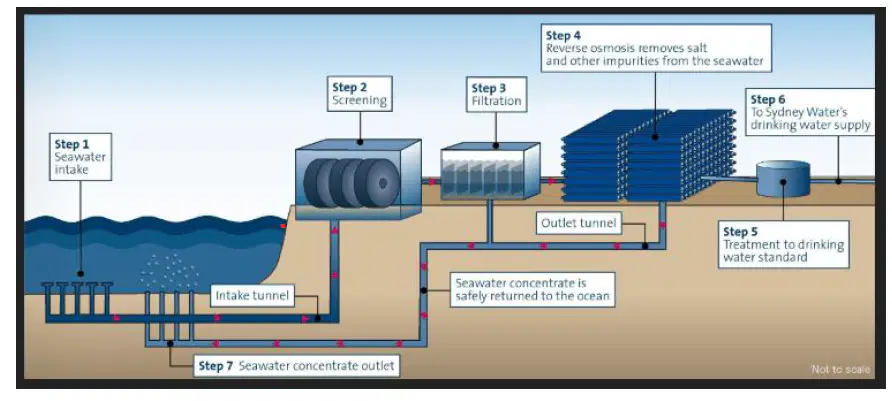
Saltwater is an abundant resource on earth, but is unusable for irrigation and drinking. As the
demand for freshwater resources increase, there is also an increased need for desalination.
The picture below represents the process of desalination.
Based on the information above, what is a potential long term effect of desalination on the
surrounding ocean environments?
A. Pollution would contaminate the ocean environment causing organisms to die and decay.
B. Alteration in ocean salt levels would cause loss of species and unbalanced populations in
marine food webs.
C. Nonrenewable resources in the ocean environment would become depleted and upset the
ecosystem balance.
D. Increased levels of minerals in the ocean would strengthen the shells of marine organisms
resulting in overpopulation.
Which of the following properties of water explains how sweat that is released during intense exercise is capable of regulating the body’s conditions?
A. cohesive ability
B. acting as a universal solvent
C. ability to moderate temperature
D. capability to expand upon freezing
Which of the following properties of water can be used to explain why water is able to form a rain drop when it falls from a cloud?
A. cohesive ability
B. universal solvent
C. expansion upon freezing
D. ability to moderate temperature
The oceans are the Earth’s largest carbon reservoirs. What property of water allows the
oceans’ water to store carbon dioxide?
A. cohesive behavior
B. versatility as a solvent
C. expansion upon freezing
D. ability to moderate temperature
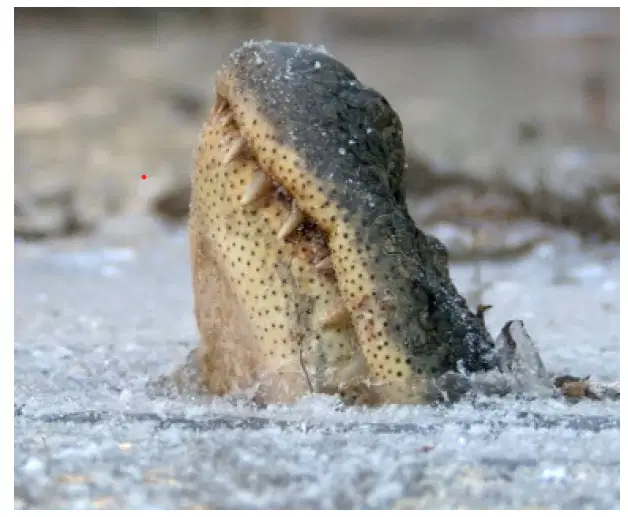
The picture below shows an alligator sticking its snout out from under a frozen pond. These
animals can survive the winter months in the water, only needing to have their snout above the
ice layer to breathe.
What property of water protects this alligator during the winter months when the pond freezes?
A. Water expands creating an insulated barrier that floats on top, causing the water below it
to be warmer.
B. Water is able to moderate its temperature to match the body temperature of the
organisms that inhabit it.
C. Water is a universal solvent in freezing temperatures allowing essential nutrients to
dissolve as needed for cellular process.
D. Water exhibits cohesive properties that allow the molecules to stick to one another
forming a layer on top of the water that protects the organisms outside temperatures.
Imagine you're a tiny phytoplankton floating in a pond. Suddenly, the sunlight starts to decrease! What do you think will happen to your phytoplankton buddies?
They'll start throwing a party because less evaporation means more water to swim in!
They'll start feeling a bit under the weather because less sunlight means less photosynthesis.
They'll just shrug their tiny phytoplankton shoulders and carry on as if nothing happened.
They'll start a seasonal dance, fluctuating with the rhythm of the sun.
Imagine you're a deep-sea explorer! Can you figure out why chemoautotrophs are the star producers in these deep ocean ecosystems?
Is it because they can perform photosynthesis using artificial light?
Or do they produce the much-needed oxygen for other organisms?
Could it be that they can whip up food without any sunlight?
Or do they feast on sulfur compounds?
Imagine you're a scientist in 2010, studying the pH levels of an estuary. Suddenly, there's an increase in pollution from a nearby factory. What do you think you would most likely observe?
The water starts throwing a party because it became more alkaline.
The water starts crying because it became more acidic.
The water is a zen master, its pH remained stable.
The water can't make up its mind, the pH fluctuated seasonally.
Imagine you're an ecologist studying changes in forest floor biomass. What kind of ecological succession event could the graph you're looking at represent?
Could it be secondary succession after a forest fire?
Or maybe it's primary succession on new volcanic land?
Could it be showing seasonal changes in a mature forest?
Or is it succession in an abandoned farm field?
Imagine you're a superhero tasked with protecting Florida's coastal ecosystems! How would you expect rising storm surges to affect your mission?
Would they bring more nutrients, boosting biodiversity?
Would they cause habitat loss, decreasing biodiversity?
Would they reduce erosion, stabilizing the coastlines?
Would they lower sea levels, creating more habitats?
Imagine you're a scientist studying landslides. You've just witnessed a massive landslide that has wiped out all soil and organisms from a mountainous area. What type of succession would you say is occurring here?
Primary succession
Secondary succession
Seasonal succession
Climactic succession
Let's take a trip back in time! Can you tell me what happened to the population of the native UK red squirrels and the introduced grey squirrels between 1945 and 2010?
Did the red squirrels decline due to habitat loss while the grey squirrels were introduced and spread?
Or did the red squirrels expand while the competing grey squirrels declined?
Maybe both species fluctuated based on seasonal food availability?
Or did the grey squirrels expand and compete with the declining red squirrels?
Imagine you're a time-traveling scientist! Between years 0-7 in the Great Plains, what do you think caused changes in the carrying capacity for primary consumers?
Did a disease epidemic reduce the carrying capacity?
Did overpredation decrease the food supply?
Did a new food source increase the carrying capacity?
Did climate change alter plant growth?
Imagine you're an explorer in a wild ecosystem! Can you tell how parasites are classified in this adventurous world?
Are they the Producers, creating their own food?
Or, are they the Primary consumers, munching on plants?
Maybe they are the Secondary consumers, preying on other animals?
Or, could they be the Detritivores, recycling dead matter?
Imagine you're a park ranger and you've just discovered that green iguanas, an invasive species, have been introduced into your park's ecosystem. What do you think would be the most likely outcome of this?
The park's biodiversity increases because there's a new species.
The iguanas compete for resources, leading to a decrease in native populations.
There's no impact because the park's predators will keep the iguana population in check.
The ecosystem becomes more resilient as the iguanas fill an empty niche.
Imagine you're a superhero tasked with saving the world's ecosystems! What would happen if extinction rates started to increase?
Would more species start to appear, maintaining biodiversity?
Would genetic diversity start to expand over time?
Would ecosystems become destabilized due to reduced biodiversity?
Would resource competition start to decrease?
Imagine you're a superhero tasked with saving an ecosystem from a catastrophic wildfire! How do you think such a disaster might affect the ecosystem's biodiversity?
Would the fire act as a fertilizer, boosting plant growth?
Would fewer species make the ecosystem stronger and more resilient?
Could the loss of niches lead to a total ecosystem collapse?
Or, would new niches form from the charred landscape, giving birth to new life?
Microscopic plants called phytoplankton live in a pond and receive 8-12 hours of sunlight per day. A new apartment building is constructed next to the pond, reducing the sunlight exposure to 2-5 hours per day. What will likely happen to the phytoplankton population as a result of the reduced sunlight?
A) The phytoplankton population will gradually decline.
B) The phytoplankton population will rapidly increase.
C) The phytoplankton will require less food.
D) The phytoplankton will migrate to another pond
In the deepest parts of the ocean, there is no sunlight so plants cannot grow. As a result, chemoautotrophs form the base of the food chain in these ecosystems instead of plants. Chemoautotrophs are organisms that produce their own food from chemicals in their environment. Which statement best explains why chemoautotrophs fill the producer role in deep ocean ecosystems?
A) Plants cannot survive in salt water.
B) Chemoautotrophs have consumed all the plants.
C) Sunlight cannot reach the ocean floor for photosynthesis.
D) Plants cannot reproduce without pollinators at great depths.
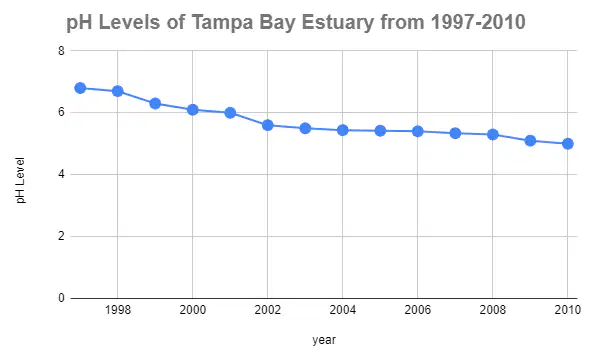
Estuaries form where freshwater rivers meet the ocean's saltwater. Over the past 20 years, factories built near the Tampa Bay estuary have increased water pollution and smog cover over the estuary. To determine the pollution's impact, researchers collected pH data in the estuary. Figure 1 shows the results.
According to the pH levels shown in Figure 1, which observation was most likely made in the estuary in 2010?
A) The death rate increased for organisms living in the estuary.
B) The carrying capacity increased for estuary organisms.
C) Saltwater species immigrated that were better adapted to the pH changes.
D) Freshwater species immigrated that were better adapted to the pH changes.

Figure 1 shows changes in forest floor biomass over 50 years.The graph in Figure 1 best represents which ecological succession event?
A) Secondary succession after a forest fire
B) Primary succession after a volcanic eruption
C) Primary succession after a glacier retreats
D) Secondary succession after a mudslide
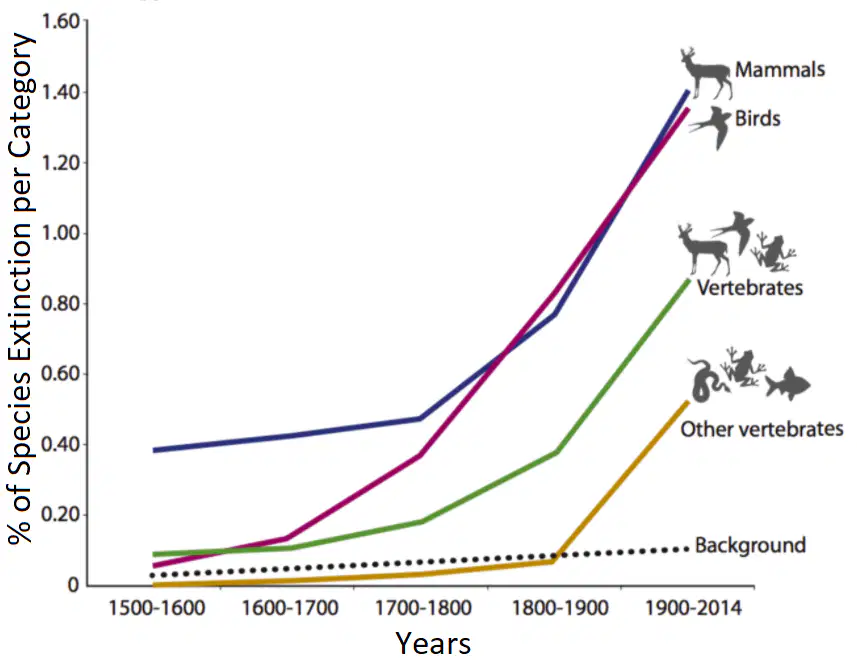
Ecologists are investigating changes in extinction rates over the past 500 years. Figure 1 displays the changes in extinction rates during this time period. Based on the extinction rate trends shown in Figure 1, which statement best describes the expected consequence?
A) Ecosystems will collapse as biodiversity decreases.
B) Ecosystems will flourish as biodiversity increases.
C) Abiotic and biotic factors will be depleted as populations increase.
D) Decreased biodiversity will occur as organisms immigrate to new habitats.
A volcanic eruption destroyed a large portion of a tropical rainforest ecosystem. Which of the following is a likely consequence of this event?
A) Decreased biodiversity leading to increased mutations in the surviving species.
B) Decreased biodiversity leading to interbreeding between remaining species.
C) Decreased biodiversity leading to greater competition for limited resources.
D) Decreased biodiversity leading to the ecosystem's collapse.
The Burmese python is an invasive snake species that has become established in the Florida Everglades. What is the most likely ecological consequence of this invasive predator on the native species?
A) Native species will start consuming different prey, destabilizing the ecosystem.
B) Native species will relocate to unoccupied areas, keeping the ecosystem stable.
C) Native species will cooperate with the pythons to share resources and stabilize the ecosystem.
D) Native species will experience greater competition and predation risk, destabilizing the ecosystem.
Invasive insect species can act as parasites on trees in forests. How would these parasitic insects most likely affect the forest ecosystem?
A) The insects will act as producers, increasing the ecosystem's carrying capacity.
B) The insects will serve as a biotic factor, stabilizing predator-prey dynamics.
C) The insects will become an abiotic factor, altering moisture levels and sunlight.
D) The insects will consume resources, reducing the ecosystem's carrying capacity.
Parasites are organisms that consume resources from a host species, often limiting the host's population growth. How are parasites best classified within an ecosystem?
A) As producers that increase the ecosystem's carrying capacity
B) As biotic factors that help stabilize predator-prey interactions
C) As abiotic factors that change moisture, sunlight or temperature
D) As consumers that lower the host species' carrying capacity
Imagine you're a conservationist studying the impact of climate change on the Arctic ecosystem. How do you think the melting of polar ice caps might affect the ecosystem's biodiversity?
Could the melting ice caps lead to an increase in the number of species as new habitats are created?
Would the melting ice caps cause a decrease in biodiversity as species lose their natural habitat?
Would the melting ice caps have no effect on the ecosystem's biodiversity?
Or, would the melting ice caps lead to an increase in competition among species for resources?
Imagine you're a botanist studying the effects of wildfires on plant life. A recent wildfire has completely destroyed a forest. What type of succession would you expect to observe here?
Primary succession
Secondary succession
Seasonal succession
Climactic succession
Imagine you're a marine biologist studying the effects of ocean acidification on coral reefs. What do you think would be the most likely impact of increased acidification?
The corals start to thrive because they love acidic conditions.
The corals start to bleach and die because they can't tolerate the increased acidity.
The corals remain unaffected because they are resilient to changes in pH.
The corals start to grow faster because the increased acidity boosts their metabolism.
Imagine you're an environmental scientist studying a forest ecosystem. What would likely happen if a new parasitic species that specifically targets the dominant tree species is introduced?
A) The forest's carrying capacity for primary consumers would increase.
B) The forest's biodiversity would decrease due to the loss of the dominant tree species.
C) The forest's biodiversity would increase due to the new parasitic species.
D) The forest's carrying capacity for primary consumers would decrease.
What is one disadvantage of using fossil fuels?
Fossil fuels will never run out
Fossil fuels are very efficient forms of energy and are readily available, making them cheaper
Burning fossil fuels contributes to the greenhouse effect which causes global warming.
Fossil fuels are better for the environment.
Why are fossil fuels considered non-renewable resources if they are still forming beneath the surface today?
They are being formed as a type of methane we cannot use
They are being formed too far beneath the surface
We are depleting the fossil fuels much faster than they can form
In recent years, the push to switch to renewable sources of energy
from nonrenewable has been much greater. Which of the following
would be reasons to convince someone to make that switch?
The cost of energy to power their homes would increase
They would release less carbon dioxide which decreases effects of global warming when compared to non-renewables
Non-renewable energy sources are in limited supply, so switching to renewable sources would mean less competition for them
In comparison to other houses, their house would be the most efficient at generating energy
When should environmental monitoring occur? Select all that apply
Never
When there is a decline in the size of a population
Only when there is a disturbance in an ecosystem
After the introduction of a new human activity
In 2014, poor treatment and testing of water resulted in a health crisis where many residents of Flint, Michigan were affected. It was found that there were high levels of copper and lead in the water supply. In 2017, filtration systems were installed in the community and lead pipes were replaced to improve water quality. City officials monitored the levels of copper and lead in water; these minerals have decreased over the last two years. Which statement best describes why it is important to continue monitoring even though levels have dropped?
To evaluate the levels of other pollutants in the water
To compare the water quality of treated and untreated samples
to determine the impact of treatment plants on the environment
to allow officials to fix the issue before it becomes a problem again
Noah, Olivia and Ethan are discussing the role of biotechnology in agriculture. What would be a potential benefit of using biotech in agricultrue
It can increase crop yield and resistance to pests
It can make the crops taste worse
It has no significant impact
It can decrease the nutritional value of crops
Cloning is an emerging field that could allow livestock breeders to create exact genetic copies of existing animals that produce high quantities of goods. Which of the following would best explain an environmental impact from the use of cloned livestock?
Consuming these livestock will cause genetic modifications in humans
More food will be produced leading to a decrease in worldwide hunger
Farmers will use more antibiotics to keep the clone healthy
The genetic diversity of the livestock will decrease
One of the biggest ways that humans are impacting biodiversity is
through habitat destruction caused by farming and urbanization. If the EPA passed a law requiring farmers to restore the habitat that they destroyed, what would happen to biodiversity?
It would continue to decline
Populations of different species would start to fight over the land
Biodiversity would start to increase and be maintained
We would not see any difference because we are already past the
point of restoration
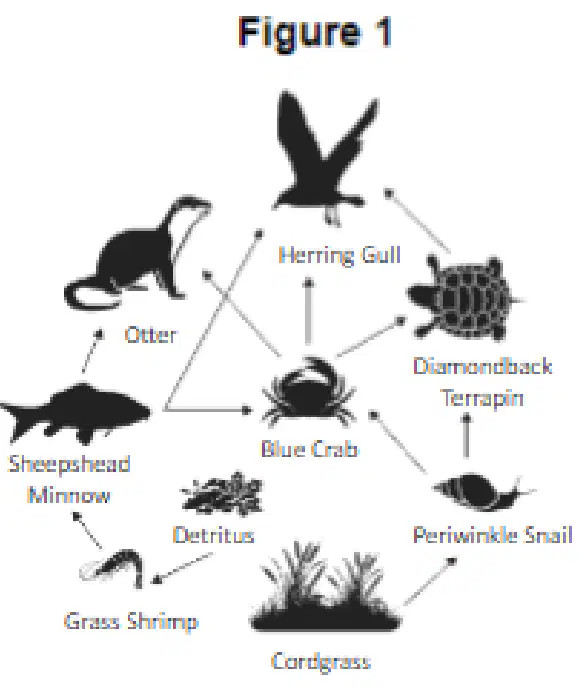
Which of the following best explains the difference in the amount of available energy in the trophic levels of the salt marsh ecosystem?
There is more available energy in the otter because they have greater muscle mass.
There is less energy available in the cordgrass because there are high levels of nitrogen from runoff.
There is more energy available in the second trophic level because more energy and nutrients are available in
the cordgrass.
There is less available energy for the herring gull because of the loss of energy through metabolism in each of
the lower trophic levels.
Match the following function to the biomolecule
Proteins
Catalyzes specific chemical reactions
Nucleic acids
stores genetic information
Lipids
regulates movement into and out of cells
Carbohydrates
Short term energy
What macromolecule is made up of C,H,O,N?
Carbohydrates
Lipids
Proteins
Nucleic acids
Which macromolecule has monosaccharides as monomers?
Carbohydrates
Lipids
Proteins
Nucleic acids
This macromolecules is responsible for providing our genetic material. Choose the macromolecule that best fits.
Carbohydrates
Lipids
Proteins
Nucleic acids
Match the macromolecule to its structure

protein

lipid

Nucleic acid

Carbohydrate
Enzymes are _______________ that _____________________ chemical reactions by ____________ the amount of activation energy required to start the reaction.
carbohydrates, slow down, lowering
proteins, speed up, increasing
lipids, speed up, lowering
proteins, speed up, lowering
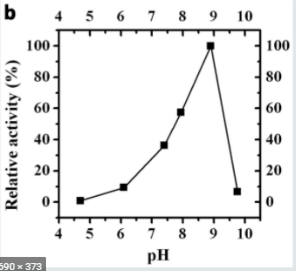
What is the optimal pH for this enzyme?
6
10
9
7

What is the optimal temperature of this enzyme?
60
40
70
30
Which of the following is NOT part of modern cell theory?
All living things are made of cells.
Cells are the basic units of structure and function.
Cells arise from non-living material through spontaneous generation.
All cells come from preexisting cells.
Which type of cell contains membrane-bound organelles?
Prokaryotic
Eukaryotic
Multicellular
Unicellular
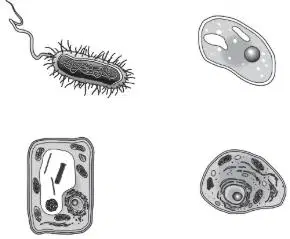
Which characteristics are shared by all four cells?
genetic material and ribosomes
membrane-bound organelles and a cell wall
presence of a mitochondria and cell membrane
mechanism for transforming sunlight into energy and DNA
Which of the following requires energy from ATP?
Diffusion of oxygen
Movement of flagella
Osmosis of water
Endocytosis of particles
"Which option correctly matches a plant structure with its role in a physiological process?
Root hairs draw in soil sugars for plant growth and reproduction.
Phloem transports carbon dioxide to leaves for cellular respiration.
Cambium facilitates photosynthesis by enabling water entry, a vital reactant.
Guard cells regulate gas exchange during transpiration by opening and closing stomata."

Which structure or feature within the flower that serves the purpose of attracting pollinators, such as bees, butterflies, or birds. These structures often include colorful petals, nectar glands, or specific scents that entice these pollinators to visit the flower.
(a)
Which specific structures within the flower responsible for producing male sex cells, which are the pollen grains containing the male gametes or sperm cells necessary for fertilization.
(a)
Which part of the flower where the female reproductive cells are produced (eggs) and where the embryo develops after fertilization occurs and this process initiates seed formation and eventually leads to the growth of new plants.
(a)
If a tropical fern, like a Boston Fern, is confined within a sealed container, regularly watered but unable to access gases like oxygen and carbon dioxide, the plant's confined environment could severely hinder its ability to carry out essential processes like photosynthesis and respiration.
The plant will grow faster because it is able to perform aerobic respiration.
The plant will not survive because it does not have oxygen for photosynthesis.
The plant will grow at a faster rate because it is able to perform anaerobic respiration.
The plant will not survive because it does not have carbon dioxide for photosynthesis.
Chloroplasts are specialized cellular structures present in plant cells, where photosynthesis occurs. During photosynthesis, chloroplasts produce glucose, the primary source of energy for plants, by converting carbon dioxide and water using light energy. What is produced in the chloroplast?
A. ATP
B. water
C. glucose
D. carbon dioxide
Yeast performs fermentation to produce gases that make bread rise. The equation below shows yeast breaking down sugar into ethanol and carbon dioxide:
C6H12O6 → 2 C2H5OH + 2 CO2
In the absence of oxygen, yeast cells cannot undergo aerobic respiration which requires oxygen to break down sugar and produce cellular energy. Instead, yeast undergo anaerobic cellular respiration, where "anaerobic" means without oxygen. During anaerobic respiration, yeast break down sugars without using oxygen, allowing energy production to continue even in low-oxygen environments. A form of anaerobic respiration that yeast uses is fermentation, whereby yeast convert sugars like glucose into cellular energy along with ethanol and carbon dioxide as byproducts. The tradeoff is less energy produced per sugar molecule versus aerobic respiration. Nonetheless, this anaerobic pathway causes the buildup of metabolic gases like carbon dioxide.
Specifically, which metabolic pathway causes yeast to produce gases that make the bread dough rise?
A) Transpiration
B) Photosynthesis
C) Aerobic cellular respiration
D) Anaerobic fermentation
Anaerobic respiration is a metabolic process where organisms produce energy without oxygen. In the case of yeast or certain bacteria, anaerobic respiration involves the conversion of glucose into ethanol (alcohol) and carbon dioxide. What chemical equation represents anaerobic respiration, and what does it signify?
A. C6H12O6 → 2C2H5OH + 2CO2 (glucose → ethanol + carbon dioxide)
B. 6CO2 + 6H2O + energy (carbon dioxide + water + energy)
C. C6H12O6 + 6O2 → 6CO2 + 6H2O + energy (glucose + oxygen → carbon dioxide + water + energy)
D. 2C6H12O6 → 2C2H5OH + 2CO2 (glucose → ethanol + carbon dioxide)

