
 Worksheets
T3 Nine Weeks 2022
Total questions: 65
Worksheet time: 33mins
Most earthworms are hermaphrodites. What does this mean?
earthworms can produce their own food
earthworms can produce both eggs and sperm
earthworms cannot reproduce
earthworms can swim around
What is one trait that all Arthropods have in common?
complex nervous system
carnivorous
exoskeleton
all of the above
What are the other two traits that arthropods share?
segmentation
6 legs
wings
jointed and paired appendages
We categorize the phylum of Arthropods into how many subphyla?
2
3
4
5

Which subphylum of Arthropods does this organism belong to?
Chelicerates
(arachnids)
Myriapods
Hexapods
(insects)
Crustaceans
Which subphylum of Arthropods has organisms that can hundreds of legs?
Chelicerates
Myriapods
Hexapods
Crustaceans
Echinodermata means...?
Spiny scales
Spiky arms
Spiny skin
Spiky shell
Echinoderms have a larval stage in which they exhibit radial symmetry before moving on to their adult stage where they exhibit bilateral symmetry.
True
False
Which characteristic do all echinoderms share?
They are carnivorous
They can move their stomach outside their mouth
They all have a start shape
They have a water vascular system
What do sea stars, brittle stars and sea urchins use to get around?
Sticky feet
Muscles in rays
Tube feet
A siphon

To which class of Echinoderms does this organism belong?
Asteroidea
(Sea Star)
Ophiurodea
(Brittle Star)
Echinoidea
(Sea Urchin)
Q. The spines on an echinoderm are actually...
part of the skin
part of the endoskeleton
made of chitin
part of the water vascular system
Q. This structure is responsible for moving water in and out of the water vascular system.
ampullae
ring canal
radial canals
madreporite
Q. Sea urchins are in the same clade as...
sand dollars
sea dollars
sea stars
brittle stars
Echinoderms have no head or brain.
True
False
Which is not an example of an echinoderm.
sea urchin
sea star
sea cucumber
sea foams

This echinoderm is a deposit feeder, has five rows of tube feet on one side, and crawls on the bottom:
sea lily
sea urchin
sea cucumber
sand dollar
If a person touches an echinoderm, its spine will break off.
true
false
Echinoderms move from place to place on tube feet.
true
false
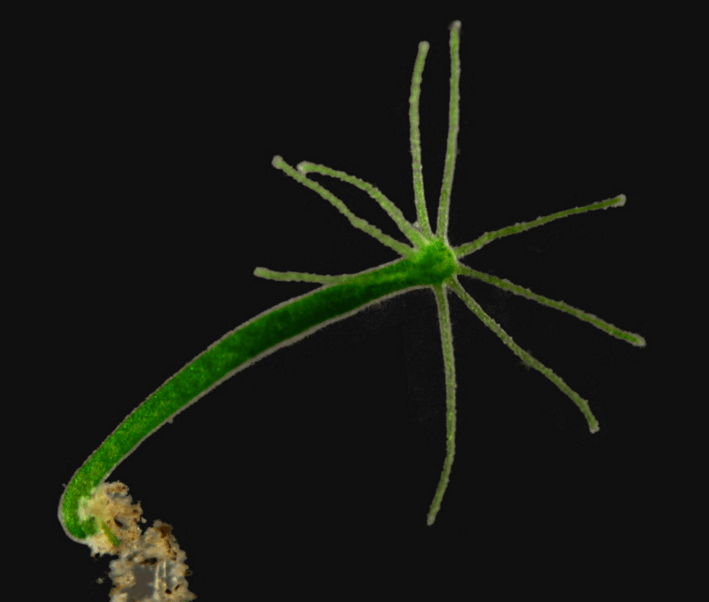
Most animals have this type of symmetry (even you too)?
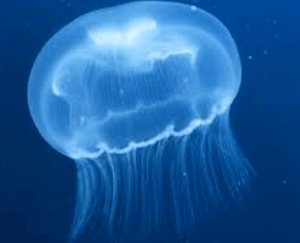
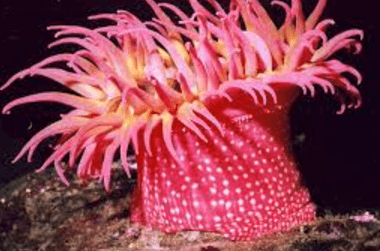
In which way are corals different from most other cnidarians?
They exist only in the medusa form
They secrete a tough outer skeleton
They reproduce only asexually
They are photosynthetic
Anthozoans make up
Single-cell organisms
Algae
Coral reefs
Planula form
Free living flatworms are
carnivores
herbivores
omnivores
detritivores
Tapeworms reproduce only
asexually
sexually and asexually
by fragmentation
by budding
Radial symmetry is more evolved characteristic than bilateral symmetry.
True
False
Nematocysts contain toxins.
True
False
Sponges are evolutinarily younger than Cnidarians
True
False


(earthworms)
(bristle worms)
(leeches)
(roundworms)


To what class do earthworms belong?
Oligochaeta
Annelida
Hirudinea
Polychaeta

What process in Annelids is carried out via diffusion?
circulation
reproduction
digestion
respiration

These marine animals have sensory structures around their head and laterally along their bodies.
Cephalopods
Oligochaetes
Polychaetes
Gastropods

How does this worm secure its food?
Predation
Scavenging
Filter feeding
herbivory
photosynthesis
Why do earthworms come out of the soil when it rains?
they could drown
they don't like being muddy
they like to swim in puddles
this is how they drink water
Earthworms are considered
herbivorous pests in gardens
detritivores / scavengers
predators
filter feeders

What is the feeding habit of this animal?
Predator
Parasite
Detritivore
Filter Feeder
Annelids have bilateral symmetry. T or F ?
False
True
Where do earthworms normally live?
Aquatic environments
Saturated dirt
Moist dirt
Deep underground
Dry dirt
Annelids have cylindrical (circular) body shapes.
True
False
There is only one species of leech.
True
False
Depends on the continent you live
What do leeches eat?
Meat/flesh
Vegetation
Blood/Flesh
Skin
Leeches only have anterior suckers.
True
False - only posterior suckers
False - posterior and anterior suckers
False - they hang on by their teeth
Which of the following is a reason why annelids are important?
Base of the food chain
Decompose in ecosystem
Medical uses
All of the above
Most earthworms are hermaphrodites. What does this mean?
earthworms can produce their own food
earthworms can produce both eggs and sperm
earthworms cannot reproduce
earthworms can swim around

