wayground logo

Free Printable Worksheets

Font size

S
M
L
XL
Worksheets

Biology B Final Exam Practice

Total questions: 82

Worksheet time: 1hrs 16mins

Name
Class
Date
1.
Why would it be important to replicate DNA before a cell divides in mitosis or meiosis?
a)
In order for genetic information to be transferred into daughter cells.
b)
In order for the cell to be able to increase in size.
c)
In order for the DNA to be contained in the nucleus.
d)
In order for the cell to re-order the DNA sequencing in the new cells.
2.

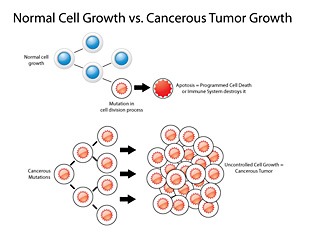
Cancer is best and fully described by ...

a)

Uncontrolled cell growth

b)

Cells that have mutations, uncontrolled cell growth, and no longer function correctly

c)

Cells which have lost the ability to reproduce

d)

Cells which create abnormal tissues

3.

There are two main groups of genes that control the cell cycle. When these types of genes get mutated, cancer can develop. The type of genes that work like accelerators and tell the cell cycle to "Go" are....

a)

Apoptosis genes

b)

Tumor suppressor genes

c)

Tumor activator genes

d)

Proto oncogenes

4.

What best describes why cancer is mostly found in old people?

a)

Old people have more wrinkles

b)

Cancer usually takes many mutations to get started and more accumulate over a life time

c)

Older people smoke more than younger people

d)

Only older people get mutations

5.
Identify the phase of mitosis
a)
prophase
b)
metaphase
c)
anaphase
d)
telophase
6.
This picture shows... 
a)
prophase
b)
metaphase
c)
anaphase
d)
telophase
7.
This picture shows... 
a)
prophase
b)
metaphase
c)
anaphase
d)
telophase
8.

The structure of coiled DNA and proteins that forms in the cells nucleus prior to mitosis is

a)

centromere

b)

centriole

c)

chromosome

d)

chromatid

9.
Which is the correct order?
a)
C,D, B, A, F, E
b)
D,A,F,C,E,B
c)
B,E,C,F,A,D
d)
C,B,D,A E,F
10.

The longest phase of the cell cycle

a)

prophase

b)

interphase

c)

metaphase

d)

mitosis

11.
Which process and type of resulting cells are represented?
a)
mitosis, gametes
b)
mitosis, body cells
c)
meiosis, gametes
d)
meiosis, body cells
12.
The chromosomes that pair up during meiosis, are called __________ chromosomes.  
a)
homozygous 
b)
asexual
c)
homologous
d)
genes
13.
A male shark has 40 chromosomes in each of its sex cells. How many would be present in its body cells?
a)
20
b)
40
c)
80
d)
160
14.
Which letter(s) in the diagram correspond to cells that are haploid? 
a)
A
b)
B
c)
C
d)
A and B
15.

Why do most living things on Earth do sexual reproduction. What is NOT true about sexual reproduction?

a)

Helps species survive

b)

Except for identical twins, it creates genetically different offspring

c)

Two individuals contribute chromosomes to the offspring

d)

It is the same as cloning

16.

Which statement below is true?

a)

Meiosis is reduction division resulting in 4 different haploid cells

b)

Meiosis results in 2 identical daughter cells

c)

Mitosis results in 4 identical diploid cells

d)

Mitosis is reduction division resulting in 4 different haploid cells

17.
Which best explains why muscle cells are different from blood cells?
a)
Muscle cells are produced by the brain, but blood cells are produced by the heart. 
b)
Different genes are activated in muscle cells than in blood cells. 
c)
Muscles cells experience different environmental influences than blood cells. 
d)
A mutation occurs during the development of muscle cells but not in blood cells. 
18.
Why do we need meiosis?
a)
To double the number of chromosomes going into sex cells
b)
To halve the number of chromosomes going into sex cells
c)
To triple the number of chromosomes going into sex cells
d)
To not change the number of chromosomes going into sex cells
19.
Meiosis makes sperm and egg cells. In humans, sperm and egg cells each have _____ chromosomes. Therefore a fertilized human egg cell (sperm and egg cell combined) would create a cell with _____ chromosomes.
a)
23, 46
b)
46, 23
c)
2, 4
d)
50, 100
20.

What did Darwin observe about finches in the Galápagos Islands?

a)

Their feathers were adapted to match their environment.

b)

Their beaks were adaptations related to their gender identity.

c)

Their beaks were adaptations related to the foods the finches ate.

d)

They had identical genotypes in all locations.

21.
The gradual change in a species over time is called
a)
mutation.
b)
evolution.
c)
migration.
d)
variation.
22.

How does natural selection lead to evolution?

a)

Stronger offspring kill weaker members of the species.

b)

Helpful variations accumulate among surviving members of the species.

c)

Overproduction provides food for stronger members of the species.

d)

Environmental changes favor weaker members of the species.

23.

What is a change in an organism that allows for it to survive in its environment?

a)

homologous

b)

vestigial

c)

variation

d)

adaptation

24.
Who was the naturalist that traveled the world to study plants and animals?
a)
Albert Einstein
b)
Charles Darwin
c)
Charles Barkley
d)
Isaac Newton
25.
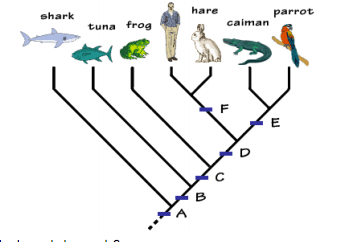
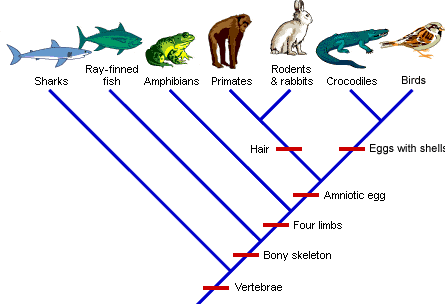
On the cladogram, which organism is the closest relative of the human?
a)
Frog
b)
Hare
c)
Caiman
d)
Parrot
26.
According to this cladogram, birds are LEAST related to: 
a)
Amphibians
b)
Sharks
c)
Ray Finned Fish
d)
Crocodiles
27.

Which is NOT a recent human adaptation?

a)

Lactase persistance

b)

Resistance to HIV

c)

Sickle Cell making resistance to malaria.

d)

All are recent human adaptations

28.
The similarities of the bones in the diagram provide evidence that---
a)
The organisms shown lived in the same natural envionrment
b)
The organisms shown may have developed from a common ancestor
c)
The organisms shown have the same genetic diseases
d)
All vertebrate species have identical forelimbs
29.
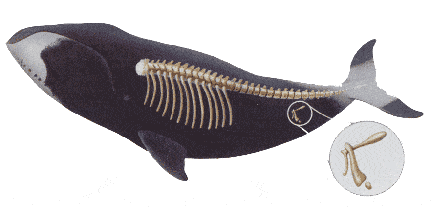
What is a Vestigial Structure?
a)
Structures that have a common function and suggest common ancestry
b)
The traits of organisms that result from sharing a common ancestor: such traits often have similar embryological origins
c)
genetically determined structures or attributes that have apparently lost most or all of their ancestral function in a given species
d)
I don't know :(
30.
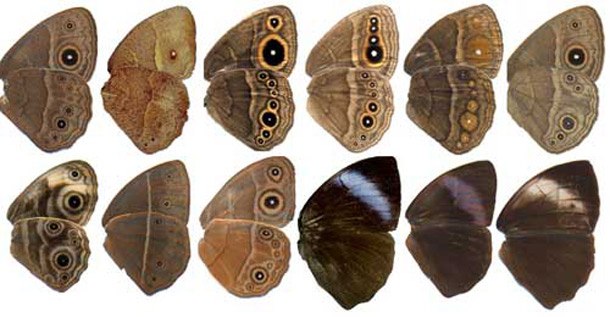
These moths are all the same species. The differences between their wings is an example of ________________
a)
Natural Selection
b)
Variation
c)
Homeostasis
d)
Extinction
31.

What is true about the finches of the Galapagos and the graphs?

a)

The beak of the finch get's larger in 1978.

b)

This is an example of directional selection.

c)

The beaks changed due to natural selection.

d)

All are true.

32.

What are the complementary bases of the followingDNA strand: AATCATGGA

a)

AATCATGGA

b)

TTAGTACCT

c)

UUAGUACCU

d)

GGATAUCUA

33.
Where does DNA replication take place?
a)
Nucleus
b)
Ribosome
c)
Cytoplasm
d)
Golgi Body
34.
Before new cells are produced, what process needs to happen?
a)
Transcription
b)
Translation
c)
DNA Replication
d)
Protein synthesis
35.
In DNA which is a correct base pairing?
a)
A with G
b)
G with T
c)
A with U
d)
A with T
36.
What is the five carbon ring of sugar in DNA called?
a)
Deoxyribose 
b)
Ribose
c)
Glucose
d)
Nucleotides
37.
The processes in which parental strands of DNA separate, serve as templates, and produce DNA molecules that have one strand of parental DNA and one strand of new DNA.
a)
Translation
b)
Replication
c)
Semi-conservative Replication
d)
Transcription
38.
The rule stating that the bases in a nucleic acid always pairs up in the same way: A=T and G=C.
a)
Replication
b)
Translation
c)
Transcription
d)
Chargaff's Rule
39.
DNA and RNA are biomolecules in the category of
a)
Proteins
b)
Lipids
c)
Nucleic Acids
d)
Carbohydrates
40.
DNA is a polymer made of monomers called
a)
Nucleotides
b)
Proteins
c)
Amino Acids
d)
Lipids
41.
Which of the following best describes a DNA molecule?
a)
double helix
b)
contains ribose
c)
made of amino acids
d)
contains Uracil
42.
In a molecule of double-stranded DNA, the amount of Adenine present is always equal to the amount of
a)
cytosine
b)
guanine
c)
thymine
d)
uracil
43.
Nitrogenous bases are joined by which type of bond?
a)
polar bonds
b)
ionic bonds
c)
covalent bonds
d)
hydrogen bonds
44.
What determines the code, or information, of a DNA molecule?
a)
the shape (structure) of the nitrogen bases
b)
the order (sequence) of the nitrogen bases
c)
the color of the nitrogen bases
d)
the frequency (number) of nitrogen bases
45.
RNA is different from DNA in ___
a)
RNA is single stranded
b)
RNA has uracil 
c)
RNA has the sugar ribos
d)
All of these
46.
Which of the following is a base that is NOT contained in DNA?
a)
Adenine
b)
Thymine
c)
Uracil
d)
Guanine
47.
DNA and RNA are macromolecules in the category of
a)
Proteins
b)
Lipids
c)
Nucleic Acids
d)
Carbohydrates
48.
In RNA, Uracil pairs with ______. 
a)
cytosine
b)
adenine
c)
guanine
d)
thymine
49.
The process to go from mRNA to a protein is called ____
a)
transcription
b)
rRNA
c)
replication
d)
translation
50.
DNA holds the code for
a)
lipids
b)
carbohydrates
c)
protein
d)
sugar
51.
Choose the nucleotide sequence of the RNA strand that would be complementary to the following strand: 
GTAGTCA
a)
UATUAGA
b)
ACGACTG
c)
CAUCAGU
d)
CATCAGT
52.
The main function of tRNA is to...
a)
carry a message that, when translated, forms proteins
b)
form a portion of ribosomes
c)
string together complementary RNA and DNA strands
d)
bring amino acids from the cytoplasm to the ribosomes
53.

What amino acid is represented by the codon UUA?

a)

Phenylalanine

b)

Tyrosine

c)

Leucine

d)

Stop codon

54.
What is the location in the cell for transcription?
a)
nucleus
b)
cytoplasm
c)
ribosome
d)
mitochondria
55.
Which is the mRNA molecule that would be transcribed from this DNA template:
TGGCAAGTACGT
a)
ACCGTTCATGCA
b)
UGGCAAGUACGU
c)
UCCGUUCUUGCU
d)
ACCGUUCAUGCA
56.

What is the correct amino acid sequence for the mRNA code AUGCCAGUAUGA

a)

Met-Pro-Ala-Val

b)

Met-Pro-Val

c)

Tyr-Gly-His

d)

Tyr-Gly-Arg-His

57.
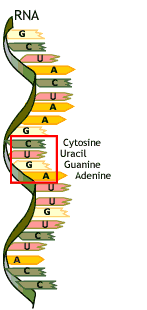
The letter X represents
a)
mRNA
b)
DNA
c)
tRNA
d)
proteins
58.
Any change in the sequence of DNA is...
a)
transgenic shift
b)
Single Genotype
c)
Monohybrid Trait
d)
Mutation
59.

DNA molecule segment is : TTACGCAAG

The mutated DNA segment is TTACGCAAC. This is an example of ___ mutation.

a)

Substitution

b)

Insertion

c)

Inversion

d)

Translocation

60.

Why are insertion and deletion mutations so harmful?

a)

They change all of the codons from the mutation on down the line, which changes the amino acid sequence

b)

They insert things that an organism doesn't need.

c)

They often delete things that organisms need.

d)

Insertion and deletions are not any more harmful than substitution mutations.

61.

Which system functions primarily to coordinate the body’s response to changes in its internal and external environment?

a)

digestive system

b)

excretory system

c)

nervous system

d)

skeletal system

62.

Which of the following is a component of the circulatory system?

a)

heart

b)

blood vessels

c)

blood

d)

all answers

63.

The system that is responsible for the production of gametes is the

a)

excretory system

b)

reproductive system

c)

nervous system

d)

integumentary system

64.
Muscle tissue functions to move 
a)
blood. 
b)
food in the digestive tract. 
c)
bones. 
d)
All Answers
65.
Organs that work together form 
a)
connective tissues. 
b)
tissue systems. 
c)
organ systems. 
d)
All Answers
66.
The functions of the skin include 
a)
defense against microbes. 
b)
regulation of body temperature. 
c)
prevention of dehydration. 
d)
All Answers
67.
The system that recognizes and attacks foreign substances is known as the 
a)
integumentary system 
b)
immune system 
c)
digestive system 
d)
nervous system 
68.
The heart and the blood vessels are separate organs that form the 
a)
skeletal system. 
b)
cardiovascular system. 
c)
reproductive system. 
d)
digestive system. 
69.
Which system involves the mouth, pharynx and esophagus? 
a)
nervous system 
b)
excretory system 
c)
digestive system 
d)
reproductive system 
70.

Male and Female ____________ systems are different but both help produce offspring (babies).

a)

organ

b)

liver

c)

reproduction

d)

heart

71.
In humans, having dimples is dominant over not having dimples. If both parents are heterozygous for dimples, what is the expected PHENOTYPE RATIO for their offspring?
a)
1:2:1
b)
3:1
c)
1:1
d)
1:0
72.
In the P generation, a purple flower pea plant produces ALL purple flowers when crossed with a white flower pea plant. The OFFSPRING (F1 generation) from this cross have a genotype of...
a)
PP
b)
pp
c)
Pp
d)
Impossible to tell
73.
Unfortunately, Huntington's Disease is a dominant disorder whose symptoms do not appear until mid- to late - thirties. If a woman heterozygous for Huntington's marries a man who does not have Huntington's, what is the likelihood that their children will have the disorder?
a)
25%
b)
50%
c)
75%
d)
100%
74.
If a black sheep mates with a white sheep, their offpsring will all be GREY. This is an example of which type of inheritance?
a)
Incomplete Dominance
b)
Codominance
c)
Sex-Linked Inheritance
d)
Recessive Inheritance
75.
Red tulips when crossed with white tulips produce (heterozygous) pink tulips. If two pink tulips are crossed, what would be the expected outcomes for the offspring?
a)
100% Pink
b)
50% Red, 50% White
c)
50% Red, 50% Pink
d)
25% Red, 50% Pink, 25% White
76.
An individual with type A blood marries an individual with type B blood and yet they have a child with type O blood. What must be the genotypes of the parents?
a)
AO and BO (IAi and IBi)
b)
AA and BB (IAIA and IBIB)
c)
AB and AB (IAIB and IAIB)
d)
OO and BB (ii and IBIB)
77.
Two individuals, both with type O blood, marry and have children. Which of the following best explains why all of their children will have type O blood?
a)
The O allele is carried on the X chromosome.
b)
The O allele is codominant.
c)
The O allele is recessive.
d)
The O allele is dominant.
78.
The allele for colorblindness is a recessive, sex-linked trait carried on the X chromosome. If a female is colorblind, what does this mean for any sons she may have?
a)
There is too little information, it depends on who she marries.
b)
All of her sons will have normal vision.
c)
All of her sons will be colorblind.
d)
All of her sons will be carriers for colorblindness.
79.
The allele for colorblindess is a recessive, sex-linked trait carried on the X chromosome. A colorblind male marries a homozygous normal vision female. Which of the following statements would be true regarding their children?
a)
All male children will be colorblind.
b)
All female children will be colorblind.
c)
All male children will be carriers for colorblindness.
d)
All female children will be carriers for colorblindness.
80.
How many generations are represented in this pedigree?
a)
1
b)
2
c)
3
d)
4
81.
In guinea pigs, black hair is dominant to white hair and short hair is dominant to long hair. What is the PHENOTYPE RATIO for the offspring in the following cross?
a)
9:3:3:1
b)
1:1:1:1
c)
4:2:2:5
d)
8:2:2:4
82.
What is the gender of the individual whose karyotype is seen in the image?
a)
Male
b)
Female