wayground logo

Free Printable Worksheets

Font size

S
M
L
XL
Worksheets

Year 9 Physics - Term 2

Total questions: 59

Worksheet time: 3hrs 58mins

Name
Class
Date
1.

Use the picture to select the correct statement.

a)

Oil is denser than water

b)

Pasta is less dense then crayon

c)

The paper clip is denser than every thing else

2.

Which liquid is the least dense?

a)

Oil

b)

Water

c)

Syrup

d)

Plastic bottle

3.

Which box has a higher density?

a)

A

b)

B

c)

They are the same

4.

What causes an object to sink in a water?

a)

if the object's density is less than the water's density.

b)

if the object's density is the same as water's density.

c)

if the object's density is greater than water's density.

d)

if the object's density is zero

5.
What is the formula for density?
a)
density = mass x volume
b)
density = mass / volume
c)
density = mass + volume
d)
density = mass - volume
6.
Frank has an eraser. It has a mass of 4g, and a volume of 2cm3. What is its density?
a)
8 g/cm3
b)
2 g/cm3
c)
1/2 g/cm3
d)
24 g/cm3
7.
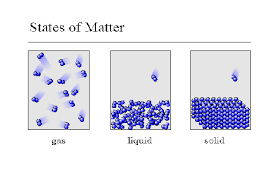
What is the difference between particles in a gas and a solid?
a)
gas particles are closer together
b)
solid particles move faster than gas particles
c)
solid particles expand on heating
d)
gas particles have more kinetic energy than solid particles
8.
How can we increase the gas pressure inside a sealed container?
a)
Increase the number of particles inside the container
b)
Increase the temperature
c)
Decrease the volume of the container
d)
All of these
9.

If a hairspray can is heated, what can be expected of the pressure of the gas inside the can?

a)

The pressure will increase

b)

The pressure will decrease

c)

The pressure will remain constant

d)

The pressure will equalize

10.
What line segment represents only the solid state?
a)
A-B
b)
B-C
c)
C-D
d)
D-E
11.
In which segment is the kinetic energy remaining constant?
a)
A-B
b)
B-C
c)
C-D
d)
E-F
12.
What state(s) of matter are present at D-E?
a)
Solid-liquid
b)
Liquid
c)
Liquid-gas
d)
Gas-Solid
13.
A substance's heating curve is shown in the graph.  What is its boiling point?
a)
100 C
b)
60 C
c)
80 C
d)
20 C
14.

This curve indicates what about the heat energy?

a)

Heat energy is being added or absorbed

b)

Heat energy is being released

15.

A north pole and a south pole will attract each other.

a)

True

b)

False

16.

Which of the following objects cannot be moved by a magnet?

a)

A paper clip

b)

A nail

c)

A toothpick

d)

A staple

17.

How is a permanent magnet different from a temporary magnet?

a)

A permanent magnet attracts materials made of iron.

b)

A permanent magnet has poles.

c)

A permanent magnet has a magnetic field.

d)

A permanent magnet keeps its magnetism for a long time.

18.

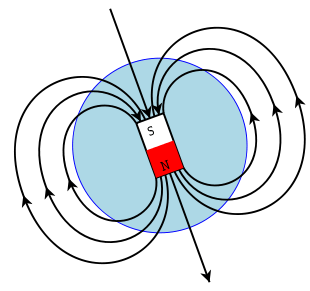
Earth acts like a giant magnet because its center is made up MOSTLY of

a)

Granite

b)

Limestone

c)

Iron

d)

Nickel

19.

Why does a compass needle, point towards the north?

a)

The compass is a bar magnet.

b)

North is up.

c)

It deflects.

d)

It lines up with the Earth's magnetic field.

20.

What will happen when these magnets are brought close together?

a)

They will attract each other.

b)

They will repel each other.

c)

Both the magnets will turn to the left.

d)

Both the magnets will turn to the right.

21.

What will the magnets in the picture do?

a)

Attract each other

b)

Repel each other

c)

Both attract and repel

d)

Neither attract nor repel

22.

What will the magnets in the picture do?

a)

Attract

b)

Repel

c)

Neither attract nor repel

d)

Both attract and repel

23.

The area of magnetic force around a magnet is known as its _____________.

a)

magnetic field

b)

magnetic declination

c)

magnetic fan lines

d)

magnetic tan lines

24.
At higher temperatures
a)
particles in an object have less energy
b)
particles in an object move faster
c)
a gas contracts
25.

Which state of matter has a definite shape?

a)

solid

b)

liquid

c)

gas

26.
The state of matter that has no definite size or shape is
a)
Solid
b)
Liquid
c)
Gas
27.
Particles of a liquid
a)
are tightly packed together and stay in a fixed position.
b)
have no viscosity.
c)
decrease in volume with increasing temperature.
d)
are free to move around one another but still touch.
28.
What does this picture represent? 
a)
solid
b)
liquid
c)
gas
d)
plasma
29.
Which state of matter has particles arranged like this?
a)
solid
b)
liquid
c)
gas
30.
A measure of how much matter an object has is--
a)
weight
b)
gravity
c)
mass
d)
volume
31.
What is the definition of "weight"?
a)
measure of the force of gravity on your body
b)
the time it takes to get on a ride 
c)
the amount of matter in an object
d)
the size of an object
32.
The weight of an object _________ as it moves away from the center of Earth.
a)
increases
b)
stays the same
c)
triples
d)
decreases
33.
The mass of an object ___________ as it moves away from the center of Earth
a)
stays the same
b)
decreases
c)
increases
d)
doubles
34.

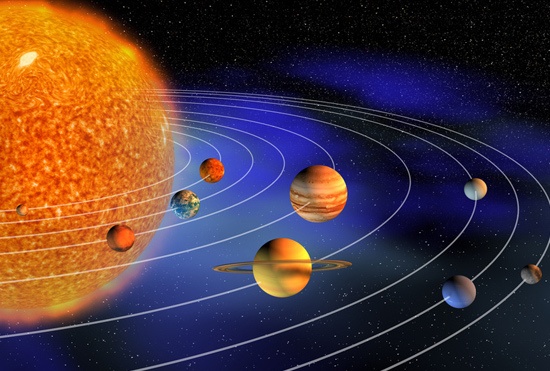
Why do all of the planets orbit the sun rather than Earth?

a)

the sun has more mass

b)

the sun is a star

c)

the Earth is heavier

d)

the sun is in the middle of the milky way

35.
As an object's mass increases, its gravitational pull will ____________.
a)
decrease
b)
increase
c)
stay the same
d)
get weaker
36.
What causes day and night?
a)
Earth's orbit around the sun
b)
Earth's rotation on its axis
c)
the sun's rotation
d)
the moon's shadow
37.
How long does it take for the Earth to do one rotation on its axis?
a)
60 seconds
b)
24 hours
c)
365 days
d)
1 light year
38.
How long does it take the Earth to orbit around the sun?
a)
325.0 days
b)
365.25 days
c)
1 month
d)
24 hours
39.
Planets orbit the Sun in a shape called a(n)
a)
circle
b)
ellipse
c)
focus
d)
perihelion
40.
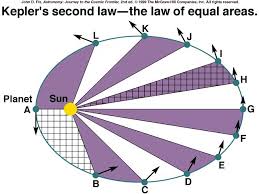
Where is the planet moving faster
a)
Position A to B
b)
Position B to C
c)
Position H to I
d)
Position I to J
41.
All objects are attracted to each other by the force of:
a)
Gravity 
b)
Inertia 
c)
Orbital Speed 
d)
Terminal Velocity 
42.
The strength of the force of gravity depends on:
a)
the masses of the objects and their speeds.
b)
the masses of the objects and the distance between them.
c)
the weight of the objects and their speeds.
d)
the masses of the objects and their weights.
43.
As mass increases, gravity ________________.
a)
Increases 
b)
Decreases 
c)
Stays the same 
44.
What would happen to your weight if you traveled to a planet that was more massive than Earth? 
a)
Your weight would stay the same 
b)
Your weight would increase 
c)
Your weight would decrease 
45.

Based on the table, which planet in our solar system will have the fastest orbital speed?

a)

Venus

b)

Earth

c)

Saturn

d)

Mercury

46.

What relationship did Kepler discover about planets and their orbital speed?

a)

Planets closest to the Sun will orbit with the fastest orbital speed.

b)

Planets with the greatest mass will orbit the Sun with the fastest orbital speed.

c)

Planets furthest from the Sun will orbit with the fastest orbital speed.

d)

Planets with the least mass will orbit the Sun with the fastest orbital speed.

47.

Total distance divided by total time is

a)

average speed

b)

average time

c)

average distance

48.
What is the net force?
a)
5000 N right
b)
4000 N right
c)
40 N left
d)
4000 N left
49.

Earth has an orbital radius of 149600000 km, and an orbital period of 365.25 days. What is the Earth's orbital speed in km/s? (DO NOT include a unit in your answer)

(a)  

50.
Wind blowing at 20 mph.Vector or scalar?
a)
Scalar
b)
Vector
51.
30 m/sec, East. Scalar or Vector
a)
Scalar
b)
Vector
c)
Neither
52.
Distance and direction of an object's change in position from a starting point
a)
displacement
b)
distance
c)
motion
d)
reference point
53.
A quantity that has both magnitude and direction is called a scalar quantity.
a)
True
b)
False
54.
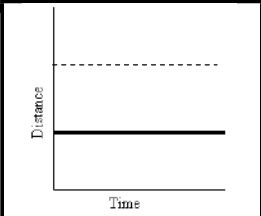
What is this graph representing?
a)
Constant Speed
b)
Acceleration (speeding up)
c)
Deceleration (slowing down)
d)
No motion
55.
At 60 seconds, how far had this object traveled? 
a)
0 m
b)
10 m
c)
20 m
d)
40 m
56.
How long did it take this object to travel 10 m?
a)
0 s
b)
10 s
c)
15 s
d)
20 s
57.
What does this graph represent?
a)
Constant speed
b)
Acceleration
c)
Not moving
58.
What is the speed of an object that travels 60 meters in 4 seconds?
a)
240 m/s
b)
15 m/s
c)
0.067 m/s
d)
15 mph
59.
A description of the speed and direction of an object's motion
a)
Velocity
b)
Speed
c)
Acceleration
d)
Vector