
 Worksheets
3rd Quarter Exam Review
Total questions: 140
Worksheet time: 1hrs 26mins
What was the name for the secret project to build an atomic bomb?
Manhattan Project
Tuskegee Airben
Secret Boom
Normandy
Who was the British leader that signed an appeasement with Hitler?
Benito Mussolini
Douglas MacArthur
Adolph Hitler
Neville Chamberlain
Who was the fascist leader of Italy?
Adolph Hitler
Dwight Eisenhower
Benito Mussolini
Neville Chamberlain
Which act permitted the US to sell arms to warring countries on a cash & carry basis?
Neutrality Act 1939
Lend-Lease Act
Anschluss
Double V
Which was a major cause of the rise dictators in Europe after WW1?
economic prosperity
Treaty of Versailles
redrawing of European borders
German win of WWI
What is the name of the Allied military strategy in the Pacific Ocean?
firebomb
island hopping
kamikaze
blitzkrieg
The D-Day Allied invasion of France took place where?
Paris
Plymoth
Tokyo
Normandy
What is the name of the program that encouraged African-Americans to join the war effort?
Tuskegee Airmen
Rosie the Riveter
Double V
NAACP
At first many Americans were against the war and supported ________________________.
fascism
communism
isolationism
internationalism
The purpose of the Nuremberg Trials was to
test the newly developed atomic bomb.
determine how the holocaust happened.
punish German leaders for war crimes.
remove the emperor of Japan from power.
What is the name of the new political party to rise in Germany following WW1?
Socialist
Nazi
Fascist
Bolshevik
Japan's goal was to take over
North America
Soviet Union
Eastern Asia
Western Asia
What was the term for the action of Britain & France giving in to Hitler's demands?
appeasement
militarization
nationalism
unification

What is the name of this iconic poster woman?
Tanya the Tank
Wonder Woman
Eleanor Roosevelt
Rosie the Riveter
Why were the Japanese unable to decipher the messages of the Navajo code talkers?
The code consisted of a series of whistle-like noises.
The code talkers had an advanced code machine.
They used the Navajo language, which had no written alphabet.
They used a math code based on the Navajo numeric system.
The turning point in the war against Japan in the Pacific was the
Battle of Midway.
bombing of Pearl Harbor.
internment of Japanese Americans.
Battle of the Bulge.
allowed economic assistance to the Allies
Lend Lease Act
Selective Service Act
Four Freedoms
Executive Order 9066
NOT one of the Four Freedoms
freedom to conquer the world
freedom from want
freedom from fear
freedom of speech
the spread of ideas for the purpose of helping or damaging a cause
propaganda
totalitarianism
fascism
appeasement
reason why Japan attacked Pearl Harbor
US stopped selling oil to Japan
US stopped buying oil from Japan
Japan wanted to conquer the US
Japan wanted to spread communism
During the war, American civilians were expected to do all BUT
raise wages & price
recycle scrap metal
grow victory gardens
buy war bonds
This bill provided education and training for veterans, paid for by the federal government.
The Veterans Bill
GI Bill of Rights.
Post War Recovery Act
Soldiers Job Bill
Which cities saw high amounts of racial tensions?
Atlanta
Detroit
Los Angeles
Boston
Which statements about the "Zoot-Suit" Riots are true? (Check all that apply)
They involved mainly African Americans.
They happened in Los Angeles
The riots began when 11 sailors reported that they had been
attacked by zoot-suit-wearing youths.
Zoot suit wearing thugs ripped the clothes off of sailors.
Check all the statements that are true about the Detroit riots of 1943.
What started as a tussle between blacks and whites at a beach on the Detroit River mushroomed into a riot when white sailors stationed nearby joined the fray.
The fighting raged for three days, fueled by false rumors that whites had murdered a black woman and her child and that black rioters had killed 17 whites.
President Roosevelt refused to send federal troops to restore order,
Seven African Americans and one white person dies in the riots.
Early in 1942, the War Department called for the mass evacuation of all Japanese Americans from Hawaii. General Delos Emmons, the military governor of Hawaii, resisted the order. Why?
To remove them would have destroyed the islands’ economy
and hindered U.S. military operations there.
He was afraid of a rebellion by Japanese Americans. .
He thought it immoral and un-American.
FDR quietly instructed him to ignore the order

During the Cold War, what bill did the U.S. Congress pass to provide financial assistance to western European countries?
Truman Doctrine
Open Door Policy
Marshall Plan
Domino Theory

What policy implemented in the Cold War said the U.S. would give military aid to a country that needed to resist communism?
Marshall Plan
Truman Doctrine
Domino Theory
Open Door Policy
During the Cold War, what policy did the U.S. follow to stop the spread of communism?
Open Door Policy
Big Stick Policy
Containment Policy
Dollar Diplomacy
Which individual/group contributed to the Red Scare by accusing American citizens of being communist spies?
McCarthy/HUAC
NAACP/Farm Workers Union
Nativists/Muckrakers
Philanthropists/Entrepreneurs

In what year did the Russians launch the satellite Sputnik?
1941
1957
1969
1991

What happened as a result of the launch of Sputnik in 1957?
It started the space race between the USSR and U.S.
The U.S. government started NASA.
U.S. began to spend more money on math and science to maintain national security.
All of the above

During what Cold War event did the U.S. bypass a Soviet blockade in Germany without provoking a military conflict?
Berlin Airlift
Vietnam War
Watergate Scandal
Bataan Death March

During the Cuban Missile Crisis, what did President J.F. Kennedy do when he heard that the Soviet Union was constructing nuclear missile sites in Cuba.
He launched a nuclear missile at the Kremlin in Moscow.
He gave into the demands of the Soviet & Cuban government.
He ordered a naval blockade around Cuba to prevent Soviet ships from bringing the necessary materials.
He declared war on the Soviet Union & Cuba.

What legislation helped American soldiers get an education and buy homes in the suburbs during the Cold War?
Interstate Commerce Act
Federal Housing Authority Act
Social Security Act
GI BIll
What was the name of the rapid increase of population following the end of WWII called?
Baby Boom
Columbian Exchange
Great Migration
Demographic Shift

How did the Counter-culture movement of the 1960s impact the Vietnam War?
The hippies protested and organized mass demonstrations.
They helped turn public opinion against the war.
They helped get the 26th amendment passed.
All of the above
What theory caused the U.S. to enter the Vietnam War in order to stop the expansion of communism across Southeast Asia?
Marshall Plan
Domino Theory
Open Door Policy
Dollar Diplomacy

What amendment was passed to lower the voting age because it was unfair that 18-20 year olds could be drafted into the army but not vote?
17th amendment
21st amendment
22nd amendment
26th amendment
What words should you immediately associate with the Cold War?
Hitler & the Nazis
Economic recession
Containment of Communism
Corruption & Industrialization
Which of the following was a primary cause of the Cold War between the United States and the Soviet Union?
direct, armed conflict between the two nations
the founding of the United Nations
a deep reduction in military expenditures
a competition for political influence over other countries
Which of the following is most characteristic of the Cold War?
The growth of nuclear arsenals in the United States and the Soviet Union
The expansion of national borders by imperialistic European countries
The implementation of isolationist foreign policies in Great Britain and China
The rapid industrialization of many Southeast Asian countries
The United States followed a policy of containment during the Cold War in response to the spread of communism.
How did the Marshall Plan reflect containment policy?
It blocked Soviet missiles from from arriving in communist Cuba.
It provided economic aid to European countries in order to prevent the spread of communism.
It authorized the use of military force against communist forces in Vietnam.
It stopped communist efforts to control the Korean Peninsula.
When the United States sent military aid to African governments to help them resist communism, it was continuing a foreign policy first asserted in the
Potsdam Agreement.
Teheran Conference.
Marshall Plan.
Truman Doctrine.
What was one major goal of the Soviet Union during the early years of the Cold War?
to expand individual liberties in the Baltic republics
to attract foreign economic investments
to create a defensive buffer zone in Eastern Europe
to establish a competitive market economy
Which of these was a cause of the Korean War?
NATO air and naval forces blocked ships sailing to North Korea.
United Nations inattention allowed guerrillas to infiltrate South Korea.
North Korean forces, with Soviet approval, invaded South Korea.
Widespread anti-colonial riots forced the Korean government to begin the war.
During the Korean War, what prevented the southern part of the peninsula from falling permanently to the invading forces?
The threat of a Soviet naval blockade
The assistance of the Chinese military
The use of atomic weapons on northern cities
The involvement of UN forces under the command of the United States
During the Cold War, in which country would the city of West Berlin be inside of?
East Germany
West Germany
Soviet Union
France
Which country, in 1948, controlled the ZONE that the entire city of Berlin was located in.
Soviet Union
Great Britain
France
United States
What was the purpose of the Berlin Airlift, between the years 1948 and 1949?
To bring necessary supplies to assist the Communists after World War II.
It was designed to help citizens in France to resist Communism.
Moving Allied soldiers to help fight the Nazis during World War II.
To supply the citizens of West Berlin while the Soviet blockade continued.
Which of these was a cause of the Korean War?
NATO air and naval forces blocked ships sailing to North Korea. .
North Korean forces, with Soviet approval, invaded South Korea
United Nations inattention allowed guerrillas to infiltrate South Korea.
Widespread anti-colonial riots forced the Korean government to begin the war.
U.S. intervention in Vietnam came as a result of the Cold War policy of
détente
appeasement
containment
brinkmanship
Which of these events was the closest the United States and the Soviet Union actually came to fighting each other during the Cold War?
Cuban Missile Crisis, 1962
Gulf of Tonkin, 1964
Bay of Pigs, 1961
Suez Crisis, 1956

What domestic issues did soldiers face when coming back home after WW2?
Many soldiers were able to return to their former job when they returned home
Many soldiers found themselves out of a job with layoffs.
A housing shortage which caused homelessness to spike in major cities.
Many soldiers faced criticism for war atrocities committed during WW2.

Democrats and Republicans saw the benefit of working together to solve the issues facing the nation. This was called
Reconciliation
Critical Consensus
Liberal Consensus
New Deal
Workers went on strike in a few areas demanding pay increases. Congress passed what act and overrode a presidential veto allowing federal injunctions to stop strikes.
Taft-Hartley Act
Smoot Hawley Act
Tik and Tok Act
GI Bill
Truman authorized a task force to investigate discrimination in the U.S which recommended several things. What one thing was Truman able to do that congress could not?
End segregation and lynching's
create a civil rights division of the federal gov.
Desegregate the armed forces
Pass the Civil Rights Act
The Fair Deal did not include which of the following?
Expanding Social Security
Universal health care
subsidies for crops
rural electrification
What was one effect of the baby boom between 1940 and 1955?
Increasing consumption stimulated economic growth.
Families turned to discount stores to save money on quality items.
Farms struggled to produce enough food to meet the high demand.
The need for additional income caused women to enter the workforce.
What was the relationship between the development of suburbs and car ownership?
Suburban development and car ownership decreased simultaneously.
Car ownership decreased as many in the suburbs relied on public transportation.
Fewer people lived in the suburbs as car ownership increased.
People became increasingly dependent on cars as more suburbs were built.
Technological innovations that produced the polio vaccine and penicillin significantly
increased children's life expectancy.
decreased economic productivity.
increased rates of bacteria-based disease.
decreased employment in medical fields.
Why might Americans have had a negative view of the Beatnik movement?
Many Americans thought Beatnik literature encouraged communism.
Many Americans disagreed with the Beatnik perspective on conformity.
Many Americans preferred authors like J.D. Salinger rather than the Beatniks.
Many Americans disagreed with the Beatniks' preference for consumerism.
What was the major cause for the mass migration to urban areas?
Returning veterans were forced to seek accommodation in the cities.
Many people moved to cities to have access to higher-quality material goods.
Minorities moved from rural areas to cities in search of economic opportunities.
Cars allowed middle-class families to move to cities from rural areas.
Define segregation
to refuse to buy, use, or go to, in order to make a protest or bring about a change.
the practice of separating people according to groups, especially racial groups.
the process of bringing all parts together into a whole.
an objection or complaint

Laws enacted by Southern state and local governments to separate white and black people in public and private facilities.
Racist
Prejudice
Discrimination
Jim Crow


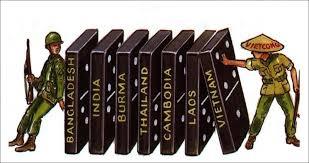


What European country controlled Vietnam until World War II?
France
Germany
Great Britain
Spain
Which of the following was NOT used by the American military in Vietnam?
Aerial attacks (regular bombs)
Agent Orange
Napalm
Nuclear bombs
Where was the United States Navy allegedly attacked in 1964?
Gulf of Thailand
Gulf of Tonkin
Pearl Harbor
South China Sea
Where did middle-class people move to after World War II?
suburbs
cities
farms
mountains

What did "The Feminine Mystique" discuss?
women should stay at home and take care of kids
women were not smart enough to work like men
women would be happier if they had to rely on men for money
women would be happier if they could work outside of the home
African American career opportunities increased and expanded during this time period.
True
False

Who wrote "The Feminine Mystique"?
Betty Friedan
Barbara Streisand
Virginia Woolf
Margaret Thatcher
What group/individuals sought to improve the treatment of migrant workers through boycotts and strikes?
SNCC, Martin Luther King
Black Panthers, Newton
United Farm Workers Union, Dolores Huerta & Cesar Chavez
Immigration Union, Dolores Huerta & Cesar Chavez
What happened as a result of the Civil Rights Act of 1964, Voting Rights Act of 1965, and the 24th Amendment?
Expanded the political and economic opportunities for minorities
Decreased the political and economic opportunities for minorities
This program created by Lyndon Johnson introduced programs like Head Start, HUD, Medicare, Food Stamps to reduce poverty and improve everyone’s quality of life-
HUAC
Great Society
New Deal
NAACP
Government organization established in 1970 to establish pollution standards, conduct environmental research, and assist state and local governments in pollution control
Environmental Protection Agency (EPA)
Environmental Projection Agency (EPA)
Environmental Prosecution Agency (EPA)
Environmental Probation Agency (EPA)

