
 Worksheets
Macroeconomics Review
Total questions: 116
Worksheet time: 4hrs 52mins
Land includes...
The "gifts of nature" or natural resources not created by human effort.
the tools, equipment, and factories used in production of goods and services
people with all their efforts and abilities
individuals who start a new business or bring a product to market.
Capital refers to...
The "gifts of nature" or natural resources not created by human effort.
people with all their efforts and abilities
the tools, equipment, and factories used in production of goods and services
individuals who start a new business or bring a product to market.
Labor refers to...
people with all their efforts and abilities
individuals who start a new business or bring a product to market.
the tools, equipment, and factories used in production of goods and services.
The "gifts of nature" or natural resources not created by human effort.
Entrepreneurs are...
people with all their efforts and abilities
individuals who start a new business or bring a product to market.
The "gifts of nature" or natural resources not created by human effort.
the tools, equipment, and factories used in production of goods and services
A market economy is best defined as
An economic system with a central authority that makes major economic decisions
An economic system in which supply, demand, and the price system help people make economic decisions
An Economic system in which private citizens own and use the factors of production in order to generate profits.
An economic system that has some combination of traditional, command, and market activities.
A command economy is best defined as
An economic system with a central authority that makes major economic decisions
An economic system in which supply, demand, and the price system help people make economic decisions
An Economic system in which private citizens own and use the factors of production in order to generate profits.
An economic system that has some combination of traditional, command, and market activities.
WHAT ARE THE 4 FACTORS OF PRODUCTION?
Land, Capital, Need & Want
Land, Labor, Capital, Entrepreneurs
Water, Air, Food & Shelter
Land, Capital, Good & Service


In a command economy, which group tends to hold the most control?
Government
Businesses
Citizens
Corporations

In a market economy, the citizens and "who else" act in self-interest.
Government
Businesses
Universities
All of the above

In a command economy, who keeps all of the profits?
Government
Citizens
Businesses
None of the above

The hands off type of economy is often call laissez-faire. Which of the following is accurate in this type of economy?
The government has total control of the economy.
The government has total control of the citizens.
The government only gets involved to make a profit.
The government does not get involved with the economy.
How many different types of economies are there?
1
2
3
4
Which type of economic system bases its decisions on custom?
Market
Command
Mixed
Traditional
Which type of economy involves trading, and doesn't usually use money?
Market
Command
Mixed
Traditional
If I produce cereal but, the government has to check to make sure I can put this product on the market, what economic system is this?
Market
Command
Mixed
Traditional
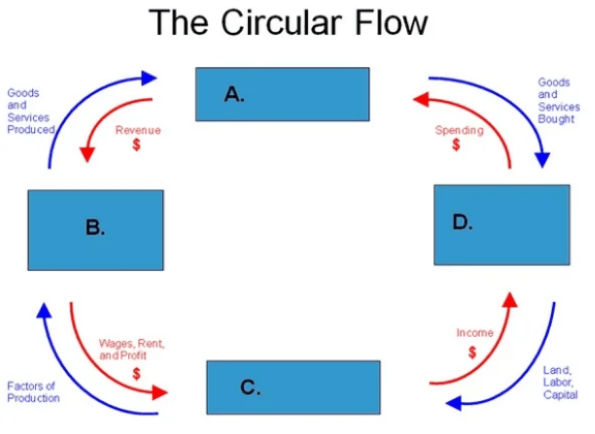
Point B represents
Product Market
Factor Market
Individuals
Businesses
What are the four main parts of the circular flow diagram?
Product Market, Stock Market, Factor Market, Fish Market
Product Market, House Market, Factor Market, Good Market
Factor Market, Product Market, Households, Firms
Factor Market, households, Stock Market, super market
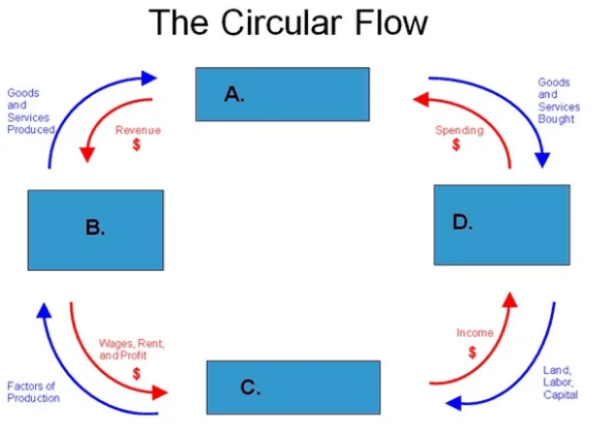
What does point A represent on the Circular flow diagram?
Households
Businesses
Factor Market
Product Market
Where are factors of production (land, labor, etc) exchanged in the circular flow model?
Factor Market
Product Market
Firms
Individuals
Where do factors of production (land, labor, etc) come from in the circular flow model?
Factor Market
Product Market
Firms
Individuals
In the circular flow diagram firms pay wages for which factor of production?
Land
Labor
Entrepreneurship
Raw materials

What does point C represent on the Circular Flow diagram?
Firm
Factor Market
Individual
Product Market

The exchange of money for goods/services to consumers is represented in which part of the circular flow diagram?
1 and 2
3 and 4
5 and 6
7 and 8

The delivery of finished products for sale in exchange for revenue is represented in which arrows?
1 and 2
3 and 4
5 and 6
7 and 8
Someone buys a car in exchange for a large amount of money. They have completed an exchange in which part of the circuclar flow model?
Product Market
Factor Market
Firms
Individuals
Money exchanged between businesses and individuals for labor.
wages
revenue
spending
profit
2 sector model showing how businesses & households interact
Circular Flow Diagram
Demand Curve
Supply Curve
Price Controls
Where buyers and sellers learn information from one another and voluntarily exchange goods, services, & money
Market
Partnership
Specialization
Command Economy
Anything that is legally accepted payment for goods and services.
Money
Dividends
Markets
Economy
The act of buyers and sellers freely & willingly engaging in market transactions
Opportunity Cost
Scarcity
Specialization
Voluntary Exchange
when each worker performs a specific task in production
Scarcity
Specialization
Voluntary Exchange
Opportunity Cost
The desire to have some good or service and the ability to pay for it
supply
equilibrium
demand
quantity demanded
Which of these best describes the law of demand?
if prices go up, quantity demanded will fall and if prices go down, quantity demanded will go up
if prices go up, quantity demanded will also go up and if prices go down, quantity demanded will also go down
there is no law of demand, each situation is unique and demand and prices cannot be predicted
prices will go up for certain goods when quantity demanded goes up and vice versa
A change in the price of a good causes people to buy more or less of an item. This best describes the concept of
the demand curve
change in quantity demanded
change in demand
elasticity
The quantity demanded of a good or service changes at all price levels best describes the concept of
change in quantity demanded
elasticity
change in demand
demand curve
Which of these shows a decrease in the quantity demanded?


Which of these shows an increase in the quantity demanded?


How is a decrease in the price of a good illustrated on a demand graph?
The demand curve shifts to the right.
The demand curve shifts to the left
There is upward movement along the demand curve
There is downward movement along the demand curve.
When the price of good A rises, people start to drink good B. In this case, what is good B considered?
luxury good
complementary good
substitute good
normal good
A decrease in the average incomes of consumers will result in which of the following?
A decrease in the demand for goods and services
An increase in the demand for goods and services
A decrease in the supply of goods and services
An increase in the supply of goods and services
The law of demand states; there is an INVERSE relationship between price and quantity demanded. Which of the following is not a true statement?
Price goes up qty demanded goes down.
Price goes down, qty demanded goes up.
Price goes up, demand goes down.
All answers are correct.
What does it mean?
Ed = 1
Perfectly inelastic demand
Inelastic demand
Unitarily elastic demand
Elastic demand
Perfectly elastic demand
What does it mean?
Ed > 1
Perfectly inelastic demand
Inelastic demand
Unitarily elastic demand
Elastic demand
Perfectly elastic demand
What does it mean?
Ed < 1
Perfectly inelastic demand
Inelastic demand
Unitarily elastic demand
Elastic demand
Perfectly elastic demand
Which of the following is an example of inelastic demand?
Jason wants the most expensive cellphone. He decides to get a cheaper model.
Priya wants to go to the season-opening game. Tickets to another game cost less, but she still buys tickets for the opener.
Tianna wants to try out a new, expensive restaurant. She goes to another restaurant whose food is excellent and costs less.
Shawn wants to buy a house in one neighborhood. But after searching, he decides to buy a house elsewhere instead.
Elasticity refers to
how producers of goods and services react to price changes
how consumers of goods and services react to price changes
how far a supply of scarce goods can be stretched
how often the price of a good or service changes when quantity demanded changes
When producers offer fewer products for sale at the same prices
Supply curve shifts right
Supply curve shifts left
They expect subsidies
The price per unit has decrease
the amount of product producers are willing to bring to the market at any price.
quantity supplied
total product
theory of production
law of supply
Suppliers will normally offer more for sale at high prices and less for sale at lower prices
Quantity supplied
Law of Supply
total production
short run
The willingness and ability of a producer to make a product is referred to as
quantity supplied
quantity demanded
supply
demand
Movement along a supply curve demonstrates
a change in quantity supplied
a change in quantity demanded
a change in supply
a change in demand
A decrease in supply is demonstrated by which of the following?


Which of the following supply curves demonstrates a decrease in the quantity supplied?
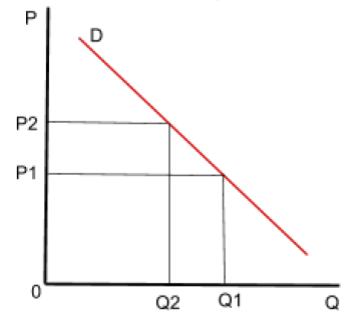


A hurricane wipes out an orange crop in Florida, sharply affecting the supply of oranges. Which chart demonstrates this concept?


The prices for houses steadily increase, causing more people to want to sell their homes. Which of these demonstrates this concept?


Identify the correct determinant of supply.
Example: If the government requires factories to reduce pollution, complying will initially increase costs of production in the market and reduce supply.
Government regulation
Cost of resources
Worker productivity/motivation
Change in technology
Identify the correct determinant of supply:
Example: If the cost of electricity used to power an automotive factories falls, the supply of cars in the market increases
Cost of production/resources
Number of sellers
Change in expectations
Change in technology
Example: As the demand for DVDs decreased due to consumer preference for streaming movies, the market price for DVDs fell. This lower market price caused sellers to leave the DVD market and supply decreased.
Example: If airlines expect prices for airline tickets to fall in September when families are less likely to travel due the school calendar, they will supply more during the summer months when they can charge higher fares.
Which of the following is NOT a determinant of supply?
Change in cost of production
Technology
Change in number of consumers
Government regulations
Which of these best defines equilibrium in a market?
a situation in which quantity supplied is greater than quantity demanded
a situation in which quantity demanded is greater than quantity supplied
a situation in which quantity supplied and quantity demanded are equal
a situation where a minimum price is set
A situation in which the quantity supplied is greater than the quantity demanded is
a shortage
a surplus
a price floor
a price ceiling
A situation in which quantity demanded is greater than quantity supplied is
a shortage
a surplus
a price floor
a price ceiling
A situation in which a minimum price is set is referred to as
a shortage
a surplus
a price ceiling
a price floor
A situation in which a maximum price is set is referred to as
a shortage
a surplus
a price ceiling
a price floor
Which of the following demonstrates price equilibrium?


Which of these demonstrates a surplus of goods?


Which of these demonstrates a shortage of goods?


If there is a shortage of beef at Fry's which of the following is the MOST likely to happen?
They will produce more beef
The price will rise
The price will fall
There will be no change
Supply is from the point of view of the____________.
Politician
Consumer
Producer
Individual
Which of the following best describes a subsidy?
Taxes on a consumer to discourage an activity.
Money taken from consumers to encourage an activity.
Money given to a business to encourage an activity.
No money changes hands.
When there is a decrease in the price of DVD players what does change?
The quantity supplied does not change
The quantity demanded does not change
We can not determine
The quantity supplied changes
If there is an increase in the price of DVD players what will happen to the supply curve?
It will shift to the left
No change
It will shift to the right
We can not determine
If there is an increase in feed prices what will happen to the supply curve for beef?
There will be no change
A shift to the right
We can not determine
A shift to the left

What is the equilibrium point?
(7,5)
(5,30)
(4,20)
(2,30)

Coordinates Demand (5,10) and Supply (5,30), is this a surplus or a shortage?
Surplus
Shortage
No change
Equilibrium

What is the surplus or shortage for coordinates demand(5,10) and supply(5,30)?
10
30
0
20

For coordinates demand(2,30) and supply(2,15), is this a surplus or shortage?
Surplus
Shortage
Equilibrium
No change

What is the surplus or shortage for coordinates demand(2,30) and supply(2,15)?
30
15
0
2

