Wayground logo

Free Printable Worksheets

Font size

S
M
L
XL
Worksheets

Rollercoaster part 1

Total questions: 70

Worksheet time: 6hrs 50mins

Name
Class
Date
1.

When fuel burns, it gives us____ and ____ energy

Choose all that apply

a)

Electrical

b)

Heat

c)

Light

d)

Electromagnetic

2.

Which one of them is not a fossil fuel?

a)

Coal

b)

Water

c)

Gas

d)

Oil

3.

Releasing a catapult contains which type of energy transformation?

a)

Strain to chemical energy

b)

Strain to Kinetic Energy

c)

Electrical to chemical energy

d)

None of three

4.

A car accelerated by engine represents which type of energy transformation?

a)

Chemical to light energy

b)

Chemical to Kinetic Energy of car

c)

Chemical to Electromagnetic energy

d)

None of three

5.

The unit of energy is ____

a)

Kilogram

b)

Grams

c)

Joules

d)

None of three

6.

Energy stored because of gravity is called:

a)

Gravitational Potential Energy

b)

Kinetic Energy

c)

Mechanical Advantage

d)

Chemical Energy

7.

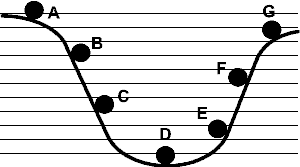
At which point does the ball has the greatest gravitational potential energy (GPE)?

a)

A

b)

G

c)

D

d)

C

e)

G

8.

Which would have the LEAST gravitational potential energy (GPE)?

a)

A ball sitting on the ground

b)

Moon viewed from the Earth

c)

An airplane flying 30,000 feet above the ground

d)

A rock sitting on top of Mt. Everest

9.

How could you increase the gravitational potential energy of an object without changing its mass and gravity?

a)

Make the object larger

b)

Lower the object towards the ground

c)

Raise the object farther off the ground

d)

Allow the object to roll on the ground

10.

You throw a ball into the air as shown in the diagram. At what point does the ball have the most gravitational potential energy?

a)

W

b)

X

c)

Y

d)

Z

11.

At which position does the child on the swing have the most gravitational potential energy?

a)

W

b)

X

c)

Y

d)

Z

12.

At which point on the roller coaster is the gravitational potential energy the greatest?

a)

W

b)

X

c)

Y

d)

Z

13.
What is the SI unit used to measure force? 
a)
pounds 
b)
grams 
c)
newtons 
d)
friction
14.
The force of gravity acting on an object is the object's ______.
a)
mass
b)
matter
c)
weight 
d)
friction 
15.
The amount of matter in an object is 
a)
pressure
b)
weight
c)
mass
d)
force
16.
What equation do I use to calculate speed?
a)
S = D/T
b)
T = D/S
c)
D=TS
17.
What equation do I use to calculate time?
a)
S = D/T
b)
T = D/S
c)
D=TS
18.
What equation do I use to calculate distance?
a)
S = D/T
b)
T = D/S
c)
D=TS
19.
What key word tells me I'm measuring speed?
a)
how fast
b)
how far
c)
how long
20.
What key word tells me I'm measuring time?
a)
how fast
b)
how far
c)
how long
21.
What key word tells me I'm measuring distance?
a)
how fast
b)
how far
c)
how long
22.
What unit would I use when measuring speed?
a)
m/sec
b)
meters
c)
seconds
23.
What unit would I use when measuring time?
a)
m/sec
b)
meters
c)
seconds
24.
What unit would I use when measuring distance?
a)
m/sec
b)
meters
c)
seconds
25.
Which of the following is a unit of time?
a)
km/hr
b)
hr
c)
km
d)
mi
26.
Which of the following is a unit of speed?
a)
km/hr
b)
hr
c)
km
d)
s
27.
Which of the following is a unit of distance ?
a)
miles/hr
b)
hr
c)
km
d)
min
28.

What is a force?

a)

the PUSH or PULL on an object

b)

The MOTION an object creates

c)

The objects HITTING one another

d)

Going REALLY FAST

29.

What is the unit for FORCE?

a)

N (Newtons)

b)

lbs (pounds)

c)

g (grams)

d)

m/s (meters per second)

30.

If the net force is 0 the object will ...

a)

CHANGE its motion

b)

STAY the SAME, NOT Move

31.
What is the net force?
a)
20 N 
b)
0 N 
c)
400 N 
d)
40 N 
32.

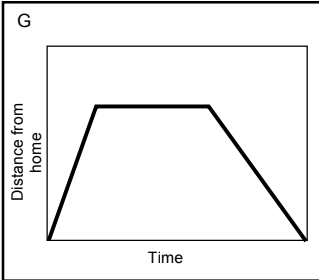
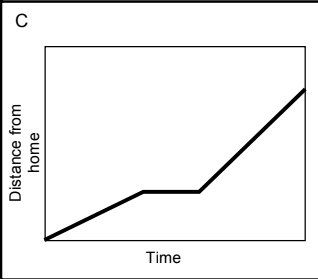
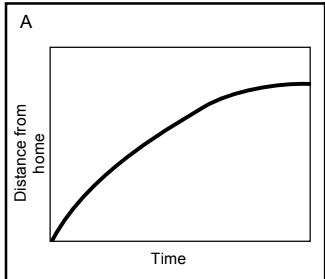
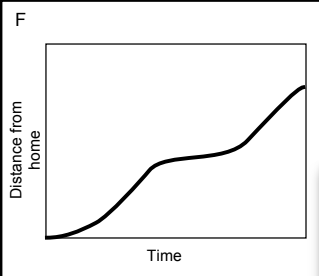
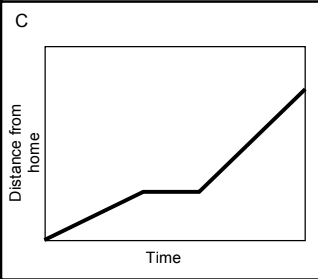
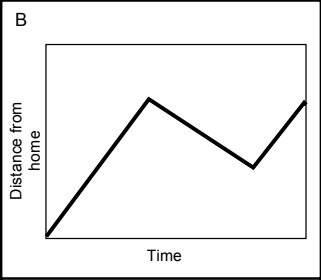
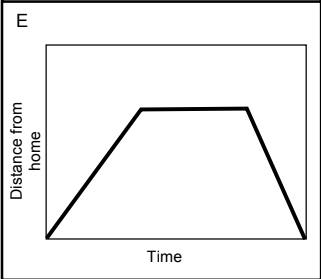
Match the description to the graph:

"The car is stopped."

a)
b)
c)
d)
33.

Match the description to the graph:

"The car is traveling at a constant speed."

a)
b)
c)
d)
34.

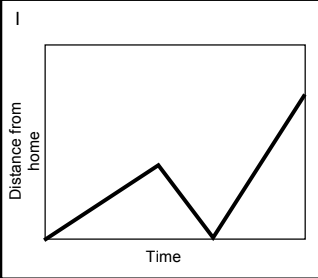
Segment A-B The bus is _________________.

a)

at rest

b)

returning (to original position)

c)

moving forward

35.
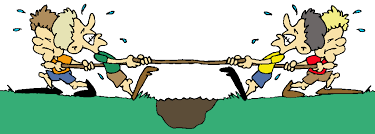
If these teams are pulling with the same amount of force what will happen?
a)
The boy in blue will win.
b)
They will not move at all.
c)
The boy in red will win.
d)
Both will fall down.
36.
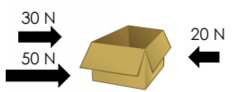
Calculate the Net Force. 
a)
60N, Left 
b)
40N, Right 
c)
0N
d)
60N, Right
37.
a)
b)
c)
d)
38.
a)
b)
c)
d)
39.
a)
b)
c)
d)
40.
a)
b)
c)
d)
41.
Which runner won the race?
a)
A
b)
B
c)
C
42.
Which runner had a head start?
a)
A
b)
B
c)
C
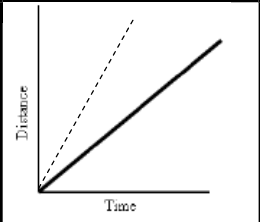
43.
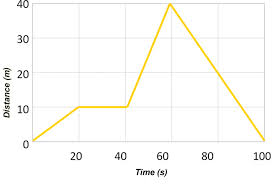
What does this graph represent?
a)
Constant Speed
b)
Acceleration
c)
Not moving
44.
How long did it take this object to travel 10 m?
a)
0 s
b)
10 s
c)
15 s
d)
20 s
45.
How long did it take this object to travel back to its reference/starting point?
a)
20 s
b)
30 s
c)
60 s
d)
100 s
46.
At 60 seconds, how far had this object traveled? 
a)
0 m
b)
10 m
c)
20 m
d)
40 m
47.
What is this graph showing?
a)
Constant Speed
b)
Acceleration (speeding up)
c)
Deceleration (slowing down)
d)
No motion
48.
Distance a vehicle travels from the time the driver applies the brakes until the vehicle stops?
a)
Perception Distance
b)
Braking Distance
c)
Total Stopping Distance
d)
Reactions Distance
49.
Braking distance
a)
increases as speed decreases
b)
Decreases as speed increases
c)
Doubles if speed doubles
d)
Increases as speed increases
50.
Total stopping distance is the distance
a)
It takes for you to perceive a hazard
b)
It takes for you to brake
c)
It takes for you to react
d)
Your vehicle travels while you make a stop
51.
The instrument used to measure dimensions of solid objects.
a)
density equation
b)
graduated cylinder
c)
displacement
d)
ruler
52.
Metric unit used to record mass.
a)
cm3
b)
grams (g)
c)
miliLiter
d)
liter (L)
53.
Which liquid has the least density?
a)
Water
b)
Glycerine
c)
Corn Oil
d)
Corn Syurp
54.
Volume is __________.
a)
how many atoms
b)
how much matter is in an object
c)
how  much something weighs
d)
how much space an object takes up
55.
The metric unit used to measure the volume of a solid objects.
a)
grams
b)
miliLiter
c)
cm3
d)
Liter (L)
56.
What is the formula for density?
a)
density = mass x volume
b)
density = mass ÷ volume 
c)
density = mass + volume
d)
density = mass - volume
57.
An object that floats in water is __________.
a)
more dense than water
b)
same density as water
c)
less dense than water
d)
must be in the shape of a cube
58.

How much liquid is represented?

a)

24 mL

b)

20.4 mL

c)

29 mL

d)

35 mL

59.

The temperature at which water freezes

a)

32°C

b)

212°C

c)

100°C

d)

0°C

60.

The temperature at which water boils

a)

32°C

b)

212°C

c)

100°C

d)

0°C

61.

What is the density of water?

a)

0.1 g/mL

b)

1 g/mL

c)

100 g/mL

d)

10 g/mL

62.

Students in a science class performed an experiment with hot and cold water. They dyed the hot water red and the cold water blue. When the students layered the water, they noticed that the hot water rose to the top and the cold water sank. What was this demonstrating?

a)

Evaporation

b)

Air Pressure

c)

Density

d)

Volume

63.
The mass of an object is 30 g.  The volume is 5 mL.  What is the density of this object?
a)
6 g/cm
b)
6 g/mL
c)
6
64.
You are given the following information: mass = 48 g; volume = 24 cm3. What is the density of this substance? 
a)
2 g/cm3
b)
1,152 g/cm3
c)
0.5 g/cm3
d)
72 g/cm3
65.
If you have a gold brick that is 2 cm by 3 cm by 4 cm and has a density of 19.3 g/cm3, what is its mass?
a)
463.2 g/cm3
b)
463.2 g
c)
0.804 kg
d)
0.804 g
66.
What is the volume of Object X?
a)
10.0 cm3
b)
15.0 cm3
c)
20.0 cm3
d)
25.0 cm3
67.
If a block of wood has a density of 0.6 g/cm3 and a mass of 120 g, what is its volume?
a)
200 cm3
b)
0.005 cm3
c)
200.0 ml
d)
72 ml
68.
True or False:  The density of a specific type of material never changes.  
a)
True
b)
False
69.
You can measure ______ with grams.
a)
mass
b)
volume
c)
conductivity
d)
melting point
70.
Which box has a higher density?  
a)
Box A
b)
Box B
c)
cannot be determined
d)
they are the same