
 Worksheets
Muscular System Revision
Total questions: 59
Worksheet time: 37mins
Voluntary muscle tissue
smooth
cardiac
skeletal
Muscle tissue found only in the heart
smooth
cardiac
skeletal
Muscle tissue that dilates and constricts the pupils of our eyes
smooth
cardiac
skeletal
Muscle tissue that is multinucleate
smooth
cardiac
skeletal
Muscle tissue composed of branching cells and intercalated discs
skeletal
cardiac
smooth
Performs very slow, sometimes rhythmic, contractions
smooth
cardiac
skeletal
Muscle tissue that maintains posture, body position, and stabilizes joints
cardiac
skeletal
smooth

The epimysium is represented by ________.
A
B
C
D

The perimysium wraps a fascicle of muscle cells and is represented by ________.
A
B
C
D

The muscle fiber (cell) is indicated by ________.
A
B
C
D
The plasma membrane of a skeletal muscle cell is called the ________.
sarcolemma
sarcomere
myofilament
sarcoplasm
sarcoplasmic reticulum
Which type of muscle tissue contracts most quickly upon stimulation?
skeletal
visceral
cardiac
smooth
Which of the following is NOT a function of the muscular system?
production of movement
maintenance of posture
stabilization of joints
generation of heat
blood cell formation
The muscular system interacts with the skeletal system by:
smooth muscles are joined with spongy bone via cartilage
skeletal muscles pull on joints to permit movement
cardiac muscle is connected to the ribs
skeletal muscles are joined to one another via ligaments
The sliding filament theory explains which of the following?
muscle extensions
muscle inductions
muscle contractions
muscle formation
Which parts of the muscular system have striations? select ALL that apply
cardiac muscle
skeletal muscle
smooth muscle
none of the above
Smooth muscle is present in your:
heart
digestive system
skeletal system
skeletal muscle
The ________ surrounds individual muscle fibers.
endomysium
perimysium
epimysium
exomysium
Each unit in a muscle fiber is called a __________.
myosin
globular heads
sarcomeres
troponin
Smooth muscle lacks:
ATP
calcium
involuntary contractions
striation
Cardiac muscle is ________ and ________.
smooth, voluntary
smooth, involuntary
striated, involuntary
striated, voluntary
Found attached to bones throughout the body
smooth
cardiac
skeletal
all
Found in the heart
smooth
cardiac
skeletal
all
Found in the walls of hollow organs; also called visceral
smooth
cardiac
skeletal
all
Use to move materials through contractions
smooth
cardiac
skeletal
all


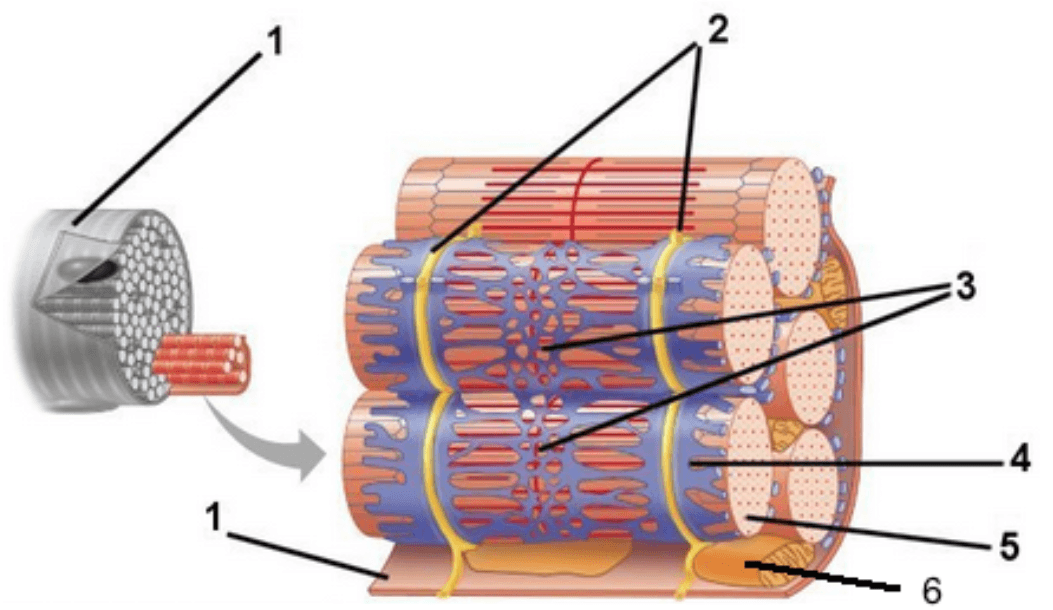
What is shown in the colored part of this diagram?
a whole muscle
five muscle fibers
five muscle fascicles
five myofibrils
What is labeled "4" (the blue/purple part) in the diagram?
sarcolemma
sarcoplasmic reticulum
transverse tubules
myofibril
Name the following in order from largest to smallest:
muscle, muscle fascicle, muscle cell, myofibril, filaments
muscle, muscle fascicle, muscle cell, filaments, myofibril
muscle, muscle cell, muscle fascicle, myofibril, filaments
muscle, muscle cell, muscle fascicle, filaments, myofibril
What is the length between Z-lines of an actin molecule called?
fascicle
sarcomere
myosin binding site
sarcoplasmic length

This type of muscle tissue is attached to bones and helps control voluntary movement
Skeletal
Cardiac
Smooth
What type of muscle(s) is involuntary?
skeletal and smooth
cardiac and skeletal
smooth and cardiac
skeletal

The movement shown is a person moving his leg outward. This movement is known as:
abduction
adduction
rotation
flexion

The primary muscle for hip extension is the:
gluteus maximus
soleus
deltoid
latissimus dorsi


What movement is occurring here?
Inversion
Eversion
Plantarflexion
Dorsiflexion
Muscles usually work in pairs, one flexes the other extends, one shortens the other lengthens?
YES
NO
Are muscles joined to bones by ligaments?
YES
NO
The prime mover when throwing a ball as the arm extends is the Triceps.
YES
NO

What muscle is the arrow pointing to?
Biceps
Triceps
Lats
Quads

Identify the muscle?
Quadriceps
Satorius
Hamstring
Gastronecmius
Which of the following exercises would best strengthen the pectoral muscles?
Lunges
Bicep curls
Crunches
Chest press
Muscles in your body move in _________.
points
their own way
pairs
One muscle _______ and the other _______.
works, works harder
contracts, relaxes
pulls, pushes
The biggest muscle in your body is?
Femur
Gluteus Maximus
Gluteus
Biceps

