
 Worksheets
DS: Mouth to Stomach
Total questions: 57
Worksheet time: 33mins
What carries food from the pharynx to the stomach?
larynx
trachea
esophagus
bronchioles
Where does the process of digestion begin?
mouth
esophagus
stomach
small intestine
What enzyme is found in saliva that starts digesting carbohydrates?
amylase
chyme
pepsin
bile
Match the following terms:
Mechanical digestion
Mastication
Ingestion
Taking food into your mouth
Chemical digestion
Enzyme action
Digestion
Chemical and Mechanical breakdown of food
Egestion
Release of feces
What chemically breaks down food into smaller molecules?
teeth
muscles of the stomach
enzymes
What are the rhythmic muscular contractions of your esophagus called to help food move along?
swallowing
peristalsis
inertia contractions
paralysis
Proteins break down to:
fatty acids
nucleic acids
amino acids
hydrochloric acids
Lipids are digested by enzymes into
smaller sugars
amino acids
fatty acids and glycerol
CO2 and H2O
Match the following LOCATION to the ACTION
Teeth
Chew
Esophagus
Peristalsis
Tongue
Tasting
Teeth and Tongue
Mastication
Uvula
Triggers gag reflex
What is the term given to a ball-like mixture of food and saliva that forms in the mouth?
Peristalsis
Mucus
Epiglottis
Bolus
Where does the digestion of carbohydrates take place?
Mouth
Mouth and Stomach
Mouth and small Intestine
Mouth and large intestine
Stomach
Enzymes are catalysts. What is a catalyst
speeds up a chemical reaction
slows down a chemical reaction
has no effect on a chemical reaction
it slows dow and speeds up a chemical reaction
what are enzymes made up of?
sugars
proteins
fats
fiblre
We need to eat so that our body has the food substances that it needs...
to repair itself
for growth
to get sick
for energy
The process of breaking down foods into smaller parts is called
digestive
indigestion
digestion
digging
Our body can easily absorb food without digesting it.
True
False

What stage of digestion is being shown by this picture?
absorption
assimilation
digestion
egestion
ingestion
Amylase in saliva changes starch into...
sugar
waste
stomach acid
chyme
What does the salivary glands do for the digestive system? Select all that apply
It produce saliva, which keeps the mouth and and bolus moist for swallowing.
It produce moist, which keeps the mouth and other parts of the digestive system saliva.
It produces ptyalin to make saliva for the mouth, so the system can start.
It produces saliva that contains chemicals that act on bacteria (immune function)
It produces an enzyme that begins carb digestion
Which of the following answers correctly sequences the pathway food takes from the beginning to end?
mouth, oesophagus, stomach, small intestine, large intestine
mouth, oesophagus, stomach, large intestine, small intestine
mouth, stomach, oesophagus, small intestine, large intestine
mouth, stomach, oesophagus, large intestine, small intestine
What is the flap like organ which prevents the food from going into trachea?
epiglottis
mouth
glands
tongue

Digestion of which nutrient takes place in buccal cavity
proteins
carbohydrate
fats
vitamins
for swallow the food
for biting and chopping food
for crushing food
for grinding food


Identify the part of the tooth labelled A.
Dentine
Pulp
Enamel
Root
How many teeth are there in the human body
33
34
32
43
Which type of tooth is designed to grind food
Canine
Molar
Incisor
I dont know
Teeth are important in digestion because
form our smile
they physically break up food into smaller pieces so enzymes can work better
they chemically break up food

What are the four front middle teeth that help to bite the food called?
incisors
premolars
molars
canines

What are the two teeth just lateral to the four front middle teeth that help to tear the food called?
incisors
premolars
molars
canines


Which teeth are identified in this picture? These teeth are big and strong to help you grind food so it can be swallowed
incisors
premolars
molars
canines
The tiny, pink bumps on your tongue are called
Saliva
Taste buds

The nerves associated with smell are referred to as the:
olfactory receptor cells
smell cells
gustatory receptor cells
umami cells
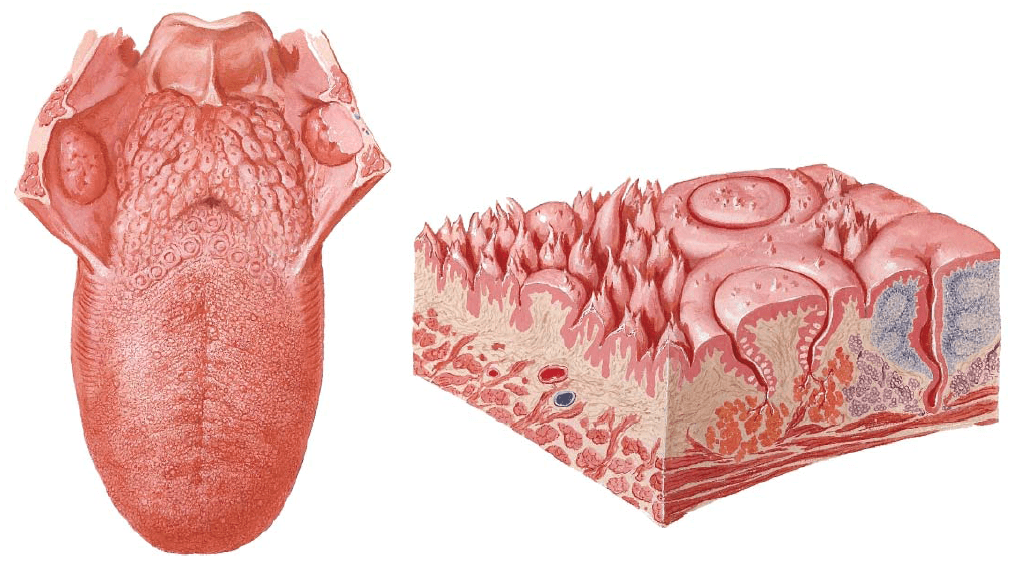
Small projections located on the tongue’s surface where taste buds are located are known as:
papillae
gustatory cells
olfactory epithelium
mucous producing glands
A person who can smell nothing has:
anosmia
hyperosmia
hyposmia
Redosmia

Senses that respond to chemicals in solution utilize which of the following:
Meissner's corpuscle
chemoreceptors
crista ampullaris
beta lactamase

Which of the following receptors guide the intake of carbohydrates:
sweet
sour
bitter
umami
salty

Which of the following receptors respond to nitrogen containing molecules:
sweet
sour
bitter
umami
salty

Which of the following receptors guides the intake of protein:
sweet
sour
bitter
umami
salty

Which of the following receptors would guide the intake of minerals such as sodium, potassium, calcium, iron, etc:
sweet
sour
bitter
umami
salty

Which of the following responds to acidic solutions:
sweet
sour
bitter
umami
salty

Which of the following detects spoiled foods and poisons:
sweet
sour
bitter
umami
salty
chemical sense of smell
ageusia
gustation
olfaction
anosmia
Your senses of taste and smell are known as you two ____________ senses.
Biological
Special
Chemical
Flavor
As the chemicals that cause smells enter your nose, they are dissolved in ________ so that they can be detected by your olfactory receptor cells.
Acid
Saliva
Water
Mucus
True or False: Holding your nose, or having a stuffed nose makes it harder to taste your food.
True
False
When we are exposed to a smell and decide it isn't something to worry about our nose will go 'nose blind'. This is a ___.
sensory adaptation that allows us to ignore old smells to detect new smells
misnomer, our nose doesn't see
sense where our nose becomes very acute to all smells
fallacy
What is the flap like structure that is in the opening of the pharynx?
epiglottis
mouth
uvula
tongue
What is the flap like structure that prevents us from choking?
epiglottis
mouth
uvula
tongue
Identify the part of the tooth labelled B.
Dentin
Pulp
Enamel
Root
Identify the part of the tooth labelled D.
Gingivitis
Pulp
Gingiva
Pulp
When 'this part' is inflamed, we call it gingivitis.
A
B
D
G
In your ___, both food and air from our nose combine. We need to take care to not inhale while we swallow.
Buccal cavity
Hard palate
Pharynx
Esophagus
Hardest material in your body:
A
B
D
F

