
 Worksheets
Ecology_2025_Eilers
Total questions: 54
Worksheet time: 46mins

Photosynthetic microscopic protists, such as algae acting as the primary producers in aquatic ecosystems.
Detritivores
Zooplankton
Phytoplankton
Pioneer Species

Organism that is the first to live in a previously uninhabited area (lichens, moss)
Individual
Biome
Population
Pioneer Species

Microscopic, free-floating animal like protist acting as primary consumers in aquatic ecosystems
Chemosynthesis
Pioneer Species
Zooplankton
Phytoplankton

Reestablishment of a damaged ecosystem in an area where the soil was left intact
Biogeochemical cycle
Primary Succession
Secondary Succession
Limiting Factor

Establishment and development of an ecosystem in an area that was previously uninhabited
Pioneer species
Secondary Succession
Primary Succession
Symbiosis

The process by which certain types of bacteria convert gaseous nitrogen into nitrogen compounds
Nitrogen Fixation
Biogeochemical Cycles
Biomass Pyramid
Predation

Ecological relationship in which one organism benefits by harming another organism.
Predation
Parasitism
Commensalism
Mutualism

Ecological relationship in which one species receives a benefit but the other species is not affected one way or another.
Predation
Parasitism
Commensalism
Mutualism

All of the physical, chemical, and biological factors that a species needs to survive, stay healthy, and reproduce in an ecosystem. If these overlap for organisms then competition between them will increase.
Commensalism
Ecological Niche
Symbiosis
Predation

Process by which one organism hunts and kills another organism for food
Predation
Parasitism
Symbiosis
Competition

Ecological relationship in which two organisms attempt to obtain the same resource
Parasitism
Symbiosis
Competition
Predation

Organism that eats dead organic matter. Examples would be earthworms, millipedes, termites, and large mushrooms.
Omnivore
Herbivore
Carnivore
Detritivore

Level of nourishment in a food chain, food web, or ecological pyramid
Habitat level
Biogeochemical level
Biome level
Trophic level

A type of detritivore that breaks down organic matter into simpler compounds, returning nutrients back into an ecosystem. An example would be the microorganisms of certain types of bacteria, protozoa, and fungi.
Decomposer
Omnivore
Carnivore
Herbivore

Organism that eats both plants and animals
Carnivore
Omnivore
Detritivore
Herbivore

Variety of life within an area
Food Web
Biotic
Biogeochemical cycles
Biodiversity

Organism that obtains energy by eating only animals
Decomposer
Detritivore
Carnivore
Herbivore

Nonliving factor in an ecosystem, such as moisture, temperature, wind, sunlight, soil, and minerals.
Abiotic
Community
Biome
Biotic

Organisms that only eat plants
Detritivore
Omnivores
Carnivores
Herbivores

Organism that obtains its energy and nutrients by consuming other organisms.
Detritivore
Decomposer
Autotroph/Producer
Heterotroph/Consumer

Organisms that obtain its energy from abiotic sources, such as sunlight
Detritivore
Decomposer
Autotroph/Producer
Heterotroph/Consumer

Living things, such as plants, animals, fungi, and bacteria.
Food Chain
Biome
Biotic
Abiotic


A food web has arrows. The arrow shows:
The direction of energy flow (from predator TO prey)
The direction of energy flow (from prey TO predator)
The biomass at each trophic level
Possible feeding relationships
The average amount of energy that does not transfer to a predator, since it was used up, is (a) %.


Which cycle are fossil fuels (oil, coal, natural gas) part of?
carbon
water
nitrogen
phosphorus


Identify the cycle pictured.
The Water cycle
The Carbon cycle
The Nitrogen cycle
The Phosphorus cycle.
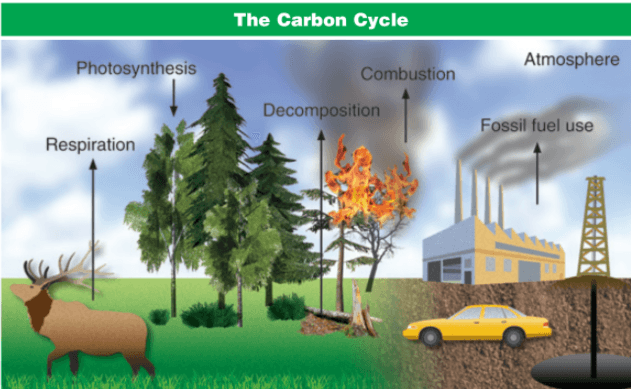
Burning (combustion) fossil fuels has which effect in the carbon cycle?
It removes carbon dioxide from the atmosphere.
It puts carbon dioxide under the ground.
It adds carbon dioxide to the atmosphere.
It has no effect in the carbon cycle.
Cellular Respiration is the process by which animals take in _____ and release _____.
photosynthesis, air
carbon, oxygen
oxygen
oxygen, carbon dioxide
Which of the following cycles needs different types of bacteria to make the most common gas in the atmosphere useful to plants?
the water cycle
the carbon cycle
the nitrogen cycle
the hydrogen cycle

How do animals (consumers) get the carbon and nitrogen they need?
From the air they breathe
From the water they drink
From the food they eat
From the sun
After land is cleared for farming, what type of succession might occur?
Primary
secondary
tertiary

After a volcanic eruption, lava covers the land. What is the order that plants grow to repopulate the area?
Lichens → Shrubs → Grasses → Trees
Lichens → tree → shrubs→Grasses
Grasses → Lichens → Shrubs → Trees
Lichens → Grasses → Shrubs → Trees

