
 Worksheets
Ch. 10 & 11- Blood and the Cardiovascular System
Total questions: 137
Worksheet time: 2hrs 59mins



Which of the following is NOT a function of the cardiovascular system?
Transport Oxygen and Carbon Dioxide to and from the respiratory system
Transport nutrients and waste to and from the digestive system
Break down food into nutrients for the body
Maintain homeostasis by regulating body temperature
The double walled sac that surrounds the heart is called the:
Arteries
Valves
Pericardium
Chambers
What type of blood do the Vena Cava carry?
Oxygenated
Deoxygenated
What type of blood travels through the aorta?
Oxygenated
Deoxygenated
Arteries carry oxygenated blood _______ the heart.
Away from
Towards
Through
Into
These blood cells protect from infections:
Red Blood Cells
White Blood Cells
Plasma
Platelets
These lower chambers of the heart pump blood out to the body through arteries:
Ventricles
Atrium
Vena cava
Aorta
The primary cardiac pacemaker
SA Node
AV Node
Bundle of His
Thorel pathways
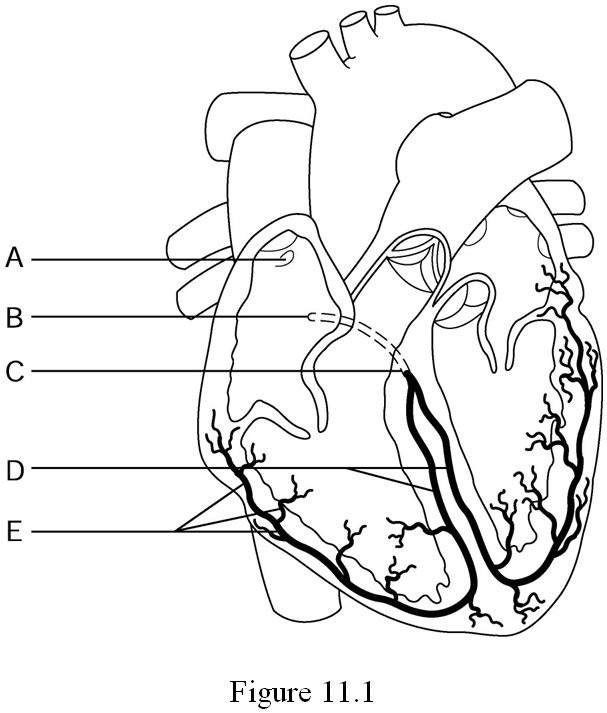
Which label is representing the Purkinje fibers?
A
C
D
E
B
lead away from heart and have valves
(Notice the highlighted word)
(Notice the highlighted word)

An interruption in blood flow to the brain results in a . . .
Stroke
Myocardial Infarction
Atrial fibrillation
Hypertensive episode
Which blood pressure reading would be considered healthy?l
140/90
80/50
120/70
160/100
An uncoordinated shuddering of the heart is the result of . . .
Stroke
Myocardial Infarction
Atrial fibrillation
Hypertensive episode
Which component of blood is responsible for carrying oxygen to the cells of the body?
Red Blood Cell
White Blood Cell
Platelets
Plasma
Which component of blood is responsible for fighting infection?
Red Blood Cell
White Blood Cell
Platelets
Plasma


What blood vessel carries blood to the left Atrium?
Vena Cava
Aorta
Pulmonary artery
Pulmonary vein
What blood vessel carries blood to the Right Atrium?
Vena Cava
Aorta
Pulmonary artery
Pulmonary vein
What blood vessel carries blood to the Rest of the body?
Vena Cava
Aorta
Pulmonary artery
Pulmonary vein
What blood vessel carries blood to the lungs
Vena Cava
Aorta
Pulmonary artery
Pulmonary vein
When blood goes through the tricuspid valve, what chamber does it flow into?
Right Atrium
Right Ventricle
Left atrium
Left Ventricle
When blood goes through the mitral valve, what chamber does it flow into?
Right Atrium
Right Ventricle
Left atrium
Left Ventricle
When blood goes through the pulmonary valve, what structure does the blood go into?
Right Atrium
aorta
pulmonary artery
Pulmonary vein
When blood goes through the aortic valve, what structure does the blood go into?
Left ventricle
aorta
pulmonary artery
Pulmonary vein
Type of circulation that brings blood from the aorta to the myocardium and back to the right atrium through the coronary sinus
Cardiopulmonary Circulation
Coronary Circulation
Fetal Circulation
Portal Circulation
Blood pressure measured when the ventricles are relaxed
Diastolic
Pulse
Venous return
Systolic
Which of the following is the smallest blood vessel?
Venules
Arterioles
Veins
Capillaries
What is "normal" blood pressure
120/110 mmHg
120/80 mmHg
100/80 mmHg
140/80 mmHg
A device used to measure the pressure against the arteries of the body.
Monitor
Gauge
sphygmomanometer
millimeter
Fatima has blood pressure 183/81, what is Fatima's systolic pressure?
81
183
183/81
81/183
Low blood pressure
diastolic pressure
systolic pressure
hypotension
hypertension
Blood pressure is used to determine
electrical current though the heart
function of coronary artery
if adequate blood is getting to tissues.
Speed of blood through veins
Why is high blood pressure or hypertension a 'silent' killer?
It has no sound
It has no symptoms
It kills people
It is a leading cause of death in the world
lowest pressure against the blood vessels of the body. Measures between contractions
diastolic pressure
systolic pressure
hypotension
hypertension

What type of Leukocyte am I?
Basophil
Monocyte
Lymphocyte
Eosinophil
Neutrophil

What type of Leukocyte am I?
Basophil
Monocyte
Lymphocyte
Eosinophil
Neutrophil

What type of Leukocyte am I?
Basophil
Monocyte
Lymphocyte
Eosinophil
Neutrophil

What type of Leukocyte am I?
Basophil
Monocyte
Lymphocyte
Eosinophil
Neutrophil

What type of Leukocyte am I?
Basophil
Monocyte
Lymphocyte
Eosinophil
Neutrophil
First to go to an area of infection or injury to destroy microorganisms
Basophil
Monocyte
Lymphocyte
Eosinophil
Neutrophil
Responsible for producing antibodies to fight diseases
Basophil
Monocyte
Lymphocyte
Eosinophil
Neutrophil
fight allergic reactions, parasitic infections and inflammation in the body.
Basophil
Monocyte
Lymphocyte
Eosinophil
Neutrophil
Largest leukocyte, remove dead cells
Basophil
Monocyte
Lymphocyte
Eosinophil
Neutrophil
Involved with allergic reactions, contain histamines
Basophil
Monocyte
Lymphocyte
Eosinophil
Neutrophil

What am I?
Basophil
Monocyte
Platelet
Eosinophil
Neutrophil
Responsible for stopping bleeding in a vessel
RBCs
WBCs
Platelet
Responsible for the transportation of O2 and CO2
RBCs
WBCs
Platelet
The process of making RBCs
Erythropoiesis
Erythropoietin
The hormone responsible for making RBCs
Erythropoiesis
Erythropoietin
Erythropoietin is produce and filtered by what?
liver
kidneys
gallbladder
spleen
I contain all the liquid portion of blood
serum
plasma
I contain all the liquid portion of blood but without clotting factors
serum
plasma

What type of RBC am I?
Normal
Howell-Jolly Body
Target Cell
Echinocytes

What type of RBC am I?
Normal
Howell-Jolly Body
Target Cell
Echinocytes

What type of RBC am I?
Normal
Howell-Jolly Body
Target Cell
Echinocytes

What type of RBC am I?
Normal
Howell-Jolly Body
Target Cell
Echinocytes
Which blood cells are most abundant in the body?
lymphocytes
platelets
erythrocytes
eosinophils
Which of the following blood pressure readings is hypertensive?
160/100
130/80
120/70
90/50
A persistent blood clot that stays in one area is called a(n)
a thrombus
an embolus
hemophilia
leukopenia


The most common type of leukocytes is
neutrophils
eosinophils
monocytes
basophils
Hemoglobin is found in
leukocytes
erthyrocytes
platelets
lymphocytes
Which is not a formed element of the blood?
platelets
erythrocyes
plasma
leukocytes
The lack of red blood cells in the blood system is called
leukemia
anemia
hypertension
hemophilia
What is the function of hemoglobin?
to carry iron
to carry wastes
to carry oxygen
to produce oxygen

The blood clot shown starts in a vein in the legs then breaks off and moves to the lung. (note: it travels instead of staying in one place). This is
hemophilia
a thrombus
anemia
an embolus

The disorder shown is due to
hypertension
a lack of platelets
a problem with hemoglobin
a lack of iron
This type of leukocyte is associated with allergic reactions.
monocytes
basophils
leukocytes
eosinophils

What is true about Artery B?
It would have a thinner arterial wall
This vessel would cause hypertension
Blood will travel through here at a faster rate
It brings blood towards the heart

In slide 1, what blood type is shown (D is the Rh protein)
A+
A-
O+
O-

A patient needs new granulocytes. Which disease might he have?
sickle cell anemia
lymphocytic leukemia
hemophilia
myeloid leukemia
Which condition causes blood pressure to drop dangerously low?
hemophilia
sickle cell anemia
septicemia
mononucleosis

What blood type is shown on the right?
A+
A-
B+
B-

For the blood type shown on the right, who can they receive from?
A and AB
A and O
B and AB
B and O
Erythroblastosis fetalis is a condition caused by _____ and is treated with _____
Rh incompatibility, RHOGAM
AB incompatibility, angioplasty
blood clots, RHOGAM
lack of platelets, blood transfusion
If a RH negative mom has a RH positive baby this disorder would put her 2nd baby at risk for getting what condition?
erythroblastosis fetalis
multiple myeloma
hemophilia
sickle cell anemia

