wayground logo

Free Printable Worksheets

NEW

Font size

S
M
L
XL
Worksheets

Test 1 Review BIO 112

Total questions: 80

Worksheet time: 2hrs 0mins

Name
Class
Date
1.
A biological ____________ is a group of interbreeding populations that is reproductively isolated from other groups.
a)
species
b)
family
c)
phylogeny
d)
hybrid
2.
______ _________ explains how two or more organisms could evolve similar traits even though they are not related to each other.
a)
convergent evolution
b)
reproductive isolation
c)
derived characters
d)
hybrid vigor
3.
A __________ is a branching diagram that shows evolutionary relationships.
a)
cladogram
b)
table
c)
derived character
d)
relationship tree
4.
The scientific name for humans is _______ ____
a)
Homo sapiens
b)
Homo neandertal
c)
homo Sapiens
d)
homo sapiens
5.
__________ characters are similar characteristics that have evolved separately in two unrelated organisms.
a)
analogous
b)
homologous
c)
cladistic
d)
phylogenic
6.
_________ characters may or may not be similar between two organisms but they developed from a common ancestor.
a)
homologous
b)
analogous
c)
cladistic
d)
phylogenic
7.
__________ enable an organism to survive in its environment.
a)
adaptations
b)
natural selections
c)
divergence
d)
extinctions
8.
________ structures are reduced in size or function.
a)
vestigial
b)
homologous
c)
cladistic
d)
phylogenic
9.
Who started the theory of evolution?
a)
Allen Wallace
b)
Charles Darwin
c)
Albert Einstein
10.
A structure that is inherited from ancestors but has long lost much or all of its original use.
a)
vestigial structure
b)
miniscule structure
c)
analogous structure
11.
Which of the following is a fossil?
a)
a plant that has recently died
b)
a group of organisms that can reproduce
c)
a structure or organ that no longer functions
d)
a trace of an organisms that existed in the past
12.
which of the following is an example of a vestigial structure?
a)
the wings of a red-tailed hawk
b)
the hind limbs of a house cat
c)
the fins of sharks
d)
the wings of an ostrich
13.
Some organisms that share a common ancestor have features that have different functions, but similar structures.  These are known as
a)
vestigial structures
b)
analogous structures
c)
homologous structures
d)
fossil structures
14.
If an organism has a vestigial structure, that structure likely once had a function in a(n)
a)
close relative
b)
early ancestor
c)
unrelated organism
d)
embryological stage
15.
Genetic variation can arise from a random change in the DNA of a gene.  The change is called a(n)
a)
mutation
b)
gene flow
c)
gene pool
d)
allele
16.
How would you describe these two features?
a)
Homologous structure
b)
Analogous structure
c)
Structural adaption
d)
Functional adaption
17.
If finches with large beaks and finches with small beaks increase in a population while finches with average sized beaks decreases, which pattern of natural selection has occurred?
a)
Directional selection
b)
Disruptive selection 
c)
Stabilizing selection
18.
Human babies don't do well if they are born too small. If they are too big complications can occur during birth. Baby size should then be selected for by which method?
a)
stabilizing
b)
directional
c)
disruptive
d)
Beyonce is having twins
19.
Genetic drift is a process that causes---
a)
The genetic makeup of an entire population to disappear
b)
The genetic makeup of an entire population to be altered
c)
Organisms to better adapt to their environment
d)
Organisms to have the same DNA as their parents
20.
a measure of how commonly a particular allele occurs in a population is known as the 
a)
gene pool
b)
allele frequency
c)
mutation rate
d)
phenotype
21.
The diagram shows a random change in the population which is:
a)
Gene flow
b)
Gene pool
c)
Genetic drift
d)
Natural selection
22.
Which of the following must occur for speciation to happen?
a)
geographic isolation
b)
reproductive isolation
c)
temporal isolation
d)
behavioral isolation
23.

A new river forms and splits two populations, causing ______________ speciation

a)

Sympatric

b)

Allopatric

c)

Extreme

d)

Convergent

24.

A speciation in which new species evolve from a single ancestral species while inhabiting the SAME geographic region.

a)

Sympatric speciation

b)

Allopatric speciation

c)

Complex speciation

d)

Divergent speciation

25.
What is a species?
a)
A group of organisms that can mate with each other and produce fertile offspring. 
b)
A group of organisms that genetically are very different from each other. 
c)
A group of organisms that can mate and produce offspring even if those offspring are infertile.
d)
Indivual organisms that live in the same environment. 
26.

What type of selection is shown?

a)

directional

b)

disruptive

c)

stabilizing

27.

What type of selection is shown?

a)

directional

b)

disruptive

c)

stabilizing

28.

What type of selection is shown?

a)

directional

b)

disruptive

c)

stabilizing

29.
A reproductive barrier that occurs before the sperm fertilizes the egg is a...
a)
Prezygotic barrier
b)
Postzygotic barrier
c)
Allopatric
d)
Sympatric
30.
If two species form a hybrid that is not viable it is what kind of reproductive barrier?
a)
Prezygotic
b)
Postzygotic
c)
Allopatric
d)
Sympatric
31.
What word describes the process of having the advantageous traits that helps an organism survive  and reproduce?
a)
natural selection
b)
adaptation
c)
mutation
d)
genetic engineering
32.
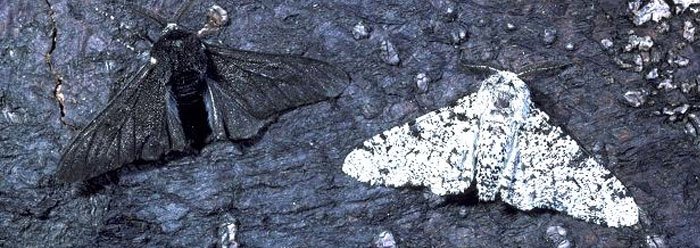
The trees these moths used to live on were white, but have been covered in soot from coal factories. Which moth will be more successful in this environment?
a)
Dark moth
b)
Light moth
c)
Both will be equally successful
d)
Neither will be successful
33.

When a species environment favors one dominant type of characteristic to the point that the other variations of the trait start to disappear is called _____.

a)

disruptive selection

b)

directional selection

c)

stabilizing selection

d)

unstabilizing selection

34.

All the genes in a population are the population’s

a)

Gene flow

b)

Gene pool

c)

Genotype

d)

Fitness

35.

Which of the following is the best definition of species?

a)

A group of organisms that lives in the same habitat

b)

A group o organisms that exploit the same ecological niche

c)

A group of organisms that can interbreed and produce viable and fertile offspring

d)

A group of organisms that have the same appearance

36.

Only a few types of a particular bird species diverge after a small number colonises a new island. This mechanism is called

a)

stabilizing selection

b)

directional selection

c)

the founder effect

d)

disruptive selection

37.

Genetic drift decreases genetic variation because a random event in a small population will change the allele frequencies.

a)

True

b)

False

38.

Bottleneck effect and founder effect change the allele frequencies by resulting certain allele to be overrepresented or eliminated in the future population

a)

True

b)

False

39.

A species is a group of individuals that live in the same area, which can interbreed among themselves and produce fertile offspring.

a)

True

b)

False

40.
Do prezygotic isolating mechanisms occur:
a)
before the zygote
b)
after the zygote
c)
at the same time as the zygote
d)
none of these
41.
The term for the formation of new and distinct species over the course of evolution is...
a)
speciation
b)
biological species concept
c)
reproductive barrier
d)
natural selection
42.
Genetic drift is change in the allele frequency of a population due to...
a)
random chance
b)
natural selection
c)
non-random mating (sexual selection)
d)
artificial selection
43.
What type of speciation involves reproductive isolation?
a)
Allopatric
b)
Sympatric
c)
Both
44.
What type of speciation involves geographic isolation?
a)
Allopatric
b)
Sympatric
c)
Both
45.
Which of the following conclusions is best supported by the cladogram above?
a)
Species P and Q are equally related to species T.
b)
Species P and T do not share a common ancestor.
c)
Species S evolved from species R.
d)
Species S is more closely related to species T than to species R.
46.
Sympatric speciation is when one species evolves in to two...
a)
In the same geographic area
b)
In different geographic areas
c)
Because of different climates
d)
None of the above
47.
A change in the genetic composition of a population as a result of descending from a small number of colonizing individuals is called:
a)
founder effect
b)
bottleneck
c)
genetic drift
d)
gene flow
48.
In the Hardy-Weinberg Equation, q2 is the frequency of what?
a)
The recessive allele 
b)
the dominant allele
c)
the recessive genotype
d)
the dominant genotype
49.
What does the variable q represent?
a)
Frequency of the heterozygote genotype
b)
Frequency of the homozygous recessive genotype
c)
The frequency of the recessive allele
d)
The frequency of the dominant allele 
50.
Which is a mechanism for change in allele frequency?
a)
gene flow
b)
genetic drift
c)
natural selection
d)
all answers are correct
51.
Which Hardy-Weinberg factor represents the frequency of heterozygous individuals in a population?
a)
p2
b)
2pq
c)
q2
d)
p2 + 2pq
52.
Gene flow involves
a)
Natural disasters killing most of the members of a population
b)
Individuals moving into and out of the population
c)
Selective mating
d)
Small changes because of the environment
53.
What does the Hardy-Weinberg equilibrium measure?
a)
changes in allele frequencies
b)
numbers of mutations
c)
goodness of fit
d)
genetic diversity
54.

If a population experiences no migration, is very large, has no mutations, has random mating, and there is no selection, which of the following would you predict?

a)

The population will evolve, but much more slowly than normal

b)

The makeup of the population's gene pool will remain virtually the same as long as these conditions hold.

c)

The composition of the population's gene pool will change slowly in a predictable manner.

d)

Dominant alleles in the population's gene pool will slowly increase in frequency while recessive alleles will decrease.

e)

The population probably has an equal frequency of A and a alleles.

55.
In the Hardy-Weinberg Equation, q2 is the frequency of what?
a)
The recessive allele 
b)
the dominant allele
c)
the recessive genotype
d)
the dominant genotype
56.
Gene flow involves
a)
Natural disasters killing most of the members of a population
b)
Individuals moving into and out of the population
c)
Selective mating
d)
Small changes because of the environment
57.
When a population is in Hardy-Weinberg equilibrium,  what is NOT happening to the species?
a)
Survival
b)
Reproduction
c)
Death
d)
Evolution
58.

If 49 out of 100 individuals in a population express the recessive phenotype, 49/100 or 0.49 would represent

a)

p

b)

p2

c)

q

d)

q2

59.
Which Hardy-Weinberg equation represents the genotype frequencies in a population?
a)
p + q = 1
b)
p2 + 2pq + q2 = 1
c)
p2 + pq2 + q2 = 1
d)
p + 2pq + q3 = 1
60.
Which Hardy-Weinberg factor represents the frequency of heterozygous individuals in a population?
a)
p2
b)
2pq
c)
q2
d)
p2 + 2pq
61.
Which of the following is not an assumption required for Hardy-Weinberg equilibrium?
a)
Random mating
b)
No mutations
c)
Population size must fluctate
d)
No gene flow
62.
A population of 150 individuals has an allele frequency of 0.3 for the dominant allele (B) and a frequency of 0.7 for the recessive allele (b). Use the Hardy-Weinberg equation to determine the frequency of the genotype (bb).
a)
0.09
b)
0.42
c)
0.49
d)
0.21
63.

If 98 out of 200 individuals in a population express the recessive phenotype, what percent of the population would you predict to be heterozygous?

a)

70%

b)

30%

c)

42%

d)

49%

64.

Within a population of 500 butterflies, the color purple is dominant over the color white. 200 of the butterflies are white. What is the frequency of homozygous dominant individuals? Give your answer as a decimal to the nearest hundredth.

a)

.40

b)

.36

c)

.16

d)

.60

65.
The science of classifying is called
a)
Biology
b)
Taxonomy
c)
Sortology
d)
Phylogeny
66.
Binomial nomenclature is the ____________ system for naming organisms.
a)
Numerical
b)
Symbolical
c)
two word
d)
alphabetical
67.
Which is the correct order of The Levels of Taxonomy?
a)
Kingdom, Phylum, Class, Order, Family, Genus, Species
b)
Kingdom, Phylum, Order, Class, Family, Genus, Species
c)
Kingdom, Phylum, Family, Class, Order, Genus, Species
d)
Species, Genus, Family, Class, Order, Phylum, Kingdom
68.
In Binomial Nomenclature the Genus and Species are in italics and only the GENUS is capitalized 
a)
False
b)
True
69.
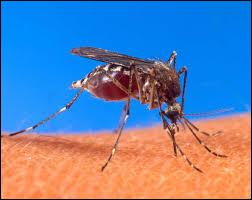
Mosquito  belongs to what kingdom?
a)
Animal Kingdom
b)
Plant Kingdom
c)
Fungi Kingdom
d)
Protista Kingdom
70.
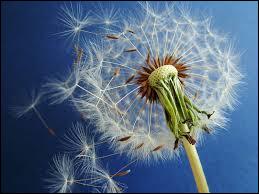
Dandelion, What kingdom does it belongs to?
a)
Plant Kingdom
b)
Animal Kingdom
c)
Fungi Kingdom
d)
Protista Kingdom
71.
Organisms in this smallest taxonomic group share many characteristics.
a)
domain
b)
kingdom
c)
species
d)
class
72.
The scientific name for an organism is made from the:
a)
class and family name
b)
genus and species name
c)
domain and kingdom name
d)
kingdom and phylum name
73.
The 8 levels of classification, broadest to most specific.
a)
Domain, Genus, Family, Order, Class, Phylum, Kingdom, Species
b)
Domain, Species, Kingdom, Genus, Phylum, Family, Class, Order
c)
Domain, Kingdom, Phylum, Class, Order, Family, Genus, Species
d)
Order, Kingdom, Species, Domain, Phylum, Family, Class, Genus
74.
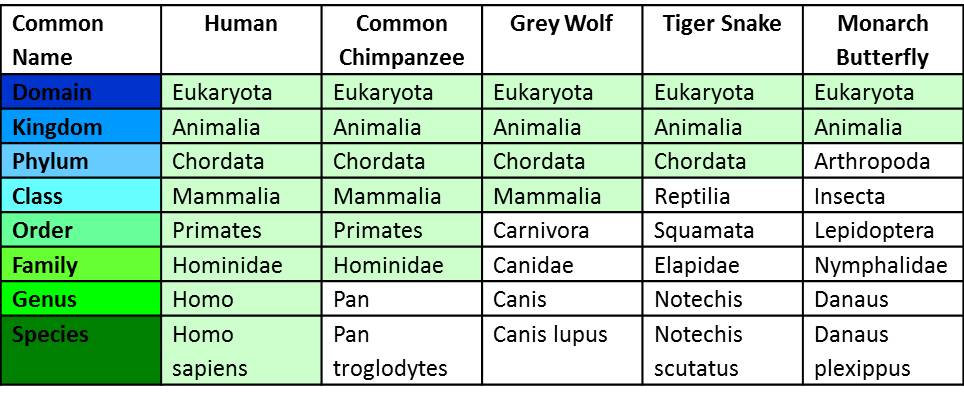
Which organism in the table is least closely related to the chimpanzee?
a)
human
b)
grey wolf
c)
tiger snake
d)
monarch butterfly
75.
Which organism in the table shown is most closely related to the common dolphin?
a)
human
b)
killer whale
c)
giant kelp
d)
bat star
76.

Which 2 organisms would be able to reproduce and produce fertile offspring?

a)

2 organisms in the same class

b)

2 organisms in the same family

c)

2 organisms in the same genus

d)

2 organisms in the same species

77.
Based upon the information shown in the cladogram below, which trait would most likely be observed in ray-finned fish?
a)
amniotic egg
b)
bony skeleton
c)
four limbs
d)
hair
78.
The 8 levels of classification, largest to smallest.
a)
Species, Genus, Family, Order, Class, Phylum, Kingdom, Domain
b)
Genus, Species, Kingdom, Domain, Phylum, Family, Class, Order
c)
Domain, Kingdom, Phylum, Class, Order, Family, Genus, Species
79.
How many domains of life are recognized?
a)
1
b)
3
c)
2
d)
4
80.
Which of the following do we capitalize?
a)
Genus
b)
Species